Native digestive tract bacteria help fend off invaders, study finds
May 10, 2012 in Medical research
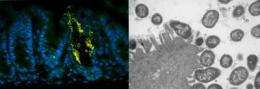
These images, made with two different techniques, show how the pathogenic bacteria attached to the lining of the gut of mice -- allowing them to out-compete the naturally occurring bacteria early in the infection. At left, an image made with fluorescence techniques, which shows pathogens in yellow and green. At right, an image made with a transmission electron microscope, showing the pathogens (oval shapes) along the gut lining. Credit: Nunez laboratory, University of Michigan
From tiny villages in developing nations to suburban kitchens in the United States, dangerous strains of E. coli bacteria sicken millions of people each year and kill untold numbers of children.
Now, new research from the University of Michigan Health System gives scientists a better understanding of what is going on in the diarrhea-wracked guts of its victims, and what might be done to prevent or treat it.
Specifically, they show that the bacteria that usually live in our digestive tracts compete against invading bacteria such as E. coli to help our bodies fend them off.
They also show that the invaders depend on certain genes to gain a temporary upper hand in that battle -- just long enough to reproduce and cause the symptoms that expel their offspring from the body so they can find a new host.
The findings, published in journal Science on its Science Express website, point to potential ways to prevent or treat infections by enterohemorrhagic or enteropathogenic E. coli. Those are the types that can lurk in undercooked ground beef, unpasteurized milk, untreated drinking water, and contaminated produce and that can cause diarrhea and other symptoms that sicken adults and can kill vulnerable children.
"More than 1,000 species of bacteria live in our guts, in a symbiotic population called the microbiota," says Gabriel Nunez, M.D., the U-M pathologist who led the research team. "These results show that these bacteria, also called commensals, compete with pathogens (disease-causing bacteria) in a previously unappreciated way and that the pathogens use a specific set of genes to temporarily outcompete commensals before leaving the body. Understanding this gives us potential targets for prevention and treatment."
For instance, since the research shows that harmful bacteria compete with commensal bacteria for certain nutrients that they need to survive, selectively removing some nutrients and boosting others might help. So might a more targeted use of antibiotics when treating patients who are battling an E. coli infection.
Nunez and first author Nobuhiko Kamada, Ph.D., a postdoctoral fellow, made the findings by studying mice that they infected with C. rodentium the rodent equivalent of harmful E. coli. The study included specially bred germ-free mice that lacked all the "good" gut bacteria that normal mice and humans harbor.
Both Nunez and Kamada are members of the U-M Medical School's Department of Pathology and the U-M Comprehensive Cancer Center, and the work fits into their broader investigations of how inflammation and immunity play a role in the body's response to cancer as well as infections.
Fittingly, Nunez holds the Paul H. de Kruif Professorship in Pathology, named for the U-M graduate who wrote Microbe Hunters, a pivotal 1926 book on the history of infectious disease research.
In the new paper, the team adds a new chapter to the understanding of how pathogenic bacteria gain a foothold in the gut literally by turning on virulence genes that allow them to attach to the cells that line the digestive tract.
This attaching-and-effacing activity, as it is called, allows the disease-causing bacteria to intimately adhere to the cells that line the gut, consume nutrients and reproduce, out-competing the natural gut bacteria. But this comfortable niche only lasts a few days or weeks, during which the host's gut gets more inflamed as the immune system responds to the insult. Diarrhea, sometimes containing blood that leaks from the gut lining, results.
And that, the researchers find, is when the pathogens stop expressing the virulence genes that allowed them to gain their upper hand. They unhitch from the gut lining, mixing in with the commensal bacteria in the open center (lumen) of the gut, and fighting for what food they can find.
While this return to competition means that some of them die, enough of them survive to be expelled in the feces. And if good sanitation systems aren't in place, the bacterial offspring have a good chance of finding a new host to take a toll on.
Better sanitation throughout the world can prevent infections in the first place, says Nunez. But when infection by pathogenic bacteria occurs, a better understanding of the way they interact with our native bacteria could eventually help save lives.
Nunez's team is working with the lab of U-M microbiologist and co-author Eric Martens, Ph.D., to screen different sugars that, if withheld or enhanced in the diet, might weaken the pathogens' effects. That could lead to a better understanding of how children and weak adults in developing nations should be fed while being treated for infection.
The University of Michigan has applied for patent protection, and is in the process of looking for commercialization partners to help bring the technology to market.
More information: Regulated Virulence Controls the Ability of a Pathogen to Compete with the Gut Microbiota, Science Express (2012).
Provided by
University of Michigan Health System
-
Resistant gut bacteria will not go away by themselves
Jun 19, 2007 |
not rated yet |
0
-
Researchers find gut bacteria teaches immune cells to see them as friendly
Sep 22, 2011 |
not rated yet |
0
-
DNA of good bacteria drives intestinal response to infection
Oct 02, 2008 |
not rated yet |
0
-
New research shows how viruses use 'good' gut bacteria to bypass immune system
Oct 14, 2011 |
not rated yet |
0
-
Intestinal enzyme helps maintain population of beneficial bacteria
Oct 18, 2010 |
not rated yet |
0
-
Motion perception revisited: High Phi effect challenges established motion perception assumptions
Apr 23, 2013 |
3 / 5 (2) |
2
-
Anything you can do I can do better: Neuromolecular foundations of the superiority illusion (Update)
Apr 02, 2013 |
4.5 / 5 (11) |
5
-
The visual system as economist: Neural resource allocation in visual adaptation
Mar 30, 2013 |
5 / 5 (2) |
9
-
Separate lives: Neuronal and organismal lifespans decoupled
Mar 27, 2013 |
4.9 / 5 (8) |
0
-
Sizing things up: The evolutionary neurobiology of scale invariance
Feb 28, 2013 |
4.8 / 5 (10) |
14
-
Why is zone 1 in liver more prone to ischemic injury?
May 23, 2013
-
How can there be villous adenoma in colon, if there are no villi there
May 22, 2013
-
How can there be a term called "intestinal metaplasia" of stomach
May 21, 2013
-
Pressure-volume curve: Elastic Recoil Pressure don't make sense
May 18, 2013
-
If you became brain-dead, would you want them to pull the plug?
May 17, 2013
-
MRI bill question
May 15, 2013
- More from Physics Forums - Medical Sciences
More news stories
Study reveals new mechanism for estrogen suppression of liver lipid synthesis
By discovering the new mechanism by which estrogen suppresses lipid synthesis in the liver, UC Irvine endocrinologists have revealed a potential new approach toward treating certain liver diseases.
Medical research
May 23, 2013 |
5 / 5 (1) |
0
|
MRI-based measurement helps predict vascular disease in the brain
Aortic arch pulse wave velocity, a measure of arterial stiffness, is a strong independent predictor of disease of the vessels that supply blood to the brain, according to a new study published in the June issue the journal ...
Medical research
May 23, 2013 |
not rated yet |
0
Antibiotics: A new understanding of sulfonamide nervous system side effects
Since the discovery of Prontosil in 1932, sulfonamide antibiotics have been used to combat a wide spectrum of bacterial infections, from acne to chlamydia and pneumonia. However, their side effects can include serious neurological ...
Medical research
May 23, 2013 |
3 / 5 (1) |
0
|
Scientists discover molecule triggers sensation of itch
Scientists at the National Institutes of Health report they have discovered in mouse studies that a small molecule released in the spinal cord triggers a process that is later experienced in the brain as ...
Medical research
May 23, 2013 |
5 / 5 (3) |
0
|
Discarded immune cells induce the relocation of stem cells
Spanish researchers have discovered that the daily clearance of neutrophils from the body stimulates the release of hematopoietic stem cells from the bone marrow into the bloodstream, according to a report published today ...
Medical research
May 23, 2013 |
5 / 5 (2) |
0
First drug to improve heart failure mortality in over a decade
Coenzyme Q10 decreases all cause mortality by half, according to the results of a multicentre randomised double blind trial presented today at Heart Failure 2013 congress. It is the first drug to improve heart failure mortality ...
Heart failure accelerates male 'menopause'
Heart failure accelerates the aging process and brings on early andropausal syndrome (AS), according to research presented today at the Heart Failure Congress 2013. AS, also referred to as male 'menopause', was four times ...
Seniors more likely to crash when driving with pet, study finds
(HealthDay)—Animals make great companions for senior citizens, but elderly people who always drive with a pet in the car are far more likely to crash than those who never drive with a pet, researchers have ...
New immune system discovered
(Medical Xpress)—A research team, led by Jeremy Barr, a biology post-doctoral fellow, unveils a new immune system that protects humans and animals from infection.
Brain can be trained in compassion, study shows
Until now, little was scientifically known about the human potential to cultivate compassion—the emotional state of caring for people who are suffering in a way that motivates altruistic behavior.
Do salamanders hold the solution to regeneration?
Salamanders' immune systems are key to their remarkable ability to regrow limbs, and could also underpin their ability to regenerate spinal cords, brain tissue and even parts of their hearts, scientists have ...