Oxytocin improves brain function in children with autism
May 21, 2012 By Karen N. Peart in Autism spectrum disorders
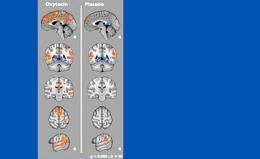
(Medical Xpress) -- Preliminary results from an ongoing, large-scale study by Yale School of Medicine researchers shows that oxytocin a naturally occurring substance produced in the brain and throughout the body increased brain function in regions that are known to process social information in children and adolescents with autism spectrum disorders (ASD).
A Yale Child Study Center research team that includes postdoctoral fellow Ilanit Gordon and Kevin Pelphrey, the Harris Associate Professor of Child Psychiatry and Psychology, presented the results on Saturday, May 19 at the International Meeting for Autism Research.
Our findings provide the first, critical steps toward devising more effective treatments for the core social deficits in autism, which may involve a combination of clinical interventions with an administration of oxytocin, said Gordon. Such a treatment approach will fundamentally improve our understanding of autism and its treatment.
Social-communicative dysfunctions are a core characteristic of autism, a neurodevelopmental disorder that can have an enormous emotional and financial burden on the affected individual, their families, and society.
Gordon said that while a great deal of progress has been made in the field of autism research, there remain few effective treatments and none that directly target the core social dysfunction. Oxytocin has recently received attention for its involvement in regulating social abilities because of its role in many aspects of social behavior and social cognition in humans and other species.
To assess the impact of oxytocin on the brain function, Gordon and her team conducted a first-of-its-kind, double-blind, placebo-controlled study on children and adolescents aged 7 to 18 with ASD. The team members gave the children a single dose of oxytocin in a nasal spray and used functional magnetic resonance brain imaging to observe its effect.
The team found that oxytocin increased activations in brain regions known to process social information. Gordon said these brain activations were linked to tasks involving multiple social information processing routes, such as seeing, hearing, and processing information relevant to understanding other people.
Provided by
Yale University
-
Could nasal spray of 'love hormone' treat autism?
May 16, 2012 |
not rated yet |
0
-
New treatment for social problems in autism? Oxytocin improves emotion recognition
Apr 08, 2010 |
not rated yet |
0
-
Hormone oxytocin improves social cognition but only in less socially proficient individuals
Sep 21, 2010 |
not rated yet |
0
-
Can one model the social deficits of autism and schizophrenia in animals?
May 05, 2011 |
not rated yet |
0
-
Brain scans detect autism's signature
Nov 15, 2010 |
not rated yet |
0
-
Motion perception revisited: High Phi effect challenges established motion perception assumptions
Apr 23, 2013 |
3 / 5 (2) |
2
-
Anything you can do I can do better: Neuromolecular foundations of the superiority illusion (Update)
Apr 02, 2013 |
4.5 / 5 (11) |
5
-
The visual system as economist: Neural resource allocation in visual adaptation
Mar 30, 2013 |
5 / 5 (2) |
9
-
Separate lives: Neuronal and organismal lifespans decoupled
Mar 27, 2013 |
4.9 / 5 (8) |
0
-
Sizing things up: The evolutionary neurobiology of scale invariance
Feb 28, 2013 |
4.8 / 5 (10) |
14
-
Change in momentum when a body is thrown up and falls back down.
3 hours ago
-
change in speed and wavelength of light while travelling from one med
3 hours ago
-
Calculus of Variation - Classical Mechanics
6 hours ago
-
Frictional Force Equation Doesn't Make Sense
6 hours ago
-
Calculating Steam Pressure in Closed Container
11 hours ago
-
Learning curve of Electromagnetism?
17 hours ago
- More from Physics Forums - Classical Physics
More news stories
Researcher helps give children with autism the chance to communicate
Research by Victoria University PhD education graduand Larah van der Meer highlights the importance of understanding the communication preferences of children with developmental disabilities such as autism.
Autism spectrum disorders
May 14, 2013 |
3.3 / 5 (3) |
1
Enhanced motion perception in autism may point to an underlying cause of the disorder
Children with autism see simple movement twice as quickly as other children their age, and this hypersensitivity to motion may provide clues to a fundamental cause of the developmental disorder, according ...
Autism spectrum disorders
May 08, 2013 |
not rated yet |
0
|
Autism scientists seek more brains to aid research
(AP)—Autism scientists are seeking more brain samples for research.
Autism spectrum disorders
May 02, 2013 |
5 / 5 (1) |
0
Drug shows some benefit for kids with autism
(HealthDay)—An experimental drug for autism did not improve levels of lethargy and social withdrawal in children who took it, but it did show some other benefits, a new study finds.
Autism spectrum disorders
May 02, 2013 |
4 / 5 (1) |
0
New study examines social isolation of young adults with autism spectrum disorder
Young adults with an autism spectrum disorder (ASD) are more likely to never see friends, never get called by friends, never be invited to activities and be socially isolated.
Autism spectrum disorders
May 02, 2013 |
5 / 5 (1) |
0
Consuming coffee linked to lower risk of detrimental liver disease, study finds
Regular consumption of coffee is associated with a reduced risk of primary sclerosing cholangitis (PSC), an autoimmune liver disease, Mayo Clinic research shows. The findings were being presented at the Digestive Disease ...
Ketamine shows significant therapeutic benefit in people with treatment-resistant depression
Patients with treatment-resistant major depression saw dramatic improvement in their illness after treatment with ketamine, an anesthetic, according to the largest ketamine clinical trial to-date led by researchers from the ...
Research examines new methods for managing digestive health
Research presented at Digestive Disease Week (DDW) explores new methods for managing digestive health through diet and lifestyle.
New smartphone application improves colonoscopy preparation
The use of a smartphone application significantly improves patients' preparation for a colonoscopy, according to new research presented today at Digestive Disease Week (DDW). The preparation process, which begins days in ...
New research identifies practice changes to improve value and quality of GI procedures
There are significant cost and risk factors associated with two procedures commonly used to diagnose or treat gastrointestinal problems, according to research presented at Digestive Disease Week (DDW).
New research identifies risks, interventions for children's GI health
An increasing number of U.S. children are experiencing gastrointestinal issues that require interventions to resolve, according to research presented at Digestive Disease Week (DDW).