Confirmation of repeated patterns of neurons indicates stereotypical organization throughout brain's cerebral cortex
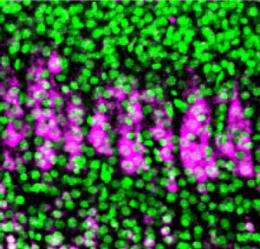
Figure 1: In the mouse visual cortex, neurons expressing id2 mRNA (magenta) are found in regularly repeating clusters. Reproduced from Ref. 1 © 2011 Hisato Maruoka et al., RIKEN Brain Science Institute
Neurons are arranged in periodic patterns that repeat over large distances in two areas of the cerebral cortex, suggesting that the entire cerebral cortex has a stereotyped organization, reports a team of researchers led by Toshihiko Hosoya of the RIKEN Brain Science Institute. The entire cortex has a stereotypical layered structure with the same cell types arranged in the same way, but how neurons are organized in the other orientationparallel to the brains surfaceis poorly understood.
Hosoya and his colleagues therefore examined layer V (5) of the mouse cortex, which contains two classes of large pyramidal neurons that look identical but differ in the connections they form. One projects axons straight down to regions beneath the cortex; the other projects to the cortex on the opposite side of the brain.
First, the researchers examined expression of the id2 gene in cells of the visual cortex, because these cells form clusters in that part of the brain. They found that id2 is expressed in nearly all cells that project axons downward, but not in those that cross over. Hosoya and colleagues verified this by visualizing the connections of cells using fluorescent cholera toxin, which binds to cell membranes and travels along the axons.
Further examination of gene expression patterns in tissue slices revealed that the cells are arranged in clusters aligned perpendicular to the brains surface, and that the clusters are organized in a regular pattern, with the same basic unit repeating every thirty micrometers (Fig. 1). They also observed the same pattern in layer V of the somatosensory cortex, suggesting that this organization is common to all other areas.
By generating a strain of mutant mice expressing green fluorescent protein in the progenitor cells that produce the cells in layer V during brain development, Hosoya and his colleagues investigated the embryonic origin of these cells. This revealed that each cluster contains neurons that are produced by different progenitor cells.
Finally, the researchers showed that the regular pattern persists in the adult visual cortex, and that neurons in each cluster show the same activity patterns in response to visual stimulation. Our preliminary data suggest that at least several other areas in the cortex have the same structure, says Hosoya. Its likely that the entire cortex has the same organization, and I expect that the human cortex has the same structure.
More information: Maruoka, H., Kubota, K., Kurokawa, R., Tsuruno, S. & Hosoya, T. Periodic organization of a major subtype of pyramidal neurons in neocortical layer V. The Journal of Neuroscience 31, 1852218542 (2011). www.jneurosci.org/… 522.abstract
Provided by
RIKEN
-
Transplanted stem cells form proper brain connections
Jan 19, 2010 |
not rated yet |
0
-
Mouse brains keyed to speed
Jan 25, 2012 |
not rated yet |
0
-
Scientists show universality in the brain evolution
Nov 04, 2010 |
not rated yet |
0
-
The beginnings of the thinking brain
Jun 28, 2006 |
not rated yet |
0
-
Scientists make brain signal discovery
Jul 06, 2011 |
not rated yet |
0
-
Motion perception revisited: High Phi effect challenges established motion perception assumptions
Apr 23, 2013 |
3 / 5 (2) |
2
-
Anything you can do I can do better: Neuromolecular foundations of the superiority illusion (Update)
Apr 02, 2013 |
4.5 / 5 (11) |
5
-
The visual system as economist: Neural resource allocation in visual adaptation
Mar 30, 2013 |
5 / 5 (2) |
9
-
Separate lives: Neuronal and organismal lifespans decoupled
Mar 27, 2013 |
4.9 / 5 (8) |
0
-
Sizing things up: The evolutionary neurobiology of scale invariance
Feb 28, 2013 |
4.8 / 5 (10) |
14
-
How can there be a term called "intestinal metaplasia" of stomach
20 hours ago
-
Pressure-volume curve: Elastic Recoil Pressure don't make sense
May 18, 2013
-
If you became brain-dead, would you want them to pull the plug?
May 17, 2013
-
MRI bill question
May 15, 2013
-
Ratio of Hydrogen of Oxygen in Dessicated Animal Protein
May 13, 2013
-
Alcohol and acetaminophen
May 13, 2013
- More from Physics Forums - Medical Sciences
More news stories
Reducing caloric intake delays nerve cell loss
Activating an enzyme known to play a role in the anti-aging benefits of calorie restriction delays the loss of brain cells and preserves cognitive function in mice, according to a study published in the May ...
Neuroscience
9 hours ago |
5 / 5 (4) |
0
|
B vitamins could delay dementia
(Medical Xpress)—Despite spending billions of dollars on research and development, drug companies have been unable to come up with effective treatments for dementia and Alzheimer's Disease (AD). Now, A. ...
Neuroscience
13 hours ago |
4.9 / 5 (11) |
0
|
Waiting for a sign? Researchers find potential brain 'switch' for new behavior
You're standing near an airport luggage carousel and your bag emerges on the conveyor belt, prompting you to spring into action. How does your brain make the shift from passively waiting to taking action when ...
Neuroscience
13 hours ago |
5 / 5 (1) |
0
|
If you can remember it, you can remember it wrong
(Medical Xpress)—Native peoples in regions where cameras are uncommon sometimes react with caution when their picture is taken. The fear that something must have been stolen from them to create the photo ...
Neuroscience
15 hours ago |
4.2 / 5 (5) |
0
|
Study shows where scene context happens in our brain
In a remote fishing community in Venezuela, a lone fisherman sits on a cliff overlooking the southern Caribbean Sea. This man –– the lookout –– is responsible for directing his comrades on the water, ...
Neuroscience
17 hours ago |
4 / 5 (1) |
0
|
Insight into the dazzling impact of insulin in cells
Australian scientists have charted the path of insulin action in cells in precise detail like never before. This provides a comprehensive blueprint for understanding what goes wrong in diabetes.
New sleeping pill poised to hit US markets
An experimental sleeping pill from US drug company Merck is effective at helping people fall and stay asleep, according to reviewers at the US Food and Drug Administration, which could soon approve the new drug.
Antidepressant reduces stress-induced heart condition
A drug commonly used to treat depression and anxiety may improve a stress-related heart condition in people with stable coronary heart disease, according to researchers at Duke Medicine.
Drugs found to both prevent and treat Alzheimer's disease in mice
Researchers at USC have found that a class of pharmaceuticals can both prevent and treat Alzheimer's Disease in mice.
Enrichment therapy effective among children with autism, study finds
Children with autism showed significant improvement after six months of simple sensory exercises at home using everyday items such as scents, spoons and sponges, according to UC Irvine neurobiologists.
Study finds vitamin C can kill drug-resistant TB (w/ video)
In a striking, unexpected discovery, researchers at Albert Einstein College of Medicine of Yeshiva University have determined that vitamin C kills drug-resistant tuberculosis (TB) bacteria in laboratory culture. The finding ...