Rats recall past to make daily decisions
May 3, 2012 in Neuroscience

Rats recall past to make daily decisions

Enlarge

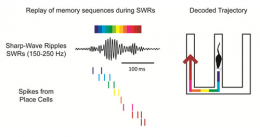
During breaks in trials when the rat was awake but inactive, areas in the brain's memory hub emitted split-second bursts of ripple-like electrical activity (SWRs). This indicated that the rat was mentally replaying an earlier experience in the maze. Individual neurons in the areas become associated with a particular place. These place cells spike when the animal is that place or — it turns out — is just mentally replaying the experience of being in that place. Embedded in the ripple-like signal above are place cells spiking in the same sequence as they did when the rat first walked through the maze (Color-coded hatch marks match the path in the maze.). Rats' performance in the maze task faltered when these awake mental replay events were blocked, revealing that they are important for memory-guided decision-making. Source: Shantanu Jadhav, Ph.D., University of California San Francisco

(Medical Xpress) -- UCSF scientists have identified patterns of brain activity in the rat brain that play a role in the formation and recall of memories and decision-making. The discovery, which builds on the team's previous findings, offers a path for studying learning, decision-making and post-traumatic stress syndrome.

The researchers previously identified patterns of brain activity in the rat hippocampus, a brain region critical for memory storage. The patterns sometimes represented where an animal was in space, and, at other times, represented fast-motion replays of places the animal had been, but no one knew whether these patterns indicated the process of memory formation and recollection.

In the journal Science (online May 3, 2012), the UCSF researchers demonstrated that the is critical for and recall. Moreover, they showed that the through which the rats see rapid replays of past experiences are fundamental to their ability to make decisions. Disturbing those particular brain patterns impaired the animals' ability to learn rules based on memories of things that had happened in the past.

"We think these memory-replay events are central to understanding how the brain retrieves past experiences and uses them to make decisions," said neuroscientist Loren Frank, PhD, a associate professor of physiology and a member of the Keck Center for Integrative Neuroscience at UCSF, who led the research with Shantanu Jadhav, PhD, a post-doctoral fellow. "They offer insight into how a past experience can have such a profound effect on how we think and feel."

The finding gives scientists a new way to investigate fundamental processes like learning and decision-making in animals and in people. It also may help shed light on like post-traumatic stress disorder (PTSD), which is characterized by strong, disturbing and uncontrolled memories.

Without links to the past, rats face indecision

Seeking to understand how the recall of specific memories in the brain guides our thinking, Frank and his colleagues built a system for detecting the underlying patterns of neuronal activity in rats. They fitted the animals with electrodes and built a system that enabled them to detect a specific pattern, called a sharp-wave ripple, in the hippocampus. Whenever they detected a ripple, they would send a small amount of electricity into another set of electrodes that would immediately interrupt the ripple event, in effect turning off all memory replay activity without otherwise affecting the brain.

The UCSF researchers knew that these sharp-wave ripples would be activated when the animals had to make choices about which direction to turn as they wended their way toward their reward: a few drops of sweetened condensed milk. These signals seem to be flashes of memory recall, said Frank, a rat's past knowledge flooding back to inform it on what had happened in the past and where it might go in the future. Squashing the sharp-wave ripples, the UCSF team found, disrupted the recall and subverted the rat's ability to correctly navigate the maze.

This shows, said Frank, that the sharp-wave ripples are critical for this type of memory recall. Through these waves, the rat reprocesses and replays old experiences in a fleeting instant—lessons from the past essential for shaping their perception of the present.

"We think these memory replay events are a fundamental constituent of memory retrieval and play a key role in human perspective and decision-making as well," he said. "These same events have been seen in memory tasks in humans, and now we know they are critical for memory in rats. We think that these fast-forward replays make up the individual elements of our own memories, which jump rapidly from event to event."

Next, the team wants to tease out information about how the rats actually use these memory replay events to make decisions and how amplifying or blocking specific replay events will change the way an animal learns and remembers. They also think that these events could be important for understanding memory problems, as when stressful memories intrude into daily life.

More information: www.youtube.com/wa… COE#t=58m21s - In this YouTube clip, NIMH grantee Loren Frank, Ph.D., explains how rats mentally replay recent experiences in a maze.

Provided by University of California, San Francisco search and more info website

5 /5 (1 vote)  

Filter


Move the slider to adjust rank threshold, so that you can hide some of the comments.


Display comments: newest first

gwrede
May 03, 2012

Rank: 5 / 5 (1)
Every time, scientists are so amazed at how other species' brain and memory works like ours. I don't understand this at all.

Shouldn't the _default_ be believing that their brain works like ours!! Or did Darwin stop just short of the brain? I think more would be accomplished, and a lot faster, if we tried to find differences instead of stumbling upon similarities between human and other brains.

Probably the next big revelation is (sometime around 2035), that some animals are found to have feelings. "Oh, how similar these particular species are to Humans!" > Well, I'm sorry, but feelings have been around already before the dinosaurs. (And if you don't believe men, think harder. Or ask someone smarter than yourself.) Geez!!
irjsiq
May 04, 2012

Rank: not rated yet
gwreed, I have thought about such as this for a while.
Personal observations infer feelings in canines and felines, and even pigeons!
Most recently the subject of 'Origin of Instinct' has captivated my thinking . . . i.e. as to say: "It seems to be 'Instinctual'.
regarding Chimpanzees interacting with various iPad displays."

My thought: Instinct represents storehouses vastly complex thoughts, with too many traits peculiar to some species, but with similar need fulfilments across species: 'Nests' are of many forms. The earlier Human nests were likely in trees! (Some primates daily, build nests in trees) Humans then moved to caves ... the point being: "Humans crave a 'place'!", it seems, also, an innate compulsion/drive!

Roy J Stewart,
Phoenix AZ
Rank 5 /5 (1 vote)
Related Stories
Relevant PhysicsForums posts

More news stories

For combat veterans suffering from post-traumatic stress disorder, 'fear circuitry' in the brain never rests

Chronic trauma can inflict lasting damage to brain regions associated with fear and anxiety. Previous imaging studies of people with post-traumatic stress disorder, or PTSD, have shown that these brain regions can over-or ...

Neuroscience created 20 hours ago | popularity 5 / 5 (1) | comments 0 | with audio podcast

Temporal processing in the olfactory system

The neural machinery underlying our olfactory sense continues to be an enigma for neuroscience. A recent review in Neuron seeks to expand traditional ideas about how neurons in the olfactory bulb might encode information about ...

Neuroscience created May 17, 2013 | popularity not rated yet | comments 0 | with audio podcast report

Melon focus headband turns to Kickstarter for rollout plans

(Medical Xpress)—What if the quality of your work depends more on your focus on the piano keys or canvas or laptop than your musical or painting or computing skills? If target users can be convinced, they ...

Neuroscience created May 17, 2013 | popularity 3.7 / 5 (3) | comments 0 | with audio podcast weblog

Deep brain stimulation: A fix when the drugs don't work

Neurological disorders can have a devastating impact on the lives of sufferers and their families.

Neuroscience created May 17, 2013 | popularity 5 / 5 (1) | comments 0 | with audio podcast

Brain makes call on which ear is used for cell phone

If you're a left-brain thinker, chances are you use your right hand to hold your cell phone up to your right ear, according to a newly published study from Henry Ford Hospital in Detroit.

Neuroscience created May 16, 2013 | popularity 2 / 5 (2) | comments 0 | with audio podcast


New research identifies risks, interventions for children's GI health

An increasing number of U.S. children are experiencing gastrointestinal issues that require interventions to resolve, according to research presented at Digestive Disease Week (DDW).

US psychiatry gets makeover in new manual

The latest makeover to a massive psychiatric tome honored by some, reviled by others and even called the "Bible" of mental disorders is being released Saturday with a host of new changes.

New case of SARS-like virus in Saudi: ministry

A new case of the deadly coronavirus has been detected in Saudi Arabia where 15 people have already died after contracting it, the health ministry announced on Saturday on its Internet website.

AIDS science at 30: 'Cure' now part of lexicon

Big names in medicine are set to give an upbeat assessment of the war on AIDS on Tuesday, 30 years after French researchers identified the virus that causes the disease.

New colonoscope provides ground-breaking view of colon

A ground-breaking advance in colonoscopy technology signals the future of colorectal care, according to research presented today at Digestive Disease Week(DDW). Additional research focuses on optimizing the minimal withdrawal ...

Flesh-eating disease victim gets prosthetic hands

(AP)—A woman who lost both hands, her left leg and right foot after contracting a flesh-eating disease has been fitted with prosthetic hands.