Doubt cast on usefulness of 'Sensory' therapies for autism
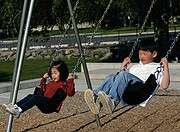
(HealthDay) -- Sensory therapies using brushes, swings and other play equipment are increasingly used by occupational therapists to treat children with developmental issues such as autism, but a large pediatricians organization says there isn't much evidence that such therapies actually work.
Still, the group isn't completely discounting the potential of sensory therapies -- it's a ripe area for research, it noted.
But before parents spend the time and money on taking children to sensory therapy, they should know that, as of now, the techniques are largely unproven.
"It's OK for parents to try these types of therapies, but there is little research backing up the effectiveness of these therapies and whether or not they improve long-term outcomes for kids with developmental disabilities," said Dr. Michelle Zimmer, an assistant professor of pediatrics at Cincinnati Children's Hospital Medical Center.
Zimmer is the co-author of a new American Academy of Pediatrics policy statement on what is often referred to as "sensory integration therapy." The policy statement appears online May 28 and in the June print issue of Pediatrics.
According to the pediatrician group, "sensory processing disorder" should not be used as a standalone diagnosis.
No one disputes that children with conditions such as autism can have abnormalities in their responses to sensory stimuli, including sight, taste, touch and sound. For example, autistic children may have aversions to loud noises, to certain food textures or to being touched unexpectedly, Zimmer said.
But that doesn't necessarily mean the problem is with their brain pathways for processing sensory information, as the term "sensory processing disorder" implies.
Instead, some other issue could underlie their reactions to stimuli, such as a behavioral issue, said Dr. Susan Hyman, chair of the American Academy of Pediatrics subcommittee on autism and an associate professor of pediatrics at University of Rochester Medical Center, in Rochester, N.Y.
Instead of chalking up various aversions or compulsions to sensory processing disorder, health care providers need to consider what other developmental issues may be going on with the child, such as autism, attention-deficit hyperactivity disorder (ADHD) and so on, Zimmer said.
"There has never been a study that has shown that a child can have just sensory processing disorder, isolated from another developmental disabilities, such as autism or ADHD," Zimmer said.
Sensory integration therapy got its start in the 1970s, when an occupational therapist described a theory for how a well-organized sensory system develops. Children, the therapist postulated, gradually learn to make use of information from a variety of sources at the same time in order to understand the world. The theory is that sensory dysfunction occurs when these systems don't develop correctly.
In sensory integration therapy, occupational therapists put children on a "sensory diet," exposing them to different sights, smells, sounds and sensations, to improve the brain's ability to process the information.
For now, however, whether it works remains a theory, Zimmer said.
Zimmer noted that occupational therapists in her hospital's autism center uses sensory therapies, and anecdotally, she's seen sensory therapy appear to help some children.
"We are happy to support parents who want to try to these therapies, but we also need to use caution in making sure that the use of these therapies is improving some outcome for their child," Zimmer said.
In the absence of controlled clinical trials testing whether sensory therapies work, parents have to try to be objective, ask themselves tough questions about whether the treatment is really working, set specific goals and determine if the child is moving toward the target.
"Is it improving the child's ability to function? That's where more research needs to happen," Zimmer said.
Hyman, who studies sensory differences in children with autism, agreed. "The scientific testing of this intervention has not demonstrated that it is effective for all children as a standalone treatment," she said. "However, for individual children, it may be an important part of a total therapy package."
Pediatricians should counsel families about the information out there on sensory therapies, she added.
"You don't want to spend a lot of time money and energy on a treatment if it's not right for them. They have to be prudent," Hyman said. "In the absence of data, parents have to utilize the information that's available to them in making choices."
More information: The U.S. National Institute on Mental Health has more on autism.
Copyright © 2012 HealthDay. All rights reserved.


