How blind can 'read' shown in new research
May 16, 2012 in Medical research
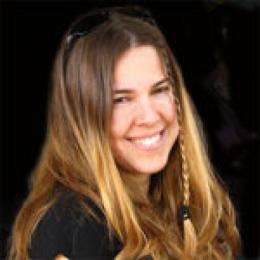
This is Ella Striem-Amit of the Hebrew University of Jerusalem. Credit: The Hebrew University of Jerusalem
A method developed at the Hebrew University of Jerusalem for training blind persons to "see" through the use of a sensory substitution device (SSD) has enabled those using the system to actually "read" an eye chart with letter sizes smaller than those used in determining the international standard for blindness.
The eight congenitally blind participants in the Hebrew University test group passed the conventional eye-exam of the Snellen acuity test, technically surpassing the world-agreed criterion of the World Health Organization (WHO) for blindness and moving them to the level of (low-vision) sighted. These results were published recently in the PLoS One Journal in the US.
The Snellen test is a standard visual test in which the patient views a chart which contains the letter E facing four different directions and in various sizes. The patient sits at a specific distance of 20 feet (6 meters) and has to determine the direction of the E's, and according to the smallest size he can read, his visual acuity is determined.
Normal vision is considered 20/20, referring to both the distance and size of the symbols on the eye chart. The congenitally blind participants in the Hebrew University test group reached a median level of 20/360, meaning they could identify letters from a distance of 20 feet that a normally sighted person (with normal vision) would be able to identify from 360 feet. The 20/360 result is better than the World health organization criterion for blindness, which is 20/400.
The Hebrew University researchers -- Dr. Amir Amedi, of the Edmond and Lily Safra Center for Brain Sciences and the Institute for Medical Research Israel-Canada at the Hebrew University, and Ph.D. student Ella Striem-Amit -- have been using a sensory substitution device developed by Dr. Peter Meijer of Holland and called "The vOICe." The device converts images from a miniature camera into "soundscapes," using a predictable algorithm, allowing the user to listen to and then interpret the visual information coming from the camera.
Remarkably, proficient users who have had a dedicated (but relatively brief) training at Dr. Amedi's lab were able to use SSDs to identify complex everyday objects, locate people and their postures, read letters and words, and even identify facial expressions.
Recently, the ability to extract and "translate" fine visual detail in this manner was demonstrated in an experiment led by Striem-Amit in which, for the first time, congenitally blind vOICe users were subjected to an ophthalmologist's standard visual acuity test, using sounds. Surprisingly, not only were the blind SSD-users able to tell which way the "tumbling E's" were turning using sounds, but most of them could perform the test at small letter sizes, below the standard World Health Organization's blindness threshold.
Such visual capacities greatly surpass even those possible by the most advanced cutting-edge retinal prostheses ("bionic eyes") available today. In fact, even though retinal prostheses may improve their resolution in the future, and have the advantage of providing the sensation of sight, they will not be accessible to a large population of blind individuals. Retinal prostheses target only very specific blindness etiologies, leaving many others without medical cure.
This factor, as well as the invasiveness and high cost of retinal prostheses make non-invasive and very cheap SSDs, such as The vOICe or other novel SSDs developed in Amedi's lab, attractive alternatives, which can be available already today to the 39 million worldwide blind population, the majority of whom live in developing countries, who could already enjoy the adventure of learning to "see" in high resolution, using sound.
Journal reference:
PLoS ONE
Provided by
Hebrew University of Jerusalem
-
Brain doesn't need vision at all in order to 'read' material
Feb 22, 2011 |
not rated yet |
0
-
Blind mice can 'see' thanks to special retinal cells
Jul 14, 2010 |
not rated yet |
0
-
Nanosized diamonds enable progress in retinal prostheses
Jun 17, 2011 |
not rated yet |
0
-
Researchers find the blind use visual brain area to improve other senses
Oct 06, 2010 |
not rated yet |
0
-
The brain as a 'task machine'
Feb 17, 2011 |
not rated yet |
0
-
Motion perception revisited: High Phi effect challenges established motion perception assumptions
Apr 23, 2013 |
3 / 5 (2) |
2
-
Anything you can do I can do better: Neuromolecular foundations of the superiority illusion (Update)
Apr 02, 2013 |
4.5 / 5 (11) |
5
-
The visual system as economist: Neural resource allocation in visual adaptation
Mar 30, 2013 |
5 / 5 (2) |
9
-
Separate lives: Neuronal and organismal lifespans decoupled
Mar 27, 2013 |
4.9 / 5 (8) |
0
-
Sizing things up: The evolutionary neurobiology of scale invariance
Feb 28, 2013 |
4.8 / 5 (10) |
14
-
Pressure-volume curve: Elastic Recoil Pressure don't make sense
17 hours ago
-
If you became brain-dead, would you want them to pull the plug?
May 17, 2013
-
MRI bill question
May 15, 2013
-
Ratio of Hydrogen of Oxygen in Dessicated Animal Protein
May 13, 2013
-
Alcohol and acetaminophen
May 13, 2013
-
Marie Curie's leukemia
May 13, 2013
- More from Physics Forums - Medical Sciences
More news stories
Now we know why old scizophrenia medicine works on antibiotics-resistant bacteria
In 2008 researchers from the University of Southern Denmark showed that the drug thioridazine, which has previously been used to treat schizophrenia, is also a powerful weapon against antibiotic-resistant bacteria such as ...
Medical research
May 17, 2013 |
3.7 / 5 (3) |
0
|
SUMO wrestling cells reveal new protective mechanism target for stroke
Scientists investigating the interaction of a group of proteins in the brain responsible for protecting nerve cells from damage have identified a new target that could increase cell survival.
Medical research
May 17, 2013 |
5 / 5 (1) |
0
How serotonin receptors can shape drug effects, from LSD to migraine medication
New findings by researchers carrying out experiments at the U.S. Department of Energy Office of Science's Advanced Photon Source (APS) help explain why some drugs that interact with two kinds of human serotonin ...
Medical research
May 17, 2013 |
not rated yet |
0
|
Preventing blood poisoning
Peptide molecules derived from the body's natural immune system can help boost the body's defence against life-threatening blood poisoning, joint University research has uncovered.
Medical research
May 17, 2013 |
4 / 5 (1) |
0
|
New mechanism to prevent type 2 diabetes in obese individuals
A new Montréal study conducted by Dr. May Faraj, associate research professor at the Université de Montréal and invited scientist at the IRCM, along with her research team and medical collaborators, shows ...
Medical research
May 17, 2013 |
not rated yet |
0
|
New research identifies risks, interventions for children's GI health
An increasing number of U.S. children are experiencing gastrointestinal issues that require interventions to resolve, according to research presented at Digestive Disease Week (DDW).
US psychiatry gets makeover in new manual
The latest makeover to a massive psychiatric tome honored by some, reviled by others and even called the "Bible" of mental disorders is being released Saturday with a host of new changes.
New case of SARS-like virus in Saudi: ministry
A new case of the deadly coronavirus has been detected in Saudi Arabia where 15 people have already died after contracting it, the health ministry announced on Saturday on its Internet website.
AIDS science at 30: 'Cure' now part of lexicon
Big names in medicine are set to give an upbeat assessment of the war on AIDS on Tuesday, 30 years after French researchers identified the virus that causes the disease.
For combat veterans suffering from post-traumatic stress disorder, 'fear circuitry' in the brain never rests
Chronic trauma can inflict lasting damage to brain regions associated with fear and anxiety. Previous imaging studies of people with post-traumatic stress disorder, or PTSD, have shown that these brain regions can over-or ...
New colonoscope provides ground-breaking view of colon
A ground-breaking advance in colonoscopy technology signals the future of colorectal care, according to research presented today at Digestive Disease Week(DDW). Additional research focuses on optimizing the minimal withdrawal ...