Better tests for sleeping sickness
May 22, 2012 in Diseases, Conditions, Syndromes
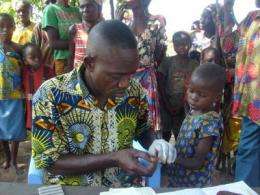
Health workers use the classical ITG rapid diagnostic test to screen blood on antibodies against sleeping sickness. A better and safer to produce test now is possible, say researchers at the Antwerp Institute of Tropical Medicine. Credit: © ITG
Lies Van Nieuwenhove, researcher at the Antwerp Institute of Tropical Medicine, has produced proteins imitating typical parts of the sleeping sickness parasite. They can be used in more efficient diagnostic tests, without the need for culturing dangerous parasites.
Each year many thousands of Africans contract sleeping sickness. The cause is a unicellular parasite, a trypanosome, which is transmitted by the bite of tsetse flies. First the parasite multiplies in blood and lymph, while evading the human immune system. It then lodges in organs like heart and kidneys and finally in the brain. Patients become disoriented, their sleeping pattern disintegrates and they get motor and mental problems. This inevitably leads to coma and death. The World Health Organisation estimates that sleeping sickness each year claims 10 000 to 20 000 lives.
In an early stage the disease is easy to treat, but once the brain is invaded, the treatment becomes more complex and one must use medicines with dangerous, even deadly, side effects. So it is important to detect the infection early.
In the regions where Trypanosoma brucei gambiense is found, medical workers for decades already use a rapid diagnostic test, developed at the Institute of Tropical Medicine, to screen millions of people each year on the presence of antibodies in their blood.
But diagnostic test are not perfect: they always will miss cases, or on the contrary they see an infection where there isn't. A bit as the metal detectors at airports: too sensitive and they annoyingly go off on each buckle, earring or coin; a bit less sensitive and pocketknives start slipping trough.
In recent years the number of cases has come down substantially, thanks to campaigns against the disease, so error margins that were acceptable in the old days, because the tests still saved so many lives, now become inadmissible. Research scientist Lies Van Nieuwenhove set out to develop a new and better test.
In such tests one demonstrates the antibodies by presenting them targets they will also recognise and attack on real trypanosomes: typical proteins that cover the parasite as a mantle. When antibody and target react when the test is 'positive' this is made visible by for instance a colour change or a clotting. Today those targets are obtained from living parasites that are raised in laboratory animals, and are a constant danger for the laboratory technicians.
Therefore Van Nieuwenhove tried to synthesise artificial targets, 'mimotopes' that mimic only a part of the original target protein, but still are sufficient to react with the patient's antibodies. She indeed could produce mimotopes that are reliable and give alarm with the right patients. These mimotopes now can be the base for a new generation of rapid diagnostic tests for sleeping sickness.
Provided by
Institute of Tropical Medicine Antwerp
-
Trojan horse bacteria use nanobodies to conquer sleeping sickness
Feb 14, 2012 |
not rated yet |
0
-
Sleeping sickness finding could lead to earlier diagnosis
Apr 14, 2008 |
not rated yet |
0
-
Parasite sheds light on sleeping sickness
Apr 21, 2011 |
not rated yet |
0
-
Scientists take a step towards better sleeping sickness treatment
Apr 25, 2012 |
not rated yet |
0
-
Major advance in sleeping sickness drug made by Glasgow scientists
Sep 06, 2011 |
not rated yet |
0
-
Motion perception revisited: High Phi effect challenges established motion perception assumptions
Apr 23, 2013 |
3 / 5 (2) |
2
-
Anything you can do I can do better: Neuromolecular foundations of the superiority illusion (Update)
Apr 02, 2013 |
4.5 / 5 (11) |
5
-
The visual system as economist: Neural resource allocation in visual adaptation
Mar 30, 2013 |
5 / 5 (2) |
9
-
Separate lives: Neuronal and organismal lifespans decoupled
Mar 27, 2013 |
4.9 / 5 (8) |
0
-
Sizing things up: The evolutionary neurobiology of scale invariance
Feb 28, 2013 |
4.8 / 5 (10) |
14
-
Classical and Quantum Mechanics via Lie algebras
Apr 15, 2011
- More from Physics Forums - Independent Research
More news stories
Researchers find genetic risk factor for pulmonary fibrosis
A paper recently published in the New England Journal of Medicine and co-written by physicians and scientists at the University of Colorado School of Medicine finds that an important genetic risk factor for pulmonary fibros ...
Diseases, Conditions, Syndromes
10 hours ago |
not rated yet |
0
Biomarkers discovered for inflammatory bowel disease
Using the Department of Defense Serum Repository (DoDSR), University of Cincinnati (UC) researchers have identified a number of biomarkers for inflammatory bowel disease (IBD), which could help with earlier diagnosis and ...
Diseases, Conditions, Syndromes
10 hours ago |
5 / 5 (1) |
0
CDC says high number of public pools contain microbes
(HealthDay)—Three-quarters of public schools in the metro Atlanta area contain microbes, including bacteria indicating the presence of fecal matter, according to research published in the May 17 issue of ...
Diseases, Conditions, Syndromes
11 hours ago |
not rated yet |
0
Study examines outbreak of spinal infections in Michigan
(HealthDay)—Factors such as increased case finding may explain why Michigan had half of the total spinal infections associated with contaminated methylprednisolone acetate in the recent fungal meningitis ...
Diseases, Conditions, Syndromes
11 hours ago |
not rated yet |
0
World not ready for mass flu outbreak, WHO says
The world is unprepared for a massive virus outbreak, the deputy chief of the World Health Organization warned Tuesday, amid fears that H7N9 bird flu striking China could morph into a form that spreads easily among people.
Diseases, Conditions, Syndromes
11 hours ago |
not rated yet |
0
If you can remember it, you can remember it wrong
(Medical Xpress)—Native peoples in regions where cameras are uncommon sometimes react with caution when their picture is taken. The fear that something must have been stolen from them to create the photo ...
B vitamins could delay dementia
(Medical Xpress)—Despite spending billions of dollars on research and development, drug companies have been unable to come up with effective treatments for dementia and Alzheimer's Disease (AD). Now, A. ...
Insight into the dazzling impact of insulin in cells
Australian scientists have charted the path of insulin action in cells in precise detail like never before. This provides a comprehensive blueprint for understanding what goes wrong in diabetes.
New sleeping pill poised to hit US markets
An experimental sleeping pill from US drug company Merck is effective at helping people fall and stay asleep, according to reviewers at the US Food and Drug Administration, which could soon approve the new drug.
Reducing caloric intake delays nerve cell loss
Activating an enzyme known to play a role in the anti-aging benefits of calorie restriction delays the loss of brain cells and preserves cognitive function in mice, according to a study published in the May ...
Antidepressant reduces stress-induced heart condition
A drug commonly used to treat depression and anxiety may improve a stress-related heart condition in people with stable coronary heart disease, according to researchers at Duke Medicine.