Brothers in arms: Commensal bacteria help fight viruses
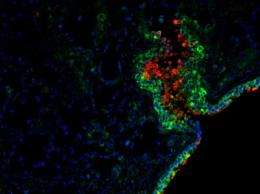
This is an inflamed mouse lung. Infiltrating innate immune cells are stained in red and green. Credit: Meera Nair, PhD, Michael Abt, PhD, David Artis, PhD; Perelman School of Medicine, UPenn
Healthy humans harbor an enormous and diverse group of bacteria and other bugs that live within their intestines. These microbial partners provide beneficial aid in multiple ways from helping digest food to the development of a healthy immune system. In a new study published online in the journal Immunity, David Artis, PhD, associate professor of Microbiology, and Michael Abt, PhD, a postdoctoral researcher in the Artis lab, Perelman School of Medicine, University of Pennsylvania, show that commensal bacteria are also essential to fight off viral infections.
"From our studies in mice, we found that signals derived from these beneficial microbes are essential for optimal immune responses to experimental viral infections," says Artis. "In one way we could consider these microbes as our 'brothers in arms' in the fight against infectious diseases." Artis is also an associate professor of Pathobiology in the Penn School of Veterinary Medicine.
Signals from commensal bacteria influence immune-cell development and susceptibility to infectious or inflammatory diseases. Commensal microbial communities colonize barrier surfaces of the skin, vaginal, upper respiratory, and gastrointestinal tracts of mammals and consist of bacteria, fungi, protozoa, and viruses. The largest and most diverse microbial communities live in the intestine.
Previous studies in patients have associated alterations in bacterial communities with susceptibility to diabetes, obesity, cancer, inflammatory bowel disease, allergy, and other disorders. Despite knowing all of this, exactly how commensal bacteria regulate immunity after being exposed to pathogens is not well understood.
To get a better picture of how these live-in bacteria are beneficial, the Artis lab used several lines of investigation. First, they demonstrated that mice -- treated with antibiotics to reduce numbers of commensal bacteria -- exhibit an impaired antiviral immune response and a substantially delayed clearance of a systemic virus or influenza virus that infects the airways. What's more, the treated mice had severely damaged airways and increased rate of death after the experimental influenza virus infection, demonstrating that alterations in commensal bacterial communities can have a negative impact on immunity against viruses.
Next, they profiled the genes that were expressed in immune cells called macrophages isolated from the antibiotic-treated mice. These data revealed a decreased expression of genes associated with antiviral immunity. In addition, macrophages from antibiotic-treated mice showed defective responses to interferons, proteins made and released in response to viruses, bacteria, parasites, or tumor cells. Under normal circumstances, interferons facilitate communication between cells to trigger the immune cells that attack pathogens or tumors. The antibiotic-treated mice also had an impaired capacity to limit viral replication. However, when mice were treated with a compound that restored interferon responsiveness, protective antiviral immunity was re-established.
"It is remarkable that signals derived from one type of microbe, in this case bacteria, can have such a profound effect on immune responses to viruses that are a very different type of microbe," says first author Abt. "Just like we would set a thermostat to regulate when a heater should come on, our studies indicate that signals derived from commensal bacteria are required to set the activation threshold of the immune system."
Taken together, these lines of evidence indicate that signals from commensal bacteria beneficially stimulate immune cells in a way that is optimal for antiviral immunity. "Although more work needs to be done, these findings could illuminate new ways to promote better immunity to potentially life-threatening viral infections," adds Artis.
Journal reference:
Immunity
Provided by
University of Pennsylvania School of Medicine
-
Good bugs gone bad: Gut immune cells keep beneficial microbes in their place
Jun 06, 2012 |
not rated yet |
0
-
Inner weapons against allergies: Gut bacteria control allergic diseases
Mar 25, 2012 |
not rated yet |
0
-
Immune cells protect body from invaders
Feb 07, 2011 |
not rated yet |
0
-
Friend or Foe? Scientists Determine How the Intestine Keeps Us Safe From Microbial Invaders
Feb 21, 2007 |
not rated yet |
0
-
DNA of good bacteria drives intestinal response to infection
Oct 02, 2008 |
not rated yet |
0
-
Motion perception revisited: High Phi effect challenges established motion perception assumptions
Apr 23, 2013 |
3 / 5 (2) |
2
-
Anything you can do I can do better: Neuromolecular foundations of the superiority illusion (Update)
Apr 02, 2013 |
4.5 / 5 (11) |
5
-
The visual system as economist: Neural resource allocation in visual adaptation
Mar 30, 2013 |
5 / 5 (2) |
9
-
Separate lives: Neuronal and organismal lifespans decoupled
Mar 27, 2013 |
4.9 / 5 (8) |
0
-
Sizing things up: The evolutionary neurobiology of scale invariance
Feb 28, 2013 |
4.8 / 5 (10) |
14
-
Change in momentum when a body is thrown up and falls back down.
3 hours ago
-
change in speed and wavelength of light while travelling from one med
4 hours ago
-
Calculus of Variation - Classical Mechanics
6 hours ago
-
Frictional Force Equation Doesn't Make Sense
6 hours ago
-
Calculating Steam Pressure in Closed Container
12 hours ago
-
Learning curve of Electromagnetism?
17 hours ago
- More from Physics Forums - Classical Physics
More news stories
Stem-cell-based strategy boosts immune system in mice
Raising hopes for cell-based therapies, UC San Francisco researchers have created the first functioning human thymus tissue from embryonic stem cells in the laboratory. The researchers showed that, in mice, ...
Immunology
May 16, 2013 |
4.8 / 5 (5) |
0
|
Resistance to visceral leishmaniasis: New mechanisms involved
Researchers from CNRS, Université Toulouse III - Paul Sabatier and IRD have elucidated new molecular mechanisms involved in resistance to visceral leishmaniasis, a serious parasitic infection. They have shown that dectin-1 ...
Immunology
May 16, 2013 |
not rated yet |
0
Women's immune systems remain younger for longer
Women's immune systems age more slowly than men's, suggests research in BioMed Central's open access journal Immunity & Ageing. The slower decline in a woman's immune system may contribute to women living longer than men. ...
Immunology
May 14, 2013 |
not rated yet |
0
Newly described type of immune cell and T cells share similar path to maturity, according to new study
(Medical Xpress)—Labs around the world, and a core group at Penn, have been studying recently described populations of immune cells called innate lymphoid cells (ILCs). Some researchers liken them to foot soldiers that ...
Immunology
May 14, 2013 |
5 / 5 (3) |
0
|
Not all cytokine-producing cells start out the same way, study finds
(Medical Xpress)—Cytokines are molecules produced by immune cells that induce the migration of other cells to sites of infection or injury, promote the production of anti-microbial agents, and signal the production of inflammatory ...
Immunology
May 13, 2013 |
5 / 5 (1) |
0
|
Consuming coffee linked to lower risk of detrimental liver disease, study finds
Regular consumption of coffee is associated with a reduced risk of primary sclerosing cholangitis (PSC), an autoimmune liver disease, Mayo Clinic research shows. The findings were being presented at the Digestive Disease ...
Ketamine shows significant therapeutic benefit in people with treatment-resistant depression
Patients with treatment-resistant major depression saw dramatic improvement in their illness after treatment with ketamine, an anesthetic, according to the largest ketamine clinical trial to-date led by researchers from the ...
Research examines new methods for managing digestive health
Research presented at Digestive Disease Week (DDW) explores new methods for managing digestive health through diet and lifestyle.
New smartphone application improves colonoscopy preparation
The use of a smartphone application significantly improves patients' preparation for a colonoscopy, according to new research presented today at Digestive Disease Week (DDW). The preparation process, which begins days in ...
New research identifies practice changes to improve value and quality of GI procedures
There are significant cost and risk factors associated with two procedures commonly used to diagnose or treat gastrointestinal problems, according to research presented at Digestive Disease Week (DDW).
New research identifies risks, interventions for children's GI health
An increasing number of U.S. children are experiencing gastrointestinal issues that require interventions to resolve, according to research presented at Digestive Disease Week (DDW).