Treading a common path to metabolic maintenance
June 15, 2012 in Medical research

Treading a common path to metabolic maintenance

Enlarge

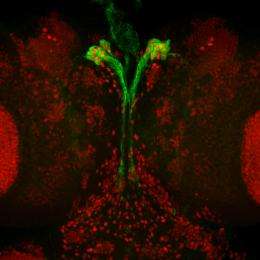
Figure 1: A cluster of IPCs within the fruit fly brain (green), with red fluorescent labeling indicating expression of the nuclear protein Dachshund. Credit: Reproduced from Ref.1 © 2012 by the National Academy of Sciences

Fruit flies and humans both rely on hormones secreted by insulin-producing cells (IPCs) for metabolic maintenance and the regulation of numerous other physiological processes. In some ways, fly IPCs differ considerably from their mammalian counterparts; they emerge from different embryonic precursor cells, and reside within the brain rather than the pancreas. Yet, they also show striking functional similarities. Now, new findings from Takashi Nishimura and colleagues at the RIKEN Center for Developmental Biology in Kobe have demonstrated that these cells employ highly similar molecular mechanisms to manage hormone production. 

Fly IPCs secrete various Drosophila insulin-like peptides (Dilps), which contribute to diverse functions including regulation of growth and metabolic activity, and Nishimura’s team was interested in understanding regulation of Dilp production. Via gene expression analysis, they learned that numerous proteins involved in eye development also contribute to IPC differentiation and the expression of Dilp-encoding genes. 

Among these, they identified a prominent role for a protein called Dachshund, which is continuously expressed in IPCs (Fig. 1) and promotes production of Dilp5 at both early and intermediate stages of fly development. A second protein called Eyeless was known to bind to the gene encoding Dilp5. Nishimura and colleagues learned that Eyeless acts in a similar fashion to Dachshund. In fact, they demonstrated that the two act cooperatively, forming a complex that binds to and activates the dilp5 gene.

Both Dachshund and Eyeless have several mammalian counterparts that, remarkably, appear to act in a similar fashion in mammalian IPCs. The researchers determined that the mammalian homologues of these fly proteins assemble into a complex and work synergistically to switch on the production of insulin in cultured human cells. Likewise, experiments reducing expression of any of these proteins in rat pancreatic cells consistently resulted in reduced insulin production. “Although analogies between Drosophila IPCs and mammalian pancreatic islet cells have been described previously,” says Nishimura, “we show here for the first time that the molecular mechanism for the regulation of insulin expression is conserved.”

Many complexities regarding the regulation of Dilp5, however, remain to be untangled. For example, new experiments from Nishimura and colleagues have shown that nutrient deprivation leads to reduced expression of Dilp5, even though both Dachshund and Eyeless levels appear to remain normal. “It is possible that IPCs receive nutritional signals, and this signal modulates Dachshund and Eyeless activity to regulate Dilp5 expression,” says Nishimura. Future experiments should help clarify how diet-induced signals modulate production of this and other key metabolic hormones.

More information: Okamoto, N., et al. Conserved role for the Dachshund protein with Drosophila Pax6 homolog Eyeless in insulin expression. Proceedings of the National Academy of Sciences 109, 2406–2411 (2012)

Journal reference: Proceedings of the National Academy of Sciences search and more info website

Provided by RIKEN search and more info website

not rated yet  

Rank not rated yet
Relevant PhysicsForums posts

More news stories

Study reveals new mechanism for estrogen suppression of liver lipid synthesis

By discovering the new mechanism by which estrogen suppresses lipid synthesis in the liver, UC Irvine endocrinologists have revealed a potential new approach toward treating certain liver diseases.

Medical research created May 23, 2013 | popularity 5 / 5 (1) | comments 0 | with audio podcast

MRI-based measurement helps predict vascular disease in the brain

Aortic arch pulse wave velocity, a measure of arterial stiffness, is a strong independent predictor of disease of the vessels that supply blood to the brain, according to a new study published in the June issue the journal ...

Medical research created May 23, 2013 | popularity not rated yet | comments 0

Antibiotics: A new understanding of sulfonamide nervous system side effects

Since the discovery of Prontosil in 1932, sulfonamide antibiotics have been used to combat a wide spectrum of bacterial infections, from acne to chlamydia and pneumonia. However, their side effects can include serious neurological ...

Medical research created May 23, 2013 | popularity 3 / 5 (1) | comments 0 | with audio podcast

Scientists discover molecule triggers sensation of itch

Scientists at the National Institutes of Health report they have discovered in mouse studies that a small molecule released in the spinal cord triggers a process that is later experienced in the brain as ...

Medical research created May 23, 2013 | popularity 5 / 5 (3) | comments 0 | with audio podcast

Discarded immune cells induce the relocation of stem cells

Spanish researchers have discovered that the daily clearance of neutrophils from the body stimulates the release of hematopoietic stem cells from the bone marrow into the bloodstream, according to a report published today ...

Medical research created May 23, 2013 | popularity 5 / 5 (2) | comments 0


First drug to improve heart failure mortality in over a decade

Coenzyme Q10 decreases all cause mortality by half, according to the results of a multicentre randomised double blind trial presented today at Heart Failure 2013 congress. It is the first drug to improve heart failure mortality ...

Seniors more likely to crash when driving with pet, study finds

(HealthDay)—Animals make great companions for senior citizens, but elderly people who always drive with a pet in the car are far more likely to crash than those who never drive with a pet, researchers have ...

Heart failure accelerates male 'menopause'

Heart failure accelerates the aging process and brings on early andropausal syndrome (AS), according to research presented today at the Heart Failure Congress 2013. AS, also referred to as male 'menopause', was four times ...

Death highest in heart failure patients admitted in January, on Friday, and overnight

Mortality and length of stay are highest in heart failure patients admitted in January, on Friday, and overnight, according to research presented today at the Heart Failure Congress 2013. The analysis of nearly 1 million ...

Feds fight morning-after pill age ruling in NY

(AP)—Department of Justice lawyers have again asked a federal appeals court in New York to delay lifting age restrictions and prescription requirements on an emergency contraceptive popularly known as the morning-after ...

New immune system discovered

(Medical Xpress)—A research team, led by Jeremy Barr, a biology post-doctoral fellow, unveils a new immune system that protects humans and animals from infection.