Device implanted in brain has therapeutic potential for Huntington's disease
June 18, 2012 in Neuroscience

Device implanted in brain has therapeutic potential for Huntington's disease

Enlarge

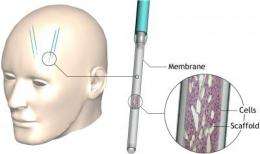
The tip of the EC biodelivery system, a straw-like device that is implanted in the brain of patients, contains living cells which are genetically modified to produce a therapeutic factor. The membrane enclosing the cells allows the factor to flow out of the device and into the patient’s brain tissue. This way, areas deep within the brain affected by Huntington’s disease can be treated to delay or prevent the disease. Credit: Jens Tornøe, NsGene A/S, Ballerup, Denmark

Studies suggest that neurotrophic factors, which play a role in the development and survival of neurons, have significant therapeutic and restorative potential for neurologic diseases such as Huntington's disease. However, clinical applications are limited because these proteins cannot easily cross the blood brain barrier, have a short half-life, and cause serious side effects. Now, a group of scientists has successfully treated neurological symptoms in laboratory rats by implanting a device to deliver a genetically engineered neurotrophic factor directly to the brain. They report on their results in the latest issue of Restorative Neurology and Neuroscience.

Researchers used Encapsulated Cell (EC) biodelivery, a platform which can be applied using conventional minimally invasive neurosurgical procedures to target deep brain structures with . "Our study adds to the continually increasing body of preclinical and clinical data positioning EC biodelivery as a promising therapeutic for larger biomolecules. It combines the therapeutic advantages of gene therapy with the well-established safety of a retrievable implant," says lead investigator Jens Tornøe, NsGene A/S, Ballerup, Denmark.

Investigators made a catheter-like device consisting of a hollow fiber membrane encapsulating a polymeric "scaffold," which provides a surface area to which neurotrophic factor-producing cells can attach. When implanted in the brain, the membrane allows the neurotrophic factor to flow out of the device, as well as allowing nutrients in. Dr. Tornøe and his colleagues used the neurotrophic factor Meteorin, which plays a role in the development of striatal projection neurons, whose degeneration is a hallmark of Huntington's disease. The scientists engineered ARPE-19 cells to produce Meteorin and used those that produced high levels of Meteorin in their experiment.

The EC biodelivery devices were implanted in the brains of rats followed by injection with quinolinic acid (QA), a potent neurotoxin that causes excitotoxicity, a component of Huntington's disease. They tested three different implant types: devices filled with the high-producing ARPE-19 cells (EC-Meteorin), devices with unmodified ARPE-19 cells (ARPE-19), and devices without cells. Motor dysfunction was tested immediately prior to injection with QA and at two and four weeks after injection.

The research team found that the EC-Meteorin devices significantly protected against QA-induced toxicity. Rats with EC-Meteorin devices manifested near normal neurological performance and significantly reduced loss of brain cells from the QA injection compared to controls. Analysis of the Meteorin-treated brains showed a markedly reduced striatal lesion size. The EC biodelivery devices were found to produce stable or even increasing levels of Meteorin throughout the study. Meteorin diffused readily from the biodelivery to the striatal tissue.

"Huntington's disease can be diagnosed with high accuracy by genetic testing. Pre-symptomatic administration of a safe therapeutic treatment providing sustained delay or prevention of disease would be of great benefit to patients," says Dr. Tornøe. "With additional functional and safety data, tests in animals larger than the rat to study distribution, and more accurate disease models to evaluate the therapeutic potential of Meteorin, we anticipate that EC biodelivery can be developed as a platform technology for targeted therapy in patients with Huntington's disease."

More information: “Encapsulated Cell-Based Biodelivery of Meteorin is Neuroprotective in the Quinolinic Acid Rat Model of Neurodegenerative Disease,” by J. Tornøe, M. Torp, J.R. Jørgensen, et al. Restorative Neurology and Neuroscience, 30(2012) 225-275. DOI: 10.3233/RNN-2012-110199

Provided by IOS Press search and more info website

not rated yet  

Rank not rated yet
Relevant PhysicsForums posts

More news stories

For combat veterans suffering from post-traumatic stress disorder, 'fear circuitry' in the brain never rests

Chronic trauma can inflict lasting damage to brain regions associated with fear and anxiety. Previous imaging studies of people with post-traumatic stress disorder, or PTSD, have shown that these brain regions can over-or ...

Neuroscience created May 18, 2013 | popularity 5 / 5 (1) | comments 0 | with audio podcast

Temporal processing in the olfactory system

The neural machinery underlying our olfactory sense continues to be an enigma for neuroscience. A recent review in Neuron seeks to expand traditional ideas about how neurons in the olfactory bulb might encode information about ...

Neuroscience created May 17, 2013 | popularity not rated yet | comments 0 | with audio podcast report

Melon focus headband turns to Kickstarter for rollout plans

(Medical Xpress)—What if the quality of your work depends more on your focus on the piano keys or canvas or laptop than your musical or painting or computing skills? If target users can be convinced, they ...

Neuroscience created May 17, 2013 | popularity 3.7 / 5 (3) | comments 0 | with audio podcast weblog

Deep brain stimulation: A fix when the drugs don't work

Neurological disorders can have a devastating impact on the lives of sufferers and their families.

Neuroscience created May 17, 2013 | popularity 5 / 5 (1) | comments 0 | with audio podcast

Brain makes call on which ear is used for cell phone

If you're a left-brain thinker, chances are you use your right hand to hold your cell phone up to your right ear, according to a newly published study from Henry Ford Hospital in Detroit.

Neuroscience created May 16, 2013 | popularity 2 / 5 (2) | comments 0 | with audio podcast


Ketamine shows significant therapeutic benefit in people with treatment-resistant depression

Patients with treatment-resistant major depression saw dramatic improvement in their illness after treatment with ketamine, an anesthetic, according to the largest ketamine clinical trial to-date led by researchers from the ...

Consuming coffee linked to lower risk of detrimental liver disease, study finds

Regular consumption of coffee is associated with a reduced risk of primary sclerosing cholangitis (PSC), an autoimmune liver disease, Mayo Clinic research shows. The findings were being presented at the Digestive Disease ...

Research examines new methods for managing digestive health

Research presented at Digestive Disease Week (DDW) explores new methods for managing digestive health through diet and lifestyle.

New smartphone application improves colonoscopy preparation

The use of a smartphone application significantly improves patients' preparation for a colonoscopy, according to new research presented today at Digestive Disease Week (DDW). The preparation process, which begins days in ...

New research identifies practice changes to improve value and quality of GI procedures

There are significant cost and risk factors associated with two procedures commonly used to diagnose or treat gastrointestinal problems, according to research presented at Digestive Disease Week (DDW).

New research identifies risks, interventions for children's GI health

An increasing number of U.S. children are experiencing gastrointestinal issues that require interventions to resolve, according to research presented at Digestive Disease Week (DDW).