Study shows treating diabetes early, intensively is best strategy
June 28, 2012 in Diabetes

UT Southwestern study shows treating diabetes early, intensively is best strategy

Enlarge

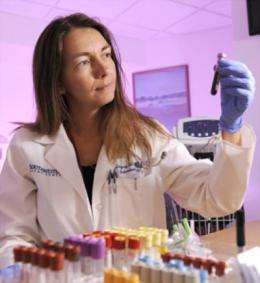
This is Dr. Ildiko Lingvay, assistant professor of internal medicine and author of the study published online in Diabetes Care. Credit: UT Southwestern Medical Center

Intensive early treatment of type 2 diabetes slows down progression of the disease by preserving the body's insulin-producing capacity, a UT Southwestern study has shown.

"We can potentially change the course of this prevalent disease, which would represent a breakthrough," said Dr. Ildiko Lingvay, assistant professor of and author of the study published online in Diabetes Care. "The intensive we propose is different from the stepwise approach recommended in standard guidelines."

As one of the fastest-growing diseases in the U.S., diabetes afflicts an estimated 25.8 million children and adults, or 8.3 percent of the population, according to the . A study by projects the number of diabetes cases to nearly double by 2025.

The UT Southwestern study was selected for presentation at the recent American Diabetes Association's Diabetes Care Symposium and will be published in the July print issue of ADA's .

While intensive treatment has been the standard at UT Southwestern for at least a decade, the industry norm has been to emphasize lifestyle changes first. The American College of Physicians, for example, suggests losing weight and dieting before drug treatment. The ADA recommends similar , plus the use of – the standard drug used to treat – for those newly diagnosed.

"We believe that the stepwise approach exposes patients to long periods of high blood sugar, which leads to complications," Dr. Lingvay said. "Unless dietary changes are significant and sustained long-term, diabetes is a progressive disease in which the body's ability to produce insulin declines."

If a patient can maintain insulin production, she explained, the disease is easier to manage. The study showed intensive treatment with insulin, followed by one of two drug regimens, enabled diabetes patients to maintain steady insulin-producing beta-cell function for three and a half years after diagnosis.

"This finding was true, regardless of the method used to attain intensive control," Dr. Lingvay said. "Intensive treatments led to excellent control of blood-sugar levels, they were well-tolerated, safe, and had good compliance."

In the UT Southwestern clinical trial, participants were randomly divided into two groups. Both groups first had three months of treatment with insulin and the anti-diabetes drug metformin. After that, one group took three types of diabetes medications daily, while the other continued the insulin and metformin treatment. Out of 63 initial trial recruits, 58 completed the study and are still being tracked for six-year results.

Dr. Lingvay said the study did not show that any single regimen worked better than another; both intensive treatment regimens were just as effective.

"The point is that whatever you choose, make sure it's intensive," she said. "We have shown that this preserves beta-cell function, and that's the key in changing the course of the disease."

Journal reference: Diabetes Care search and more info website

Provided by UT Southwestern Medical Center search and more info website

5 /5 (1 vote)  

Rank 5 /5 (1 vote)
Relevant PhysicsForums posts

More news stories

Fish oil supplements may help fight against Type 2 diabetes

Widely-used fish oil supplements modestly increase amounts of a hormone that is associated with lower risk of diabetes and heart disease, according to a study accepted for publication in The Endocrine Society's Journal of ...

Diabetes created 23 hours ago | popularity 5 / 5 (1) | comments 0

Study shows that women who smoke during pregnancy increase the risk of both obesity and gestational diabetes in their da

Women who smoke during pregnancy increase the risk of both obesity and gestational diabetes, in their daughters, concludes research published in Diabetologia, the journal of the European Association for the Study of Diabet ...

Diabetes created May 20, 2013 | popularity not rated yet | comments 0

Rise in type 2 diabetes amongst young

The number of young people diagnosed with type 2 diabetes has seen the sharpest rise over the last twenty years compared to a background of a general increase across the board, new University research has ...

Diabetes created May 20, 2013 | popularity not rated yet | comments 1

Research uncovers a potential role of two proteins in diabetes

(Medical Xpress)—Flinders University researchers are breaking new ground in a decade-long journey to pinpoint the function of two closely related proteins.

Diabetes created May 20, 2013 | popularity 5 / 5 (2) | comments 0 | with audio podcast

Exercise prevents fructose-induced hypertriglyceridemia

(HealthDay)—Moderate aerobic exercise prevents fructose-induced hypertriglyceridemia in healthy males, according to a study published online May 14 in Diabetes.

Diabetes created May 17, 2013 | popularity 5 / 5 (1) | comments 0 | with audio podcast


UN reports 22 deaths worldwide from coronavirus

A new coronavirus has now claimed 22 lives worldwide out of 44 lab-confirmed cases, mostly in Saudi Arabia, World Health Organization officials said Thursday.

Motion quotient: IQ predicted by ability to filter motion (w/ video)

A brief visual task can predict IQ, according to a new study. This surprisingly simple exercise measures the brain's unconscious ability to filter out visual movement. The study shows that individuals whose ...

Defective cellular waste removal explains why Gaucher patients often develop Parkinson's disease

Gaucher disease causes debilitating and sometimes fatal neurodegeneration in early childhood. Recent studies have uncovered a link between the mutations responsible for Gaucher disease and an increased risk ...

Protein preps cells to survive stress of cancer growth and chemotherapy

Scientists have uncovered a survival mechanism that occurs in breast cells that have just turned premalignant-cells on the cusp between normalcy and cancers-which may lead to new methods of stopping tumors.

The secret lives, and deaths, of neurons

As the human body fine-tunes its neurological wiring, nerve cells often must fix a faulty connection by amputating an axon—the "business end" of the neuron that sends electrical impulses to tissues or other ...

Regenerating spinal cord fibers may be treatment for stroke-related disabilities

A study by researchers at Henry Ford Hospital found "substantial evidence" that a regenerative process involving damaged nerve fibers in the spinal cord could hold the key to better functional recovery by most stroke victims.