Why is it so difficult to trace the origins of food poisoning outbreaks?
June 1, 2012 in Diseases, Conditions, Syndromes

Why is it so difficult to trace the origins of food poisoning outbreaks?

Enlarge

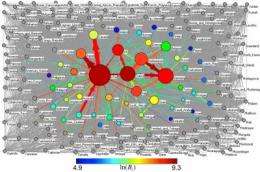
This graphic illustrates the complete International Agro-Food Trade Network in 1998. Credit: Ercsey-Ravasz M, Toroczkai Z, Lakner Z, Baranyi J (2012) Complexity of the International Agro-Food Trade Network and Its Impact on Food Safety. PLoS ONE 7(5): e37810. doi:10.1371/journal.pone.0037810

As illustrated by the 2011 E. coli outbreak in Germany in 2011, any delay in identifying the source of food poisoning outbreaks can cost lives and cause considerable political and economical damage. An international multidisciplinary team of scientists have shown that difficulties in finding the sources of contamination behind food poisoning cases are inevitable due to the increasing complexity of a global food traffic network where food products are constantly crossing country borders, generating a worldwide network.

As consumers we are used to seeing country of origin labels on certain foods, but what about on products with more than one ingredient? A recent study by the Safety Authority of Ireland showed that 53 countries contributed to the ingredients of an ordinary "Chicken Kiev" in a Dublin restaurant. This diversity of sources is partly to blame for the failure to identify the sources of food poisoning outbreaks, and has lead to calls for international health agencies to initiate a system to monitor this 'human .' But just how complex is the human food web? What is its structure, can we quantify it, and what can we learn from it?

In the first study of its kind, published in the journal , the scientists studied databases of food import and export to understand how 'food fluxes' generate a complicated . They were led by Professor József Baranyi of the Institute of Food Research, which is strategically funded by the Biotechnology and Biological Sciences Research Council.

Using agri-food import-export data from the UN and FAO databases, the authors chart out the worldwide food-transport and show that it forms an amazingly transport web. With the help of network science methods they reveal that it has highly vulnerable hotspots and demonstrate that, without increased control, some of these are prime positions for making outbreak tracing difficult.

The research identifies a number of countries as being central to the network or holding particular influence due to the dynamics of the food traffic, and stricter regulation in monitoring food trade here could benefit the network globally. Countries that take in many ingredients, process these into products, and act as distribution hubs are of particular concern.

"We found that the current structure of international food trade effectively makes The Netherlands a combined melting pot and Lazy Susan, with the busiest link to Germany," said Professor Baranyi. "This could explain why the tracing of the source suffered long delays in these countries in two serious outbreaks in 2011. This could be observed in both the E. coli outbreak in sprouts and the dioxin contamination in eggs."

The findings are supported by two types of analyses: one is based on the graph theoretical analysis of the structure of the international food trade network that allows the identification of the network core using the well- established "betweenness centrality" measures of nodes and edges for this purpose; the other is a measure based on the dynamics of the food-flow on the network, expressing to what extent a country is a "source" or a "sink".

Given the demonstrated complexity of the human food web, this work also introduces and validates for the first time a rigorous, quantitative methodology to help with biotracing and identifying the sources of outbreaks, a problem that is only expected to increase in its magnitude, complexity and impact, in the face of current globalization trends.

More information: "Complexity of the International Agro-Food Trade Network and Its Impact on Food Safety" was published in PLoS ONE 31st May 2012 dx.plos.org/10.137… pone.0037810

Journal reference: PLoS ONE search and more info website

Provided by Norwich BioScience Institutes search and more info website

not rated yet  

Rank not rated yet
Related Stories
Relevant PhysicsForums posts

More news stories

New case of SARS-like virus in Saudi: ministry

A new case of the deadly coronavirus has been detected in Saudi Arabia where 15 people have already died after contracting it, the health ministry announced on Saturday on its Internet website.

Diseases, Conditions, Syndromes created 12 hours ago | popularity not rated yet | comments 0

Little evidence for prediction rules for low back pain

(HealthDay)—Few randomized clinical trials have been done to assess clinical prediction rules for patients with lower back pain, and the trials that have been done are of low quality and do not provide ...

Diseases, Conditions, Syndromes created May 17, 2013 | popularity not rated yet | comments 0 | with audio podcast

New malaria test kit gives a boost to elimination efforts worldwide

A new, highly sensitive blood test that quickly detects even the lowest levels of malaria parasites in the body could make a dramatic difference in efforts to tackle the disease in the UK and across the world, according to ...

Diseases, Conditions, Syndromes created May 17, 2013 | popularity not rated yet | comments 0

WHO says single yellow fever shot is enough

(AP)—The World Health Organization says a yellow fever booster vaccination given 10 years after the initial shot isn't necessary.

Diseases, Conditions, Syndromes created May 17, 2013 | popularity not rated yet | comments 0

23 dead in initiation rites in South Africa

(AP)—Twenty-three youths have died in the past nine days at initiation ceremonies that include circumcisions and survival tests, South African police said Friday.

Diseases, Conditions, Syndromes created May 17, 2013 | popularity 5 / 5 (1) | comments 3


New research identifies risks, interventions for children's GI health

An increasing number of U.S. children are experiencing gastrointestinal issues that require interventions to resolve, according to research presented at Digestive Disease Week (DDW).

US psychiatry gets makeover in new manual

The latest makeover to a massive psychiatric tome honored by some, reviled by others and even called the "Bible" of mental disorders is being released Saturday with a host of new changes.

AIDS science at 30: 'Cure' now part of lexicon

Big names in medicine are set to give an upbeat assessment of the war on AIDS on Tuesday, 30 years after French researchers identified the virus that causes the disease.

For combat veterans suffering from post-traumatic stress disorder, 'fear circuitry' in the brain never rests

Chronic trauma can inflict lasting damage to brain regions associated with fear and anxiety. Previous imaging studies of people with post-traumatic stress disorder, or PTSD, have shown that these brain regions can over-or ...

New colonoscope provides ground-breaking view of colon

A ground-breaking advance in colonoscopy technology signals the future of colorectal care, according to research presented today at Digestive Disease Week(DDW). Additional research focuses on optimizing the minimal withdrawal ...

Body clocks of depressed people altered at cell level, researchers show

Every cell in our bodies runs on a 24-hour clock, tuned to the night-day, light-dark cycles that have ruled us since the dawn of humanity. The brain acts as timekeeper, keeping the cellular clock in sync ...