Doctors successfully implant synthetic larynx piece into two patients
June 29, 2012 by Bob Yirka in Medical research report

Doctors successfully implant synthetic larynx piece into two patients

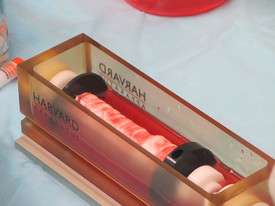
Harvard Bioscience "InBreath" Bioreactor with synthetic laryngotracheal scaffold seeded with patient's own cells

(Medical Xpress) -- Doctors working at the Karolinska University Hospital in Stockholm, have for the first time, successfully implanted a synthetically grown integral part of the human larynx into two live human patients, restoring their ability to speak. The groundbreaking procedure is considered to be the first step towards creating an entire larynx using scaffolding and stem cells to replace a natural one damaged by accident or disease.

The , also called the , is an organ in the throat that houses the mechanism involved in speech. It also helps direct breath flow and aids in preventing food or other objects from entering the trachea. At the base of the larynx between the parts that contribute to speech and the trachea is a collar shaped piece of windpipe called the cricoid arch and plate. Its job is to form the outer wall of the lower larynx. Because of its location, it is oftentimes crushed when people involved in car accidents have their throat thrust against the top of the steering wheel. That’s what happened to the two patients who received the new lab grown parts from the international team of doctors working together on the new procedure. Both of them lost the ability to speak as a result.

To create the new part, a group of researchers working at Harvard Bioscience in the US first built a scaffolding out of a synthetic material. They then applied stem cells taken from the bone marrow of the patient who was to receive the and caused them to attach in a special reactor box. Because the stem cells came from the patient, their bodies won’t react by trying to reject the foreign part. The same team led by Doctor Paolo Macchiarini implanted a synthetically grown into a patient last summer and all indications are that it was a success as well.

Implanting synthetic organs or parts of them is new science. Currently, other medical procedures used to restore speech to damaged organs have relied on harvesting parts from cadavers, which of course means the patient will have to deal with rejection issues for the rest of their life.

Macchiarini and his team, in conjunction with others such as those are Harvard Bioscience, all agree that such procedures are just the first step. The ultimate goal is to build an entire synthetic larynx from scratch that will function just as well as a normal one, restoring speech to those that suffer from any ailment of the voice box; a goal that is likely to take decades to achieve due to the intricacy of the larynx and all its moving parts.

© 2012 Phys.Org

5 /5 (5 votes)  

Rank 5 /5 (5 votes)
Related Stories
Relevant PhysicsForums posts

More news stories

Study reveals new mechanism for estrogen suppression of liver lipid synthesis

By discovering the new mechanism by which estrogen suppresses lipid synthesis in the liver, UC Irvine endocrinologists have revealed a potential new approach toward treating certain liver diseases.

Medical research created May 23, 2013 | popularity 5 / 5 (1) | comments 0 | with audio podcast

MRI-based measurement helps predict vascular disease in the brain

Aortic arch pulse wave velocity, a measure of arterial stiffness, is a strong independent predictor of disease of the vessels that supply blood to the brain, according to a new study published in the June issue the journal ...

Medical research created May 23, 2013 | popularity not rated yet | comments 0

Antibiotics: A new understanding of sulfonamide nervous system side effects

Since the discovery of Prontosil in 1932, sulfonamide antibiotics have been used to combat a wide spectrum of bacterial infections, from acne to chlamydia and pneumonia. However, their side effects can include serious neurological ...

Medical research created May 23, 2013 | popularity 3 / 5 (1) | comments 0 | with audio podcast

Scientists discover molecule triggers sensation of itch

Scientists at the National Institutes of Health report they have discovered in mouse studies that a small molecule released in the spinal cord triggers a process that is later experienced in the brain as ...

Medical research created May 23, 2013 | popularity 5 / 5 (3) | comments 0 | with audio podcast

Discarded immune cells induce the relocation of stem cells

Spanish researchers have discovered that the daily clearance of neutrophils from the body stimulates the release of hematopoietic stem cells from the bone marrow into the bloodstream, according to a report published today ...

Medical research created May 23, 2013 | popularity 5 / 5 (2) | comments 0


Seniors more likely to crash when driving with pet, study finds

(HealthDay)—Animals make great companions for senior citizens, but elderly people who always drive with a pet in the car are far more likely to crash than those who never drive with a pet, researchers have ...

First drug to improve heart failure mortality in over a decade

Coenzyme Q10 decreases all cause mortality by half, according to the results of a multicentre randomised double blind trial presented today at Heart Failure 2013 congress. It is the first drug to improve heart failure mortality ...

Heart failure accelerates male 'menopause'

Heart failure accelerates the aging process and brings on early andropausal syndrome (AS), according to research presented today at the Heart Failure Congress 2013. AS, also referred to as male 'menopause', was four times ...

Death highest in heart failure patients admitted in January, on Friday, and overnight

Mortality and length of stay are highest in heart failure patients admitted in January, on Friday, and overnight, according to research presented today at the Heart Failure Congress 2013. The analysis of nearly 1 million ...

Feds fight morning-after pill age ruling in NY

(AP)—Department of Justice lawyers have again asked a federal appeals court in New York to delay lifting age restrictions and prescription requirements on an emergency contraceptive popularly known as the morning-after ...

Driving and hands-free talking lead to spike in errors, study shows

Talking on a hands-free device while behind the wheel can lead to a sharp increase in errors that could imperil other drivers on the road, according to new research from the University of Alberta.