Drug-Eluting stents offer no advantage for A-Fib patients
June 22, 2012 in Cardiology

Drug-Eluting stents offer no advantage for A-Fib patients

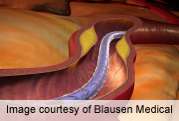
Drug-eluting stents do not seem to offer advantages over bare-metal stents for patients with atrial fibrillation who undergo percutaneous coronary intervention with stent implantation, according to research published in the July 1 issue of The American Journal of Cardiology.

(HealthDay) -- Drug-eluting stents (DESs) do not seem to offer advantages over bare-metal stents (BMSs) for patients with atrial fibrillation (AF) who undergo percutaneous coronary intervention (PCI) with stent implantation, according to research published in the July 1 issue of The American Journal of Cardiology.

Laurent Fauchier, M.D., Ph.D., of the Université François Rabelais in Tours, France, and colleagues compared the efficacy and safety of DESs with BMSs in 833 consecutive unselected patients with AF, seen from 2000 to 2010, who had undergone PCI with stent implantation.

Of the stents implanted, 81 percent were BMSs and 19 percent were DESs. During a median follow-up of 688 days, the researchers found that the incidence of all-cause mortality and of major adverse cardiac events (MACEs; death, acute myocardial infarction, target lesion revascularization) was similar between the two groups. The results remained similar after adjustment for confounders and age. Older age, implantation of stent during acute ST-segment elevation myocardial infarction, and stent diameter were significantly and independently associated with an increased risk of MACEs. DESs did not correlate with a higher risk of bleeding, and the ratio of serious events at follow-up was similar for DES and BMS implantation.

"In conclusion, in our cohort, systematic use of DESs does not seem to be justified in most patients with AF because it was not associated with any clear advantage compared to BMSs," the authors write.

More information: Abstract
Full Text (subscription or payment may be required)

Journal reference: American Journal of Cardiology search and more info website

Copyright © 2012 HealthDay. All rights reserved.

not rated yet  

Rank not rated yet
Relevant PhysicsForums posts

More news stories

Which women should be screened for high cholesterol?

National guidelines recommend that at-risk women be screened for elevated cholesterol levels to reduce their chances of developing cardiovascular disease. But who is 'at risk?' The results of a study by investigators ...

Cardiology created 10 minutes ago | popularity not rated yet | comments 0

Atherosclerotic disease heredity mapped in nationwide study

Researchers at Lund University in Sweden have mapped the significance of heredity for common forms of atherosclerotic disease. No studies have previously examined whether different forms of the disease share heredity.

Cardiology created 1 hour ago | popularity not rated yet | comments 0

Study finds improved CPR quality saves lives

(Medical Xpress)—Life-saving CPR has been a foundation of emergency medicine for more than a half century. But researchers at the University of Arizona College of Medicine-Phoenix are continuing to refine the procedure, ...

Cardiology created 3 hours ago | popularity not rated yet | comments 0

Genetic screening could reveal hidden high risk for coronary heart disease

Finnish researchers have shown that genetic marker information can improve risk evaluation of coronary heart disease. The study comprised over 24,000 Finnish subjects and was led by Professor Samuli Ripatti. The results revealed ...

Cardiology created 5 hours ago | popularity not rated yet | comments 0

Free fatty acids linked to cardiac risk in late adulthood

(HealthDay)—Blood levels of free fatty acids are associated with insulin resistance during young adulthood and cardiovascular risk factors in later adulthood, according to a study published online May 13 ...

Cardiology created May 17, 2013 | popularity not rated yet | comments 0 | with audio podcast


New study finds blind people have the potential to use their 'inner bat' to locate objects

New research from the University of Southampton has shown that blind and visually impaired people have the potential to use echolocation, similar to that used by bats and dolphins, to determine the location of an object.

Researchers find far-reaching, microvascular damage in uninjured side of brain after stroke

While the effects of acute stroke have been widely studied, brain damage during the subacute phase of stroke has been a neglected area of research. Now, a new study by the University of South Florida reports that within a ...

Breakup of physician, drug company relationship could improve health care, cut cost

A new report suggests that improved health care and significant reductions in drug costs might be attained by breaking up the age-old relationship between physicians and drug company representatives who promote the newest, ...

Germ-fighting vaccine system makes great strides in delivery

A novel vaccine study from South Dakota State University (SDSU) will headline the groundbreaking research that will be unveiled at the American Association of Pharmaceutical Scientists' (AAPS) National Biotechnology Conference ...

Diabetes drug tested in Parkinson's disease patients

Parkinson's disease (PD) is a degenerative neurological disorder marked by a progressive loss of motor control. Despite intensive research, there are currently no approved therapies that have been demonstrated to alter the ...

Study supports 'aggressive' treatment for posterior fossa hematoma in newborns

Posterior fossa subdural hematoma (PFSDH) is a serious and rare condition in newborns, generally occurring after difficult deliveries. But with appropriate treatment, there's an excellent chance of good long-term outcomes ...