Proposed drug may reverse Huntington's disease symptoms
June 20, 2012 in Neuroscience

Proposed drug may reverse Huntington's disease symptoms

Enlarge

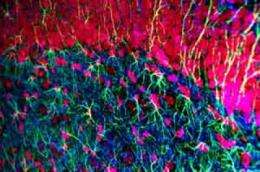
This image shows stained mouse neurons. Credit: Image courtesy of Taylor Bayouth

With a single drug treatment, researchers at the Ludwig Institute for Cancer Research at the University of California, San Diego School of Medicine can silence the mutated gene responsible for Huntington's disease, slowing and partially reversing progression of the fatal neurodegenerative disorder in animal models.

The findings are published in the June 21, 2012 online issue of the journal Neuron.

Researchers suggest the drug therapy, tested in mouse and non-human primate models, could produce sustained motor and neurological benefits in with moderate and severe forms of the disorder. Currently, there is no effective treatment.

Huntington's disease afflicts approximately 30,000 Americans, whose symptoms include uncontrolled movements and progressive cognitive and psychiatric problems. The disease is caused by the mutation of a single gene, which results in the production and accumulation of toxic proteins throughout the brain.

Don W. Cleveland, PhD, professor and chair of the UC San Diego Department of Cellular and and head of the Laboratory of Cell Biology at the Ludwig Institute for Cancer Research, and colleagues infused mouse and primate models of Huntington's disease with one-time injections of an identified DNA drug based on antisense oligonucleotides (ASOs). These ASOs selectively bind to and destroy the mutant gene's molecular instructions for making the toxic .

The singular treatment produced rapid results. Treated animals began moving better within one month and achieved normal motor function within two. More remarkably, the benefits persisted, lasting nine months, well after the drug had disappeared and production of the toxic proteins had resumed.

"For diseases like Huntington's, where a product is tolerated for decades prior to disease onset, these findings open up the provocative possibility that transient treatment can lead to a prolonged benefit to patients," said Cleveland. "This finding raises the prospect of a 'huntingtin holiday,' which may allow for clearance of disease-causing species that might take weeks or months to re-form. If so, then a single application of a drug to reduce expression of a target gene could 'reset the disease clock,' providing a benefit long after huntingtin suppression has ended."

Beyond improving motor and cognitive function, researchers said the ASO treatment also blocked brain atrophy and increased lifespan in mouse models with a severe form of the disease. The therapy was equally effective whether one or both huntingtin genes were mutated, a positive indicator for human therapy.

Cleveland noted that the approach was particularly promising because antisense therapies have already been proven safe in clinical trials and are the focus of much drug development. Moreover, the findings may have broader implications, he said, for other "age-dependent neurodegenerative diseases that develop from exposure to a mutant protein product" and perhaps for nervous system cancers, such as glioblastomas.

More information: Kordasiewicz et al.: "Sustained therapeutic reversal of Huntington's disease by transient repression of huntingtin synthesis." DOI:10.1016/j.neuron.2012.05.009

Journal reference: Neuron search and more info website

Provided by University of California - San Diego search and more info website

not rated yet  

Rank not rated yet
Relevant PhysicsForums posts

More news stories

Having both migraines, depression may mean smaller brain

(HealthDay)—Migraines and depression can each cause a great deal of suffering, but new research indicates the combination of the two may be linked to something else entirely—a smaller brain.

Neuroscience created 14 hours ago | popularity 4 / 5 (2) | comments 0 | with audio podcast

Researchers analyse hunting behaviour of fish larvae in virtual reality

Moving objects attract greater attention – a fact exploited by video screens in public spaces and animated advertising banners on the Internet. For most animal species, moving objects also play a major ...

Neuroscience created 16 hours ago | popularity not rated yet | comments 0 | with audio podcast

Signs of motor disorders can appear years before disease manifestation

It is known that signs of neurological disorders such as Alzheimer's and Huntington's disease can appear years before the disease becomes manifest; these signs take the form of subtle changes in the brain and behavior of ...

Neuroscience created 16 hours ago | popularity not rated yet | comments 0

Taming suspect gene reverses schizophrenia-like abnormalities in mice

Scientists have reversed behavioral and brain abnormalities in adult mice that resemble some features of schizophrenia by restoring normal expression to a suspect gene that is over-expressed in humans with ...

Neuroscience created 18 hours ago | popularity 5 / 5 (2) | comments 0 | with audio podcast

Scientists uncover molecular roots of cocaine addiction in the brain

Researchers at Johns Hopkins have unraveled the molecular foundations of cocaine's effects on the brain, and identified a compound that blocks cravings for the drug in cocaine-addicted mice. The compound, already proven safe ...

Neuroscience created 18 hours ago | popularity not rated yet | comments 0 | with audio podcast


US teen birth rate drops to record low

US teen births have dropped to a record low, but the country still has one of the highest rates among developed nations, the US Centers for Disease Control and Prevention said Thursday.

Slowing the aging process—only with antibiotics

Swiss scientists reveal the mechanism responsible for aging hidden deep within mitochondria—and dramatically slow it down in worms by administering antibiotics to the young.

Researchers complete largest genetic sequencing study of human disease

Researchers from Queen Mary, University of London have led the largest sequencing study of human disease to date, investigating the genetic basis of six autoimmune diseases.

Brain can be trained in compassion, study shows

Until now, little was scientifically known about the human potential to cultivate compassion—the emotional state of caring for people who are suffering in a way that motivates altruistic behavior.

Rate of bicycle-related fatalities significantly lower in states with helmet laws

Existing research shows that bicyclists who wear helmets have an 88 percent lower risk of brain injury, but researchers at Boston Children's Hospital found that simply having bicycle helmet laws in place showed a 20 percent ...

Novel approach for influenza vaccination shows promise in early animal testing

A new approach for immunizing against influenza elicited a more potent immune response and broader protection than the currently licensed seasonal influenza vaccines when tested in mice and ferrets. The vaccine ...