Gene clue to drug resistance in African sleeping sickness
June 19, 2012 in Diseases, Conditions, Syndromes

Gene clue to drug resistance in African sleeping sickness

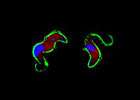
African trypanosomes (variant surface glycoprotein, green; red fluorescent protein, red; DNA, blue). Credit: Lucy Glover, London School of Hygiene and Tropical Medicine.

(Medical Xpress) -- Researchers have identified a gene that controls susceptibility to drug treatment in Trypanosoma brucei, the parasite responsible for African sleeping sickness.

Human African trypanosomiasis (HAT), also known as sleeping sickness, is a parasite disease that is transmitted by the tsetse fly and is usually fatal if left untreated. There is currently no vaccine, and is the only .

During the early stages of the disease, pentamidine is typically the only drug available. However, diagnosis is often late and in these cases the arsenic-based drug melarsoprol is often used, despite the fact that the therapy itself kills approximately 5 per cent of patients.

This desperate situation is made worse by the increasing incidence of melarsoprol resistance in up to 30 per cent of patients in some areas. Cross-resistance among the melarsoprol-pentamidine drug classes was reported more than 60 years ago, but understanding of the underlying mechanism remains incomplete.

Earlier this year, research led by a team at the London School of Hygiene and Tropical Medicine identified two parasite genes that are involved in the action of both pentamidine and melarsoprol. Both genes encode channels that can transport water and glycerol in or out of the parasite.

Now, the same team - in collaboration with the University of Glasgow - have shown that trypanosomes lacking just one of the genes, the AQP2 gene, were resistant to both drugs and that this gene alone could explain the previously observed drug resistance. They also found that the same gene was specifically disrupted in a drug-resistant strain generated in the laboratory several years previously. The findings suggest that AQP2 is required to enable the drugs to get into the parasite.

Dr David Horn from the London School of Hygiene and Tropical Medicine explains the importance of the findings: "Disrupting AQP2 is probably akin to turning off a tap, reducing the flow of drugs into the cell.

"One important question now is whether disruption of the AQP2 gene can explain cases of drug resistance in patients. If so, then we can look to develop a test based on this that could help to tackle drug resistance in the field when it arises."

More information: Baker N et al. Aquaglyceroporin 2 controls susceptibility to melarsoprol and pentamidine in African trypanosomes. Proc Natl Acad Sci 2012 (epub ahead of print).

Journal reference: Proceedings of the National Academy of Sciences search and more info website

Provided by Wellcome Trust search and more info website

3 /5 (2 votes)  

Rank 3 /5 (2 votes)
Relevant PhysicsForums posts

More news stories

WHO: Scientific red tape mars efforts vs. virus

International efforts to combat a new pneumonia-like virus that has now killed 22 people are being slowed by unclear rules and competition for the potentially profitable rights to disease samples, the head ...

Diseases, Conditions, Syndromes created 3 hours ago | popularity not rated yet | comments 0

Shortage of key drug hampering U.S. efforts to control TB, report says

(HealthDay)—A shortage of a critical tuberculosis drug has hampered the efforts of health departments across the United States to contain the spread of the highly infectious lung disease, federal officials ...

Diseases, Conditions, Syndromes created 4 hours ago | popularity not rated yet | comments 0

Heart healthy lifestyle may cut kidney disease patients' risk of kidney failure

Maintaining a heart healthy lifestyle may also help protect chronic kidney disease patients from developing kidney failure and dying prematurely, according to a study appearing in an upcoming issue of the Journal of the Am ...

Diseases, Conditions, Syndromes created 4 hours ago | popularity not rated yet | comments 0

Flu vaccine also linked to narcolepsy in adults, study reports

Finnish researchers unveiled new data Thursday to link the Pandemrix flu vaccine to a higher risk of the sleeping disorder narcolepsy in adults.

Diseases, Conditions, Syndromes created 5 hours ago | popularity not rated yet | comments 0

Second child contracts polio in Pakistan's Waziristan

A second child has contracted polio in a restive Pakistani tribal region near the Afghan border after the Taliban banned vaccinations there nearly a year ago, a UN official said Thursday.

Diseases, Conditions, Syndromes created 5 hours ago | popularity not rated yet | comments 0


Controlling mood through the motions of mitochondria

(Medical Xpress)—Regulating the distribution of power in neurons is done by a system that makes the national electric grid look simple by comparison. Each neuron has several thousand mitochondria confined ...

Multiple research teams unable to confirm high-profile Alzheimer's study

Teams of highly respected Alzheimer's researchers failed to replicate what appeared to be breakthrough results for the treatment of this brain disease when they were published last year in the journal Science.

Scientists discover molecule triggers sensation of itch

Scientists at the National Institutes of Health report they have discovered in mouse studies that a small molecule released in the spinal cord triggers a process that is later experienced in the brain as ...

Type 2 diabetes progresses faster in kids, study finds

(HealthDay)—Type 2 diabetes is more aggressive in children than adults, with signs of serious complications seen just a few years after diagnosis, new research finds.

Motion quotient: IQ predicted by ability to filter motion (w/ video)

A brief visual task can predict IQ, according to a new study. This surprisingly simple exercise measures the brain's unconscious ability to filter out visual movement. The study shows that individuals whose ...

Researchers find common childhood asthma unconnected to allergens or inflammation

Little is known about why asthma develops, how it constricts the airway or why response to treatments varies between patients. Now, a team of researchers at Weill Cornell Medical College, Columbia University Medical Center ...