Human antibody for dengue virus isolated
June 22, 2012 by Lin Edwards in Diseases, Conditions, Syndromes report

dengue

Enlarge

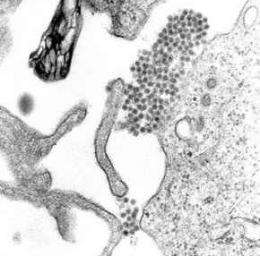
A TEM micrograph showing Dengue virus virions (the cluster of dark dots near the center). Image: CDC

(Phys.org) -- A group of scientists in Singapore and the UK have isolated a human antibody capable of effectively neutralizing the mosquito-borne dengue virus. Dengue fever is currently incurable and infects an estimated 100,000 people a year, mostly in the tropics. The only treatment is alleviating the symptoms, which can include intense joint and muscle pain, nausea, vomiting, high fever, and death in severe cases.

Dengue virus (DENV) has four strains or serotypes (1 to 4), and a person infected by one serotype produces antibodies that make them immune for life to infection from that serotype, but that usually only give limited or transient immunity to the other three. The newly isolated antibody is extremely effective for serotype 1.

The researchers isolated the , HM14c10, which was formed in the body of a patient in Singapore who had recovered from a DENV1 infection. The antibody turned out to be extremely fast-acting and gave powerful immunity to the virus.

The group recruited around 100 recovered dengue patients and found over 200,000 antibodies in total. The HM14c10 antibody turned out to be so powerful that it kills the virus before it is able to infect the cells, according to lead researcher, Professor Lok of the National University of Singapore.

After isolating the antibody the researchers carried out experiments on mice and discovered that it functions by stretching across the virus surface, preventing the changes to its that must take place for the virus to be able to infect cells.

The paper was published in the journal Science Translational Medicine, and the findings may help researchers develop new therapies to treat or prevent infection by the . The research showed the antibody to be far more effective at neutralizing viruses than the anti-dengue chemicals now in development.

The next phase of the research on DENV1 will be clinical trials to test the antibody on patients infected with DENV1. The team will also continue to check the remaining in their library to determine if any are as effective against the other serotypes, and they have already found a likely candidate against 2.

Another lead author of the paper, Dr Paul A. MacAry of the National University of Singapore said that in Singapore around 90% of dengue fever cases were either DENV1 or 2, and their research should lead to an antibody for each of these strains within about six months.

More information: The Structural Basis for Serotype-Specific Neutralization of Dengue Virus by a Human Antibody, Sci Transl Med 20 June 2012:
Vol. 4, Issue 139, p. 139ra83. DOI: 10.1126/scitranslmed.3003888

ABSTRACT
Dengue virus (DENV) is a mosquito-borne flavivirus that affects 2.5 billion people worldwide. There are four dengue serotypes (DENV1 to DENV4), and infection with one elicits lifelong immunity to that serotype but offers only transient protection against the other serotypes. Identification of the protective determinants of the human antibody response to DENV is a vital requirement for the design and evaluation of future preventative therapies and treatments. Here, we describe the isolation of a neutralizing antibody from a DENV1-infected patient. The human antibody 14c10 (HM14c10) binds specifically to DENV1. HM14c10 neutralizes the virus principally by blocking virus attachment; at higher concentrations, a post-attachment step can also be inhibited. In vivo studies show that the HM14c10 antibody has antiviral activity at picomolar concentrations. A 7 Å resolution cryoelectron microscopy map of Fab fragments of HM14c10 in a complex with DENV1 shows targeting of a discontinuous epitope that spans the adjacent surface of envelope protein dimers. As found previously, a human antibody specific for the related West Nile virus binds to a similar quaternary structure, suggesting that this could be an immunodominant epitope. These findings provide a structural and molecular context for durable, serotype-specific immunity to DENV infection.

Journal reference: Science Translational Medicine search and more info website

© 2012 Phys.Org

5 /5 (5 votes)  

Filter


Move the slider to adjust rank threshold, so that you can hide some of the comments.


Display comments: newest first

trekgeek1
Jun 22, 2012

Rank: not rated yet
So is HM14c10 a designation for that certain antibody which was present in the one survivor or is that antibody present in all survivors but it was just more effective in the one person?

Also, my biology isn't up to snuff. Is it that the persons immune system is just superior to other people's and thus made a superior antibody or is it just plain luck that their immune system made such a powerful antibody? "Luck" in the sense that it was a typical antibody made by an immune system but had some beneficial mutation.
Rank 5 /5 (5 votes)
Relevant PhysicsForums posts

More news stories

Ferrets, pigs susceptible to H7N9 avian influenza virus

Chinese and U.S. scientists have used virus isolated from a person who died from H7N9 avian influenza infection to determine whether the virus could infect and be transmitted between ferrets. Ferrets are often used as a mammalian ...

Diseases, Conditions, Syndromes created 17 minutes ago | popularity not rated yet | comments 0 | with audio podcast

UN reports 22 deaths worldwide from coronavirus

A new coronavirus has now claimed 22 lives worldwide out of 44 lab-confirmed cases, mostly in Saudi Arabia, World Health Organization officials said Thursday.

Diseases, Conditions, Syndromes created 3 hours ago | popularity not rated yet | comments 0

Researchers suggest boosting body's natural flu killers

A known difficulty in fighting influenza (flu) is the ability of the flu viruses to mutate and thus evade various medications that were previously found to be effective. Researchers at the Hebrew University of Jerusalem have ...

Diseases, Conditions, Syndromes created 4 hours ago | popularity not rated yet | comments 0 | with audio podcast

Swine flu pandemic of 2009 more deadly for younger adults, study finds

As the world prepares for what may be the next pandemic strain of influenza virus, in the H7N9 bird flu, a new UC Irvine study reveals that the 2009 H1N1 swine flu pandemic was deadliest for people under the age of 65, while ...

Diseases, Conditions, Syndromes created 22 hours ago | popularity not rated yet | comments 0

Polio cases found in Kenya and Somalia, WHO says

The World Health Organization says the Horn of Africa is experiencing an outbreak of polio with cases confirmed in Kenya and Somalia.

Diseases, Conditions, Syndromes created 23 hours ago | popularity not rated yet | comments 0


Scientists discover molecule triggers sensation of itch

Scientists at the National Institutes of Health report they have discovered in mouse studies that a small molecule released in the spinal cord triggers a process that is later experienced in the brain as the sensation of ...

Multiple research teams unable to confirm high-profile Alzheimer's study

Teams of highly respected Alzheimer's researchers failed to replicate what appeared to be breakthrough results for the treatment of this brain disease when they were published last year in the journal Science.

Motion quotient: IQ predicted by ability to filter motion (w/ video)

A brief visual task can predict IQ, according to a new study. This surprisingly simple exercise measures the brain's unconscious ability to filter out visual movement. The study shows that individuals whose ...

Researchers find common childhood asthma unconnected to allergens or inflammation

Little is known about why asthma develops, how it constricts the airway or why response to treatments varies between patients. Now, a team of researchers at Weill Cornell Medical College, Columbia University Medical Center ...

Drug reverses Alzheimer's disease deficits in mice, research confirms

An anti-cancer drug reverses memory deficits in an Alzheimer's disease mouse model, University of Pittsburgh Graduate School of Public Health researchers confirm in the journal Science.

Economic incentives increase blood donation without negative consequences

Can economic incentives such as gift cards, T-shirts, and time off from work motivate members of the public to increase their donations of blood?