Husband-wife team set out to improve breast cancer exams
One in eight women in the United States will develop breast cancer over the course of her lifetime.
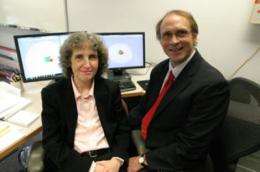
Lorraine G. Olson, professor of mechanical engineering at the Rose-Hulman Institute of Technology in Terre Haute, Indiana, was diagnosed in 2005 at the age of 45. Fortunately, her breast cancer was caught early from a routine mammogram, but like many women, she was prodded by her physician to do the exam.
"To be honest, I put off my mammogram for months before my primary care physician made an appointment for me," Olson said. "The standard mammogram hurts a fair amount and I didn't think I'd have a problem since I was pretty young."
Mammograms involve placing one breast at a time between two plates that compress and spread the breast tissue, which causes discomfort for most women.
As fate may have it, Olson's husband, Robert Throne, was diagnosed with prostate cancer in 2005 a few months after Olson's diagnosis. Throne is the head of the Department of Electrical and Computer Engineering at Rose-Hulman.
Few cancer survivors are in the position to change the way cancer is diagnosed, but Olson and Throne are doing just that for breast cancer. Together, they have created math models to improve early detection efforts. The research could be instrumental in the development of a new robotic device that will mimic manual breast palpations, enabling doctors to record accurate data about the underlying tissue.
"The device won't replace mammography," Olson said, but the less invasive method could be an affordable, effective tool. For nearly six years, this has been the focal point of the husband-wife research team.
"Cancerous tissues are as much as ten times stiffer than healthy tissues," Olson said. "Manual breast exams are looking at tissue stiffness, but, currently, there isn't a good way to record the results."
To better understand the concept of stiffness, Olson compares it with cheese. A three ounce block of cream cheese and a three ounce block of cheddar cheese are about the same size and density (weight/volume). However, when you probe the block of cheddar cheese it doesn't change shape nearly as much as the cream cheese—that's because cheddar is much stiffer.
Olson and Throne want their system to automate and refine the manual breast exam process. "Step one is to find a way to record accurate results," Olson said. "Step two is to use mathematical techniques to make a picture of what's going on inside the breast tissue in terms of stiffness."
Mammograms use X-rays, which are only sensitive to tissue density, not stiffness.
The new exam would look something like this: A woman lies on an exam table and a ring is placed around her breast; a robotic arm then performs the breast exam and measures how much force it takes and how much the tissue moves.
"This is how we imagine it's going to work, but for now we're just doing computer simulations of the process," Olson says.
To run these simulations quickly and to generate accurate results, Olson is applying the computational power of the resources at the Texas Advanced Computing Center (TACC) at The University of Texas at Austin.
"None of this would have been possible without the resources we used through TACC and XSEDE," Olson said, referring to the National Science Foundation-funded cyberinfrastructure that provides free advanced computing resources and time to researchers across the country. "By using supercomputers I can parallelize the job and finish simulations in minutes."
For the breast cancer research, speed of execution is very important, as a typical genetic algorithm must be iterated many times to produce a usable result for a complex problem. Olson is working with 2D and 3D algorithms to create a picture that represents the variations in tissue stiffness.
"It's quite promising," Olson said. "You can put a tumor about one centimeter across near the middle of the breast tissue, and then run this algorithm—it will tell you that there's a one centimeter tumor in the same location."
During the summer of 2012, Olson and her husband will try to speed up their algorithm's ability to solve problems by a factor of two. They also aim to improve the "fitness function" on their measured data to determine the best way to perform the tests at a clinical level. A fitness function summarizes, as a single figure of merit, how close a given design solution is to achieving the set aims.
In the near future, Olson and Throne plan to move the research from computer simulations to actual experiments and clinical use. The husband-wife team hopes that this new test will become an inexpensive, routine exam performed painlessly and harmlessly as part of an annual checkup even for relatively young women. This would greatly aid in early detection when breast cancer is most treatable.
"My daughter is 21 now," Olson said, "and I need to hurry up with the research because she wants it ready."


