Music of kindness: Playing together strengthens empathy in children
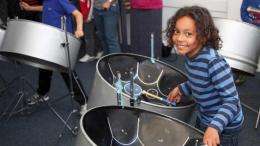
A year-long study on children’s music-making indicates that playing music in groups on a regular basis greatly improves a child’s ability to empathise with others.
Researchers looking at group education sessions for 8 to 11 year old children have shown that engaging in regular music-based activities with others – from ensembles to simple rhythmic exercises – can conspicuously advance empathy development, increasing a child’s capacity to recognise and consider the emotions of others.
A total of 52 children – boys and girls – were split into three groups at random. One of these groups met on a weekly basis to interact through musical games devised by the researchers, while the other two acted as control groups – one met with the same regularity but activities focused on words and drama but not music, the other received no additional activities.
Using standard and novel techniques such as answering questions designed to test compassion, and responding to emotion in facial expressions and movies, each child’s level of emotional empathy was evaluated at the start of the study and then again after a year. The researchers found that children in the music-based activity group showed a substantial increase in empathy scores and a higher average score compared to the other groups.
“These results bear out our hypothesis that certain components of musical interaction may enhance a capacity for emotional empathy, which continues outside the musical context,” says Tal-Chen Rabinowitch, from the Centre for Music and Science, who led the study.
“We feel that the program of musical activities we’ve developed could serve as a platform for a new approach to music education – one that helps advance not just musical skill but also social abilities and, in particular, the emotional understanding of others.”
The activities used in the study were developed to emphasize the components of musical interaction that the researchers believed would promote empathy – fostering greater understanding of shared mental states.
These empathy-promoting musical components include imitation, where children were asked to mimic or match other players’ movements and musical motifs – such as in the ‘Mirror Match’ game – and entrainment, where the researchers used rhythm to encourage synchronised performance – so that children learnt to align and adjust themselves through attending to others.
By engaging with these musical activities, the children were regularly experiencing states of what the researchers describe as ‘shared intentionality’ – an understanding of each other’s intentions through a common aim or object of attention – creating an emotional affinity among the children.
The team, which also included Professor Ian Cross, head of the Centre for Music and Science at the Faculty of Music, and Dr. Pamela Burnard of the Faculty of Education, came up with increasingly complex music games to explore ‘shared intentionality’ – activities included creating music that reflected the perceived emotion of others, or composing music together with a clear theme.
According to the researchers, music and rhythm allows a sense of mutual ‘honesty’ that goes beyond the more precise expression in verbal communication. In essence, everyone can feel a rhythm and respond – sharing an experience regardless of linguistic skills.
“The point about music is that it can make you feel as though you are sharing the same experience, when you don’t need to be doing the same thing or feeling the same way,” says Cross. “There is a strong sense in communal music that you simply do feel you are experiencing the same thing as everyone else.”
The researchers believe that teaching emotional intelligence should become part of school curriculums, and that music might be a very good way to do it. “Increased ability to empathise may lead to altruistic behaviour that benefits educational environments such as patience and cooperativeness,” says Rabinowitch. “Previous studies have shown that children who score higher on an empathy scale are more likely to help others being bullied for example.”
“Working with children on social and emotional communication allows them to gain confidence in experiencing another person’s emotional state – and producing a supportive emotional response. We believe music to be one of the most welcoming and enjoyable – as well as extremely effective – mediums through which ‘empathy education’ can be achieved.”
“We hope to build on the suggestive results of this study and to replicate its findings with larger groups and in different cultural settings. One of the areas I’m keen to explore is its effectiveness on populations that are seen to have less capacity for empathy – such as those on the autistic spectrum.”
Adds Cross: “Conventional primary music education is thought of as skill or craft based, but in the context of a musical interaction program such as ours it’s not just learning to do something – it’s learning to interact with others. The findings show that music as a group medium can give rise to and sustain the development of empathy – but at the same time it is still artistic education, and there’s no reason it can’t be both.”


