Psychologists reveals how brain performs 'motor chunking' tasks
You pick up your cell phone and dial the new number of a friend. Ten numbers. One. Number. At. A. Time. Because you haven't actually typed the number before, your brain handles each button press separately, as a sequence of distinct movements.
After dialing the number a few more times, you find yourself typing it out as a series of three successive bursts of movement: the area code, the first three numbers, the last four numbers. Those three separate chunks allow you to type the number faster, and with greater precision. Eventually, dialed often enough, the number is stored in your brain as one chunk. Who needs speed dial?
"You can think about a chunk as a rhythm," said Nicholas Wymbs, a postdoctoral researcher in UC Santa Barbara's Department of Psychological and Brain Sciences, and the lead author of a new study on motor chunking in the journal Neuron, published by Cell Press. "We highlight the two-part process that seems to occur when we are chunking. This is demonstrated by the rhythm we use when typing the phone number: rapid bursts of finger movements that are interspersed by pauses."
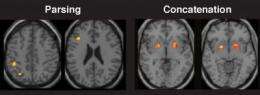
The rhythm is the human brain taking information and processing it in an efficient way, according to Wymbs. "On one level, the brain is going to try to divide up, or parse, long sequences of movement," he said. "This parsing process functions to group or cluster movements in the most efficient way possible."
But it is also in our brain's best interest to assemble single or short strings of movements into longer, integrated sequences so that a complex behavior can be made with as little effort as possible. "The motor system in the brain wants to output movement in the most computational, low-cost way as possible," Wymbs said. "With this integrative process, it's going to try to bind as many individual motor movements into a fluid, uniform movement as it possibly can."
The two processes are at odds with each other, and it's how the brain reconciles this struggle during motor learning that intrigues Wymbs and the study's other authors, including Scott Grafton, professor of psychology and director of the UCSB Brain Imaging Center. "What we are interested in is functional plasticity of the brain –– how the brain changes when we learn actions, or motor sequences as we refer to them in this paper," Wymbs said.
The study was conducted using human subjects in the Magnetic Resonance Imaging (MRI) scanner in the Brain Imaging Center. The experiment involved three days of training with people performing and practicing three separate motor sequences for up to 200 trials each during the collection of functional MRI data. The subjects were all right-handed but they were asked to learn the sequences using the four fingers of their left hands. Participants practiced the sequences during the operation of the MRI scanner by tapping out responses with a button box that looked like a set of piano keys, with long, rectangular buttons.
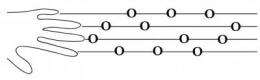
"People would see a static image shown on a video screen that detailed the sequence to be typed out," Wymbs said. "They're lying down inside the scanner and they see this image above their eyes. Interestingly, some people reported that the images looked like something out of (the video game) Guitar Hero, and, indeed, it does look a bit like guitar tablature. They would have to type out the 'notes' from left to right, as you normally would when reading music.
"After practicing a sequence for 200 trials, they would get pretty good at it," Wymbs added. "After awhile, the note patterns become familiar. At the start of the training, it would take someone about four and a half seconds to complete each sequence of 12 button presses. By the end of the experiment, the average participant could produce the same sequence in under three seconds."
The researchers' goal was to look at which areas of the brain support the two-part process of chunking. "We feel that the motor process, or the concatenation process as we refer to it in the paper, tends to take over as you continue to practice and continue to learn the sequences," Wymbs said. "That's the one that's tied to the motor output system –– the thing that's actually accomplishing what we set out to do."
With the experience of repeating a motor sequence, such as typing out a phone number, speaking, typing on a computer, or even texting, it becomes more automatic. "With automaticity comes the recruitment of core motor output regions," Wymbs said.
The scientists discovered that the putamen –– a brain region that is critically important to movement –– supports the concatenation process of motor chunking, with robust connectivity to parts of the brain that are intimately tied to the output of skilled motor behavior. On the other hand, they found that cortical regions in the left hemisphere respond more during the parsing process of motor chunking. "These regions have been linked to the manipulation of motor information, which is something that we probably do more of when we just begin to learn the sequences as chunks," Wymbs said.
"Initially, when you're doing one of these 12-element sequences, you want to pause," Wymbs added. "That would evoke more of the parsing mechanism. But then, over time, as you learn a sequence so that it becomes more automatic, and the concatenation process takes over and it wants to put all of these individual elements into a single fluid behavior."
According to Wymbs, the findings could have implications for the study and diagnosis of Parkinson's and other diseases of the motor system that involve action. "We show here that there are two potentially competing systems that lead to the isolation of different systems that both work to allow us to process things efficiently when we're learning," Wymbs said.


