Receptor may hold key to multiple sclerosis treatment
June 11, 2012 By Krishna Ramanujan in Immunology

Receptor may hold key to multiple sclerosis treatment

Enlarge

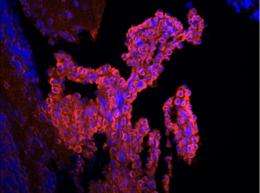
This image shows the A2A adenosine receptor (in red) abundantly expressed in the central nervous system (CNS). The blue color identifies the nuclei of cells in the CNS.

(Medical Xpress) -- A receptor recently discovered to control the movement of immune cells across central nervous system barriers (including the blood-brain barrier) may hold the key to treating multiple sclerosis (MS), a neuroinflammatory disease of the central nervous system.

In MS, immune cells enter the and attack and destroy the surrounding the of in the brain and spinal cord, resulting in blindness, paralysis, incontinence and many more symptoms.

The research, appearing last month online and in print June 1 in the Journal of Immunology, reveals how the A2A adenosine receptor expressed on blood-brain barrier cells acts as a gateway, allowing immune cells to enter the brain, where they can cause havoc in people with MS.

The blood-brain barrier is composed of specialized cells that selectively prevent substances from passing from the into the brain.

"We found that expression of this A2A adenosine receptor is important for regulating the entry of cells into the brain; whereby its activation allows immune cell entry and its blocks entry," said Margaret Bynoe, associate professor of immunology at Cornell's College of Veterinary Medicine and senior author of the paper, which was also selected as a featured publication in the "In This Issue" section of the journal, where the top 10 percent of manuscripts are featured. Jeffrey Mills, a postdoctoral associate in Bynoe's lab, is the paper's lead author.

In this study, the researchers used mice where the A2A adenosine receptor was knocked out and then infused those mice with normal immune cells from wild-type mice expressing the A2A adenosine receptor. This produced chimeric mice expressing the A2A receptor on immune cells, but not on blood-brain barrier cells. Without A2A receptor on blood-brain barrier cells, the normal failed to effectively infiltrate the central nervous system, and thus, these mice were protected and developed less severe symptoms of MS-like disease.

"The absence of the A2A receptor on blood-brain barrier cells is similar to the effect of pharmacologically blocking the receptor with antagonists [drugs], which also protected mice from MS-like disease," Bynoe said.

"The implications of these findings are that, potentially, modulation of this receptor can be beneficial for future treatment of MS," she added.

The study was funded by the National Institutes of Health.

Journal reference: Journal of Immunology search and more info website

Provided by Cornell University search and more info website

5 /5 (2 votes)  

Rank 5 /5 (2 votes)
Relevant PhysicsForums posts

More news stories

Pollen count apps for smartphones are nothing to sneeze at

Kate O'Reilly's spring allergy survival kit includes the usual stuff - nasal sprays, allergy pills and a box of tissues. This season, she's added a new weapon to her line of defense: an app on her smartphone.

Immunology created 17 hours ago | popularity not rated yet | comments 0

Going live: Immune cell activation in multiple sclerosis

Biological processes are generally based on events at the molecular and cellular level. To understand what happens in the course of infections, diseases or normal bodily functions, scientists would need to ...

Immunology created 20 hours ago | popularity 5 / 5 (5) | comments 0 | with audio podcast

Vaccine blackjack: IL-21 critical to fight against viral infections

(Medical Xpress)—Scientists at Emory Vaccine Center have shown that an immune regulatory molecule called IL-21 is needed for long-lasting antibody responses in mice against viral infections.

Immunology created May 23, 2013 | popularity 5 / 5 (2) | comments 0 | with audio podcast

Fast-acting mothers' milk for healthier babies

Human breastmilk responds quickly to protect the child when there is an infection in mothers or babies, according to new international research led by The University of Western Australia.

Immunology created May 23, 2013 | popularity 5 / 5 (1) | comments 0

New immune system discovered

(Medical Xpress)—A research team, led by Jeremy Barr, a biology post-doctoral fellow, unveils a new immune system that protects humans and animals from infection.

Immunology created May 20, 2013 | popularity 4.8 / 5 (29) | comments 9 | with audio podcast


Heart failure accelerates male 'menopause'

Heart failure accelerates the aging process and brings on early andropausal syndrome (AS), according to research presented today at the Heart Failure Congress 2013. AS, also referred to as male 'menopause', was four times ...

First drug to improve heart failure mortality in over a decade

Coenzyme Q10 decreases all cause mortality by half, according to the results of a multicentre randomised double blind trial presented today at Heart Failure 2013 congress. It is the first drug to improve heart failure mortality ...

Feds fight morning-after pill age ruling in NY

(AP)—Department of Justice lawyers have again asked a federal appeals court in New York to delay lifting age restrictions and prescription requirements on an emergency contraceptive popularly known as the morning-after ...

Death highest in heart failure patients admitted in January, on Friday, and overnight

Mortality and length of stay are highest in heart failure patients admitted in January, on Friday, and overnight, according to research presented today at the Heart Failure Congress 2013. The analysis of nearly 1 million ...

Engineered cytomegalovirus protects monkeys from HIV equivalent

(Medical Xpress)—A new study by researchers in the US has shown that an ancient virus can be modified to help in the fight against the simian immunodeficiency virus SIV, which is the equivalent in monkeys ...

Researchers identify first drug targets in childhood genetic tumor disorder

Two mutations central to the development of infantile myofibromatosis (IM)—a disorder characterized by multiple tumors involving the skin, bone, and soft tissue—may provide new therapeutic targets, according to researchers ...