Stem cells can be harvested long after death: study
June 12, 2012 in Medical research
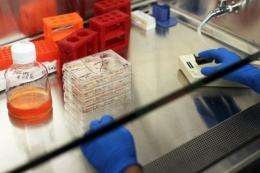
Stem cells are fed at the University of Connecticut's Stem Cell Institute in 2010. Some stem cells can lay dormant for more than two weeks in a dead person and then be revived to divide into new, functioning cells, scientists in France say.
Some stem cells can lay dormant for more than two weeks in a dead person and then be revived to divide into new, functioning cells, scientists in France said Tuesday.
The research, published in the journal Nature Communications, unlocks further knowledge about the versatility of these cells, touted as a future source to replenish damaged tissue.
"Remarkably, skeletal muscle stem cells can survive for 17 days in humans and 16 days in mice, post mortem well beyond the 1-2 days currently thought," they said in a statement.
The stem cells retained their ability to differentiate into perfectly functioning muscle cells, they found.
"This discovery could form the basis of a new source, and more importantly new methods of conservation, for stem cells used to treat a number of pathologies," the statement said.
Stem cells are infant cells that develop into the specialised tissues of the body.
They have sparked great excitement as they offer hopes of rebuilding organs damaged by disease or accident.
The study led by Fabrice Chretien of France's Pasteur Institute found that to survive in adverse conditions, skeletal muscle stem cells lower their metabolism to enter a dormant state, using less energy.
The team then also looked at stem cells taken from bone marrow, where blood cells are produced.
These remained viable for four days after death in lab mice and retained their ability to reconstitute tissue after a bone marrow transplant.
"By harvesting stem cells from the bone marrow of consenting donors post mortem, doctors could address to a certain extent the shortage of tissues and cells," said the statement, issued by the four institutes backing the research.
The investigators sounded a word of caution, though.
The approach was "highly promising", but required more testing and validation before it could be tested in humans.
More information: Skeletal muscle stem cells adopt a dormant cell state post mortem and retain regenerative capacity, Nature Communications, June 12, 2012
Journal reference:
Nature Communications
(c) 2012 AFP
-
Molecule dictates how stem cells travel
Jan 14, 2006 |
not rated yet |
0
-
Exercise boosts health by influencing stem cells to become bone, not fat, researchers find
Sep 01, 2011 |
not rated yet |
0
-
Scientist discovers stem cell 'partnership' that could advance regenerative medicine
Aug 17, 2010 |
not rated yet |
0
-
Dutch researcher develops new method of stem cell culture
May 21, 2010 |
not rated yet |
0
-
Adipose tissue produces cells involved in immune response
Nov 26, 2010 |
not rated yet |
0
-
Motion perception revisited: High Phi effect challenges established motion perception assumptions
Apr 23, 2013 |
3 / 5 (2) |
2
-
Anything you can do I can do better: Neuromolecular foundations of the superiority illusion (Update)
Apr 02, 2013 |
4.5 / 5 (11) |
5
-
The visual system as economist: Neural resource allocation in visual adaptation
Mar 30, 2013 |
5 / 5 (2) |
9
-
Separate lives: Neuronal and organismal lifespans decoupled
Mar 27, 2013 |
4.9 / 5 (8) |
0
-
Sizing things up: The evolutionary neurobiology of scale invariance
Feb 28, 2013 |
4.8 / 5 (10) |
14
-
Pressure-volume curve: Elastic Recoil Pressure don't make sense
May 18, 2013
-
If you became brain-dead, would you want them to pull the plug?
May 17, 2013
-
MRI bill question
May 15, 2013
-
Ratio of Hydrogen of Oxygen in Dessicated Animal Protein
May 13, 2013
-
Alcohol and acetaminophen
May 13, 2013
-
Marie Curie's leukemia
May 13, 2013
- More from Physics Forums - Medical Sciences
More news stories
Study suggests new source of kidneys for transplant
Nearly 20 percent of kidneys that are recovered from deceased donors in the U.S. are refused for transplant due to factors ranging from scarring in small blood vessels of the kidney's filtering units to the organ going too ...
Medical research
4 hours ago |
not rated yet |
0
|
Discovery of circadian clock in mice hair reveals period of time when damage from radiotherapy can be quickly repaired
Discovering that mouse hair has a circadian clock - a 24-hour cycle of growth followed by restorative repair - researchers suspect that hair loss in humans from toxic cancer radiotherapy and chemotherapy ...
Medical research
4 hours ago |
5 / 5 (2) |
1
|
Do salamanders hold the solution to regeneration?
Salamanders' immune systems are key to their remarkable ability to regrow limbs, and could also underpin their ability to regenerate spinal cords, brain tissue and even parts of their hearts, scientists have ...
Medical research
5 hours ago |
5 / 5 (1) |
0
|
New study finds blind people have the potential to use their 'inner bat' to locate objects
New research from the University of Southampton has shown that blind and visually impaired people have the potential to use echolocation, similar to that used by bats and dolphins, to determine the location of an object.
Medical research
8 hours ago |
not rated yet |
1
|
Germ-fighting vaccine system makes great strides in delivery
A novel vaccine study from South Dakota State University (SDSU) will headline the groundbreaking research that will be unveiled at the American Association of Pharmaceutical Scientists' (AAPS) National Biotechnology Conference ...
Medical research
8 hours ago |
not rated yet |
0
The compound in the Mediterranean diet that makes cancer cells 'mortal'
New research suggests that a compound abundant in the Mediterranean diet takes away cancer cells' "superpower" to escape death. By altering a very specific step in gene regulation, this compound essentially re-educates cancer ...
New immune system discovered
(Medical Xpress)—A research team, led by Jeremy Barr, a biology post-doctoral fellow, unveils a new immune system that protects humans and animals from infection.
Practice makes perfect? Not so much
Turns out, that old "practice makes perfect" adage may be overblown. New research led by Michigan State University's Zach Hambrick finds that a copious amount of practice is not enough to explain why people ...
Scientists identify molecular trigger for Alzheimer's disease
Researchers have pinpointed a catalytic trigger for the onset of Alzheimer's disease – when the fundamental structure of a protein molecule changes to cause a chain reaction that leads to the death of neurons ...
Older prostate cancer patients should think twice before undergoing treatment
Older prostate cancer patients with other underlying health conditions should think twice before committing to surgery or radiation therapy for their cancer, according to a multicenter study led by researchers in the UCLA ...
New test better detects elephantiasis worm infection
A new diagnostic test for a worm infection that can lead to severe enlargement and deformities of the legs and genitals is far more sensitive than the currently used test, according to results of a field ...
Jun 12, 2012
Rank: not rated yet
Jun 13, 2012
Rank: not rated yet
Jun 13, 2012
Rank: not rated yet