AIDS conference opens Sunday at key turning point
The world's largest AIDS conference returned to the U.S. on Sunday with a plea against complacency at a time when the epidemic is at a critical turning point. "We can start to end AIDS," one expert said.
There is no cure or vaccine yet, but scientists say they have the tools to finally stem the spread of this intractable virus — largely by using treatment not just to save patients but to make them less infectious, too.
"Future generations are counting on our courage to think big, be bold and seize the opportunity before us," said Dr. Diane Havlir of the University of California, San Francisco, a co-chair of the International AIDS Conference.
The Obama administration calls the goal an AIDS-free generation, and Health and Human Services Secretary Kathleen Sebelius said what was "once a far-off dream, now is in sight."
But the challenge that more than 20,000 scientists, doctors, people living with HIV and policy-makers will grapple with this week is how to make this promising science a practical reality. What combinations of protections work best in different regions, from AIDS-ravaged poor countries to hot spots in developed countries like the U.S.? With HIV increasingly an epidemic of the poor and the marginalized, will countries find the will to invest in the most vulnerable?
And where's the money? The world spent $16.8 billion fighting AIDS in poor countries last year, but that's still $7 billion a year shy of the amount needed to get the 15 million people most in need of treatment on drugs by 2015, the United Nations says. Eight million take them today.
Experts told the conference Sunday that a global recession and fatigue in the AIDS fight threaten those dollars.

"We must resolve together never to go backwards," said Dr. Elly Katabira, president of the International AIDS Society.
Added Havlir, "It would be an extraordinary failure of global will and conscience if financial constraints truncated our ability to end AIDS just when the science has shown us that this goal is achievable."
One key step in stemming HIV's spread is to treat more infected pregnant women so they don't spread the virus to their babies. Some 300,000 children were infected last year, but that number is steadiliy dropping.
UNAIDS chief Michel Sidibe put a face to that investment Sunday, introducing a mother from Nigeria who received U.S.-funded treatment that meant her daughter, now 13, was born without HIV.
"I do not want to be the lucky exception," Florence Uche Ignatius told the crowd.
Added her daughter, Ebube Francis Taylor, "I want all children to be born just like me, free of HIV."
But the hurdles are huge. Some 34.2 million now are living with HIV around the world. The epidemic is worst in developing countries, especially in Africa. Progress has stalled even in the U.S., which has seen about 50,000 new infections every year for a decade. Here, nearly 1.2 million people live with HIV, and one in five doesn't know it. African-Americans are particularly hard-hit, accounting for about half of infections.

Getting medication is a problem for the poor here, too. Sebelius said the Obama administration had released nearly $80 million in grants this week to increase access to treatment, and is trying novel partnerships with community groups to help people stick with the medication daily for life. First up is a pilot program with the MAC AIDS Fund that will send text-message reminders about medication to young people living in the South.
The AIDS conference — remarkable for giving a forum not just to leading scientists but to people who live with HIV — hasn't returned to the U.S. since 1990, in protest of the longtime ban on people with the virus entering the country. The Obama administration lifted the travel ban in 2010, finishing a process begun under the Bush administration. Not lifted was a ban on sex workers and injecting drug users, and protesters briefly interrupted the opening news conference to decry their absence from the meeting.
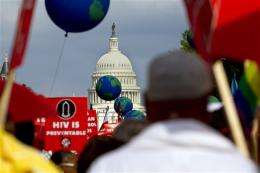
People living with HIV marched through downtown Washington Sunday to urge the public and policy-makers to pay attention to a disease that, in this country, doesn't get much publicity anymore.
"We're everyday people. Anybody and everybody can catch this," said Ann Dixon, who traveled from North Little Rock, Arkansas, to attend the march. She learned she had HIV in 1997.
Copyright 2012 The Associated Press. All rights reserved. This material may not be published, broadcast, rewritten or redistributed.


