Alzheimer's plaques in PET brain scans identify future cognitive decline
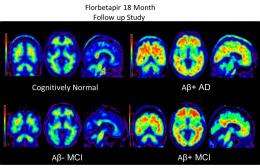
Among patients with mild or no cognitive impairment, brain scans using a new radioactive dye can detect early evidence of Alzheimer's disease that may predict future decline, according to a multi-center study led by researchers at Duke University Medical Center.
The finding is published online July 11, 2012, in the journal Neurology, the medical journal of the American Academy of Neurology. It expands on smaller studies demonstrating that early detection of tell-tale plaques could be a predictive tool to help guide care and treatment decisions for patients with Alzheimer's disease.
"Even at a short follow-up of 18 months we can see how the presence of amyloid plaques affects cognitive function," said P. Murali Doraiswamy, M.D., professor of psychiatry at Duke who co-led the study with R. Edward Coleman, M.D., professor of radiology at Duke . "Most people who come to the doctor with mild impairment really want to know the short-term prognosis and potential long-term effect."
Doraiswamy said such knowledge also has some pitfalls. There is no cure for Alzheimer's disease, which afflicts 5.4 million people in the United States and is the sixth-leading cause of death among U.S. adults. But he said numerous drugs are being investigated, and identifying earlier disease would improve research into their potential benefits and speed new discoveries, while also enhancing care and treatment of current patients.
In the Neurology study, 151 people who had enrolled in a multi-center test of a new radioactive dye called florbetapir (Amyvid) were recruited to participate in a 36-month analysis. Of those participants, 69 had normal cognitive function at the start of the study, 51 had been diagnosed with mild impairment, and 31 had Alzheimer's dementia.
All completed cognitive tests and underwent a brain scan using Positron Emission Tomography, or PET imaging. The technology uses radioactive tracers designed to highlight specific tissue to create a three-dimensional picture of an organ or a biological function.
The dye used in the study, florbetapir, was recently approved by the U.S. Food and Drug Administration for PET imaging of the brain to estimate beta-amyloid plaque density in patients who are being evaluated for cognitive impairment. It binds to the amyloid plaques that characterize Alzheimer's disease, providing a window into the brain to see if the plaques have formed, and how extensively.
Patients in the study were reassessed with additional cognitive exams at 18 months and 36 months. At the 18-month point, patients with mild cognitive impairment who had PET evidence of plaque at the trial's start worsened to a great degree on cognitive tests than patients who had no evidence of plaque at the trial's start. Twenty-nine percent of the plaque-positive patients in this group developed Alzheimer's dementia, compared to 10 percent who started with no plaque.
Cognitively normal patients with a plaque-positive PET scan at the start of the study also showed more mental decline at 18 months compared to those who were negative for plaque.
The study additionally found that people with negative scans reversed from minimally impaired to normal more often than people with positive PET scan, suggesting test anxiety or concentration problems could have affected their initial performance.
"For the most part we have been blind about who would progress and who wouldn't, so this approach is a step toward having a biomarker that predicts risk of decline in people who are experiencing cognitive impairment," Doraiswamy said.
He said the study's results provide initial data that needs to be verified by additional research. Final, 36-month data from the study has been completed and will be presented at the Alzheimer's Association International Conference this week in Vancouver, Canada. Doraiswamy also cautioned that florbetapir is currently not approved to predict the development of dementia or other neurologic conditions and stressed that it should not be used as a screening tool in otherwise normal or minimally impaired people. Likewise, a positive scan is not necessarily diagnostic for Alzheimer's by itself.


