Antibodies reverse type 1 diabetes in new immunotherapy study
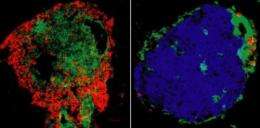
This image shows T cells (red, green) not detected and insulin (blue) readily observed in pancreatic islets of antibody-treated (Right) VS.untreated (Left) diabetic NOD mouse. Credit: Tisch Lab, UNC-Chapel Hill
Scientists at the University of North Carolina School of Medicine have used injections of antibodies to rapidly reverse the onset of Type I diabetes in mice genetically bred to develop the disease. Moreover, just two injections maintained disease remission indefinitely without harming the immune system.
The findings, published online ahead of print (June 29, 2012) in the journal Diabetes, suggest for the first time that using a short course of immunotherapy may someday be of value for reversing the onset of Type I diabetes in recently diagnosed people. This form of diabetes, formerly known as insulin-dependent diabetes mellitus, is an autoimmune disease in which the body's own immune T cells target and destroy insulin-producing beta cells in the pancreas.
The immune system consists of T cells that are required for maintaining immunity against different bacterial and viral pathogens. In people who develop Type 1 diabetes, "autoreactive" T cells that actively destroy beta cells are not kept in check as they are in healthy people.
Senior study author Roland Tisch, PhD, professor of microbiology and immunology at UNC, said a need for effective immunotherapies also exists to treat Type 1 diabetes in people already living with the disease.
"Clinically, there have been some promising results using so-called depleting antibodies in recently diagnosed Type 1 diabetic patients, but the disease process is blocked for only a short period of time," Tisch said. "These antibodies don't discriminate between T cells normally required for maintaining immunity to disease-causing pathogens and the autoreactive T cells. Therefore T cells involved in maintaining normal immune function are also going to be depleted.
"You're getting some efficacy from immunotherapy but its only transient, it doesn't reverse the disease, and there are various complications associated with the use of these depleting antibodies."
Tisch said his UNC lab has been studying the use of certain "non-depleting antibodies." These bind to particular proteins known as CD4 and CD8 expressed by all T cells. Just as the name implies, when these non-depleting antibodies selectively bind to CD4 and CD8 they don't destroy the T cells; the overall numbers of T cells are unaffected.
With this in mind Tisch wanted to determine whether these non-depleting antibodies could have a therapeutic effect in the non-obese diabetic, or NOD mouse, an excellent model for human Type 1 diabetes.
The answer is yes. In some of the recently diagnosed NOD mice, blood sugar levels returned to normal within 48 hours of treatment. Within five days, about 80 percent of the animals had undergone diabetes remission, reversal of clinical diabetes.
"The protective effect is very rapid, and once established, is long-term," he said. "We followed the animals in excess of 400 days after the two antibody treatments, and the majority remained free of diabetes. And although the antibodies are cleared from within the animals in 2-3 weeks after treatment, the protective effect persists." The study showed that beta cells in the NOD mice had been rescued from ongoing autoimmune destruction.
In looking for the mechanism to explain how the therapy worked, the researchers found that the antibodies had a very selective effect on T cells that mediated beta cell destruction. After treatment, "all the T cells that we would normally see in the pancreas or in tissues associated with the pancreas had been purged," said Tisch. This despite the fact that the numbers of T cells found in other tissues and blood were unaffected.
The researchers also found an increase in the numbers of "immune regulatory" T cells. In the healthy individual, these regulatory T cells block autoimmunity, Tisch explained. "They protect us from the autoreactive cells that all of us have. And that's why most of us don't develop autoimmune diseases such as Type 1 diabetes."
"We've demonstrated that the use of non-depleting antibodies is very robust. We're now generating and plan to test antibodies that are specific for the human version of the CD4 and CD8 molecules."
Journal reference:
Diabetes
Provided by
University of North Carolina Health Care
-
Subset of self-destructive immune cells may selectively drive diabetes
Apr 21, 2011 |
not rated yet |
0
-
Connexins: Providing protection to cells destroyed in Type 1 diabetes
Nov 07, 2011 |
not rated yet |
0
-
Researchers prevent mice from developing diabetes
Jun 29, 2012 |
not rated yet |
0
-
Gene therapy reverses type 1 diabetes in mice
Jun 21, 2010 |
not rated yet |
0
-
Cancer and arthritis therapy may be promising treatment for diabetes
Dec 18, 2007 |
not rated yet |
0
-
Motion perception revisited: High Phi effect challenges established motion perception assumptions
Apr 23, 2013 |
3 / 5 (2) |
2
-
Anything you can do I can do better: Neuromolecular foundations of the superiority illusion (Update)
Apr 02, 2013 |
4.5 / 5 (11) |
5
-
The visual system as economist: Neural resource allocation in visual adaptation
Mar 30, 2013 |
5 / 5 (2) |
9
-
Separate lives: Neuronal and organismal lifespans decoupled
Mar 27, 2013 |
4.9 / 5 (8) |
0
-
Sizing things up: The evolutionary neurobiology of scale invariance
Feb 28, 2013 |
4.8 / 5 (10) |
14
-
The Durability of Bone: Long Falls
6 hours ago
-
Is energy convertible to matter?
8 hours ago
-
Rotating electron as a dipole is this right?
10 hours ago
-
Dipole term in multipole expansion
14 hours ago
-
Bubbles in a Pre-Boiling/Boiling pot of water
15 hours ago
-
Assumptions of Griffith's fracture theory
May 21, 2013
- More from Physics Forums - Classical Physics
More news stories
Study shows that women who smoke during pregnancy increase the risk of both obesity and gestational diabetes in their da
Women who smoke during pregnancy increase the risk of both obesity and gestational diabetes, in their daughters, concludes research published in Diabetologia, the journal of the European Association for the Study of Diabet ...
Diabetes
May 20, 2013 |
not rated yet |
0
Rise in type 2 diabetes amongst young
The number of young people diagnosed with type 2 diabetes has seen the sharpest rise over the last twenty years compared to a background of a general increase across the board, new University research has ...
Diabetes
May 20, 2013 |
not rated yet |
0
Research uncovers a potential role of two proteins in diabetes
(Medical Xpress)—Flinders University researchers are breaking new ground in a decade-long journey to pinpoint the function of two closely related proteins.
Diabetes
May 20, 2013 |
5 / 5 (2) |
0
|
Exercise prevents fructose-induced hypertriglyceridemia
(HealthDay)—Moderate aerobic exercise prevents fructose-induced hypertriglyceridemia in healthy males, according to a study published online May 14 in Diabetes.
Diabetes
May 17, 2013 |
5 / 5 (1) |
0
|
DNA variant affects diabetes risk and treatment response
A DNA variant near a digestive enzyme does not only affect risk of developing diabetes but also affects the response to treatment, an international consortium of researchers including the University of Dundee has found.
Diabetes
May 17, 2013 |
not rated yet |
0
|
Phthalates: Study links chemicals widely found in plastics, processed food to elevated blood pressure in children, teens
Plastic additives known as phthalates (pronounced THAL-ates) are odorless, colorless and just about everywhere: They turn up in flooring, plastic cups, beach balls, plastic wrap, intravenous tubing and—according to the ...
If you can remember it, you can remember it wrong
(Medical Xpress)—Native peoples in regions where cameras are uncommon sometimes react with caution when their picture is taken. The fear that something must have been stolen from them to create the photo ...
B vitamins could delay dementia
(Medical Xpress)—Despite spending billions of dollars on research and development, drug companies have been unable to come up with effective treatments for dementia and Alzheimer's Disease (AD). Now, A. ...
Insight into the dazzling impact of insulin in cells
Australian scientists have charted the path of insulin action in cells in precise detail like never before. This provides a comprehensive blueprint for understanding what goes wrong in diabetes.
New sleeping pill poised to hit US markets
An experimental sleeping pill from US drug company Merck is effective at helping people fall and stay asleep, according to reviewers at the US Food and Drug Administration, which could soon approve the new drug.
Reducing caloric intake delays nerve cell loss
Activating an enzyme known to play a role in the anti-aging benefits of calorie restriction delays the loss of brain cells and preserves cognitive function in mice, according to a study published in the May ...
Jul 05, 2012
Rank: not rated yet
http://medicalxpr...ing.html
http://medicalxpr...lls.html
http://medicalxpr...tes.html
Curing diabetes is the holy grail of medicine, along side of cancer, heart disease, etc. These are the highest cost factors in medicine. Diabetes is insidious because it is precursor to many other diseases. Type 1 is vicious because it attacks children.