Hunting for autism's chemical clues
July 5, 2012 in Autism spectrum disorders

Hunting for autism's chemical clues

Enlarge

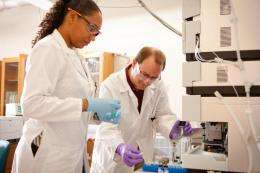
Left to right: Charmion Cruickshank and Troy Wood. Wood, an associate professor of chemistry, heads a study that could one day contribute to the development of a biological test for autism.

On her laptop computer one recent afternoon, University at Buffalo researcher Charmion Cruickshank calls up a mass spectrometry readout showing the breakdown of chemicals in the urine of a child with autism.

She has similar information for nine other children -- four with the disorder and five without -- and she has spent the past few years sifting through this puzzle of data for autism's clues.

The goal of the research, led by UB Troy Wood, is to pinpoint an array of that appear in distinct amounts in the urine of children with autism. If the team is successful, a biological test for diagnosing the disorder -- so far elusive -- could be within reach.

Such a test would provide clinicians with a more objective way of identifying autism, which is currently diagnosed by observing behavior.

"We're trying to understand, at the molecular level, how autism is occurring and manifesting itself," said Wood, an associate professor of chemistry. "A biological test for autism could assist with early , which is critical because if you can identify children with autism early in life, the outcome is going to be better."

Pilot studies in Wood's laboratory have uncovered what may be a number of distinctive chemical traits in the urine of children with autism.

For example, compounds that appeared at depleted levels include the reduced form of glutathione -- a finding that Cruickshank, a UB PhD graduate, outlined in the dissertation she defended this May. Levels of stercobilin, another substance, also seemed abnormally low.

Deficiencies of both of these compounds are an indicator of oxidative stress, which some researchers believe plays a role in autism, Wood said.

To verify these preliminary results, which have not been published in a journal, Wood is hoping to complete a larger, validation study. Such a study would analyze 75 to 100 urine samples from children with autism, and an equal number of urine samples from children in a control group.

Besides stercobilin and reduced glutathione, Wood and his team have also identified a handful of other compounds in the urine that may be correlated with autism. He noted that for a biological test to be reliable, scientists will need to identify not just one or two compounds that are biomarkers for autism, but several.

Cruickshank, now a postdoctoral researcher at National Jewish Health in Denver, Colo., and Zachary Fine, a former UB student who helped process in Wood's lab, said they hoped their work would eventually lead, one day, to real benefits for children with autism. Both researchers have friends who either had the disorder themselves or had family members with autism.

"The hope is to be able to eliminate some of the subjectiveness in diagnosing autism, and to get a better understanding of what's actually causing it," said Fine, who graduated in May with a bachelor of science in chemistry and is now a quality assurance analyst at Johnson & Johnson. "They're saying that more have autism today than before, but it's not clear if that's because they're understanding the disease better, or if people are just diagnosing it more."

The research in Wood's laboratory on biomarkers is conducted, in part, with a Fourier transform ion cyclotron resonance mass spectrometer that was purchased in 2011 using a National Institutes of Health stimulus grant.

Provided by University at Buffalo search and more info website

5 /5 (1 vote)  

Filter


Move the slider to adjust rank threshold, so that you can hide some of the comments.


Display comments: newest first

quicksilver
Jul 06, 2012

Rank: 5 / 5 (1)
Hi

The chemical trail for detecting autism is all powerful.

I find it depressing that after 40 years we still need to hunt for the chemical fingerprint for autism.

I find it depressing that chemicals looked at in 2012 are so simple. Why did we not look decades ago at thes simple entities?

Spending 99.99 per cent of research money on DNA analysis is wasteful in the exptreme.

Past so called top experts in the autism field can be seen finding brain destroying chemicals in all children and explaining this away as evidence that brain destroying chemicals must be good for them.

I find it VERY DISTURBING that this very young researcher into chemical fingerprints has already had to DEFEND her work! WHY?

It is evident to a stone age man that chemicals are the makers of life and will be the precipitators of ILLNESS like autism.

Go for it, WASHINGTON!
BossyBrenda
Aug 19, 2012

Rank: 5 / 5 (1)
Well of course it will be, the brain works chemically, thats a well known fact. However, it says for children, can this also be the same case for finding out if adults have the syndrome? I agree quicksilver, all this should have been looked into a very long time ago, and it has also been known for many many years that boys are more likely to have it than girls, but as of yet have seen nothing new here printed in 2012 about girls that have it and the effects etc. Like anything I suppose it could be a genetic trait, but that could also be argued from what I can see.
Rank 5 /5 (1 vote)
Relevant PhysicsForums posts

More news stories

Enrichment therapy effective among children with autism, study finds

Children with autism showed significant improvement after six months of simple sensory exercises at home using everyday items such as scents, spoons and sponges, according to UC Irvine neurobiologists.

Autism spectrum disorders created May 21, 2013 | popularity 3 / 5 (1) | comments 0 | with audio podcast

Researcher helps give children with autism the chance to communicate

Research by Victoria University PhD education graduand Larah van der Meer highlights the importance of understanding the communication preferences of children with developmental disabilities such as autism.

Autism spectrum disorders created May 14, 2013 | popularity 3.3 / 5 (3) | comments 1

Developers dive in to create a wealth of autism apps

At times, Andy Shih still finds himself overwhelmed by the groundswell of interest in autism applications he's seen in the three years since Apple Inc. released the first iPad.

Autism spectrum disorders created May 09, 2013 | popularity 2 / 5 (1) | comments 0

Enhanced motion perception in autism may point to an underlying cause of the disorder

Children with autism see simple movement twice as quickly as other children their age, and this hypersensitivity to motion may provide clues to a fundamental cause of the developmental disorder, according ...

Autism spectrum disorders created May 08, 2013 | popularity not rated yet | comments 0 | with audio podcast

Autism scientists seek more brains to aid research

(AP)—Autism scientists are seeking more brain samples for research.

Autism spectrum disorders created May 02, 2013 | popularity 5 / 5 (1) | comments 0


Enzyme-activating antibodies revealed as marker for most severe form of rheumatoid arthritis

In a series of lab experiments designed to unravel the workings of a key enzyme widely considered a possible trigger of rheumatoid arthritis, researchers at Johns Hopkins have found that in the most severe ...

Research offers promising new approach to treatment of lung cancer

Researchers have developed a new drug delivery system that allows inhalation of chemotherapeutic drugs to help treat lung cancer, and in laboratory and animal tests it appears to reduce the systemic damage ...

Overeating learned in infancy, study suggests

In the long run, encouraging a baby to finish the last ounce in their bottle might be doing more harm than good.

Study details genes that control whether tumors adapt or die when faced with p53 activating drugs

When turned on, the gene p53 turns off cancer. However, when existing drugs boost p53, only a few tumors die – the rest resist the challenge. A study published in the journal Cell Reports shows how: tumors that live even i ...

Children of married parents less likely to be obese

Children living in households where the parents are married are less likely to be obese, according to new research from Rice University and the University of Houston.

Researchers rewrite obsolete blood-ordering rules

Johns Hopkins researchers have developed new guidelines—the first in more than 35 years—to govern the amount of blood ordered for surgical patients. The recommendations, based on a lengthy study of blood use at The Johns ...