Belgian scientists develop way to detect superparasites
July 19, 2012 in Diseases, Conditions, Syndromes
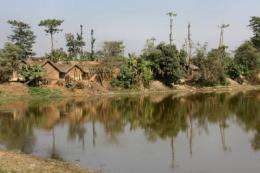
This is a typical village in Siraha district, Nepal, where leishmaniasis (also known as Kala-azar) is observed regularly. Scientists of the Antwerp Institute of Tropical Medicine developed a test for the "super" version of the Leishmania parasite, which is at the same time resistant to the classical drug against it, and more resilient to the human immune system (a biological first). Credit: © ITG
Belgian scientists of the Institute of Tropical Medicine (ITM) in Antwerp, Belgium made a breakthrough in bridging high tech molecular biology research on microbial pathogens and the needs of the poorest of the poor. After sequencing the complete genome of Leishmania donovani (a parasite causing one of the most important tropical diseases after malaria) in hundreds of clinical isolates, they identified a series of mutations specific of 'superparasites' and developed a simple assay that should allow tracking them anywhere. This EU-funded research was done in collaboration with the Wellcome Trust Sanger Institute in UK and clinical partners of the Banaras Hindu University (India) and the BP Koirala Institute of Health Sciences (Nepal); it is published in the last issue of the Journal of Infectious Diseases.
Leishmania is a unicellular parasite that is transmitted through the bite of sandflies and occurs mainly in Latin-America, East-Africa, Asia and countries around the Mediterranean Sea. The parasite causes a disease called leishmaniasis which can range from self-healing cutaneous to deadly visceral disease, depending on the infecting species. Recently, the World Health Organisation estimated up to 1,6 million of new cases of leishmaniasis every year, affecting essentially the poorest of the poor. In comparison to these figures, the hundreds of imported cases reported among travelers appear a drop of water in the ocean. Some of these parasites are more dangerous than others, among them those causing visceral leishmaniasis, a clinical form which is lethal in the absence of treatment.
Recently, the same group of scientists reported among these (already) dangerous microbes, the existence of 'superparasites' in the Indian sub-continent, which are drug resistant and at the same time also better equipped to cope with our immune system. To our knowledge, it is the first time such a doubly armed organism is found in nature. (see "Do our medicines boost pathogens?", 21 dec 2011.) These superparasites could jeopardize current efforts to control this devastating disease.
The European Commission currently supports a series of research projects to develop new drugs against this type of parasites or to protect the few existing ones against the development of resistance (See http://www.leishrisk.net/leishrisk/). In the context of the Kaladrug project, the Belgian scientists of ITM, together with British colleagues of the Wellcome Trust Sanger Institute and Indian and Nepalese clinical colleagues, unraveled the DNA code of Leishmania using state-of-the-art genomic technologies while aiming to discover features allowing to track superparasites. The scientists found a series of mutations that were specific for these drug resistant and more virulent microbes and developed an easy-to-apply assay that would allow to detect them rapidly. "Thanks to the discovery of these mutations, made possible through funding by the European Commission, the spread and emergence of these drug resistant parasites can be more efficiently monitored, contributing to a better and more adequate control of the parasite and the disease it causes." says Dr Manu Vanaerschot (ITM), first author of the paper. "We hope that this finding will ultimately pave the way to a field applicable drug resistance detection device not only for pentavalent antimonials but for all antileishmanial drugs. This is an important breakthrough which will help immensely in the control of the menace of leishmaniasis", says Shyam Sundar, from the Banaras Hindu University, a world authority in clinical research.
Technological revolutions during the last years have allowed a huge effort of sequencing the genome of hundreds of microbes. This type of research provides an unprecedented potential for new solutions to fight these pathogens by revealing their Achilles heal, so to say. These technologies can reveal the microbes true identity, offering new targets for drugs or vaccines and allowing scientists to track them. "Through the application of the latest technologies on precious clinical material to identify easy-to-use markers we strengthen our position among the world top in the field of translational research for infectious diseases and at the same time benefit those, often poor, patients that are usually most neglected in the society", says Prof Dujardin (ITM), coordinator of the Kaladrug project. "This project also clearly highlights the inestimable value of involving local clinical partners in the affected regions. Here, the European Commission plays an important role by funding fundamental research that at the same time provides solutions for clinical or epidemiological challenges."
Journal reference:
Journal of Infectious Diseases
Provided by
Institute of Tropical Medicine Antwerp
-
Do our medicines boost pathogens?
Dec 21, 2011 |
not rated yet |
0
-
Different paths to drug resistance in Leishmania
Oct 27, 2011 |
not rated yet |
0
-
Old drug shows new promise to treat leishmaniasis
Feb 02, 2012 |
not rated yet |
0
-
First vaccine against fatal visceral leishmaniasis enters clinical trial
Feb 23, 2012 |
not rated yet |
0
-
Sandfly saliva provides important clues for new Leishmaniasis treatments
Aug 31, 2011 |
not rated yet |
0
-
Motion perception revisited: High Phi effect challenges established motion perception assumptions
Apr 23, 2013 |
3 / 5 (2) |
2
-
Anything you can do I can do better: Neuromolecular foundations of the superiority illusion (Update)
Apr 02, 2013 |
4.5 / 5 (11) |
5
-
The visual system as economist: Neural resource allocation in visual adaptation
Mar 30, 2013 |
5 / 5 (2) |
9
-
Separate lives: Neuronal and organismal lifespans decoupled
Mar 27, 2013 |
4.9 / 5 (8) |
0
-
Sizing things up: The evolutionary neurobiology of scale invariance
Feb 28, 2013 |
4.8 / 5 (10) |
14
-
Classical and Quantum Mechanics via Lie algebras
Apr 15, 2011
- More from Physics Forums - Independent Research
More news stories
Swine flu pandemic of 2009 more deadly for younger adults, study finds
As the world prepares for what may be the next pandemic strain of influenza virus, in the H7N9 bird flu, a new UC Irvine study reveals that the 2009 H1N1 swine flu pandemic was deadliest for people under the age of 65, while ...
Diseases, Conditions, Syndromes
7 hours ago |
not rated yet |
0
Polio cases found in Kenya and Somalia, WHO says
The World Health Organization says the Horn of Africa is experiencing an outbreak of polio with cases confirmed in Kenya and Somalia.
Diseases, Conditions, Syndromes
8 hours ago |
not rated yet |
0
SARS-like virus claims new life in Saudi
A man who had contracted the coronavirus has died in Saudi Arabia, raising the death toll in the kingdom from the SARS-like virus to 17, the health ministry announced on its website on Wednesday.
Diseases, Conditions, Syndromes
8 hours ago |
not rated yet |
0
Novel approach for influenza vaccination shows promise in early animal testing
A new approach for immunizing against influenza elicited a more potent immune response and broader protection than the currently licensed seasonal influenza vaccines when tested in mice and ferrets. The vaccine ...
Diseases, Conditions, Syndromes
8 hours ago |
not rated yet |
0
|
Mild hypothyroidism raises mortality risk among heart failure patients
Patients with underlying heart failure are more likely to experience adverse outcomes from mild hypothyroidism, according to a recent study accepted for publication in The Endocrine Society's Journal of Clinical Endocrinology & ...
Diseases, Conditions, Syndromes
10 hours ago |
not rated yet |
0
Rate of bicycle-related fatalities significantly lower in states with helmet laws
Existing research shows that bicyclists who wear helmets have an 88 percent lower risk of brain injury, but researchers at Boston Children's Hospital found that simply having bicycle helmet laws in place showed a 20 percent ...
Slowing the aging process—only with antibiotics
Swiss scientists reveal the mechanism responsible for aging hidden deep within mitochondria—and dramatically slow it down in worms by administering antibiotics to the young.
Researchers complete largest genetic sequencing study of human disease
Researchers from Queen Mary, University of London have led the largest sequencing study of human disease to date, investigating the genetic basis of six autoimmune diseases.
Brain can be trained in compassion, study shows
Until now, little was scientifically known about the human potential to cultivate compassion—the emotional state of caring for people who are suffering in a way that motivates altruistic behavior.
Having both migraines, depression may mean smaller brain
(HealthDay)—Migraines and depression can each cause a great deal of suffering, but new research indicates the combination of the two may be linked to something else entirely—a smaller brain.
Calorie information in fast food restaurants used by 40 percent of 9-18 year olds when making food choices
A new study published online today (Thursday) in the Journal of Public Health has found that of young people who visited fast food or chain restaurants in the U.S. in 2010, girls and youth who were obese were more likely ...