Support for cancer patients is just phone call away
July 11, 2012 By Elizabeth Fernandez in Cancer
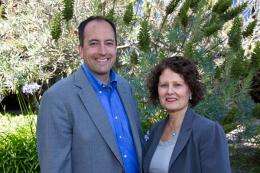
Jeffrey Belkora, PhD, a UCSF faculty member and director of Decision Services with the UCSF Helen Diller Family Comprehensive Cancer Center, and and Margaret Staffer, vice president and program director of the Cancer Support Community/San Francisco Bay Area. Credit: Susan Merrell/UCSF
Cancer patients across the country have a new way to navigate through difficult treatment decisions and communicate better with their doctors. Open to Options, which recently launched nationally, was developed in conjunction with UCSF to guide patients in making critical health decisions.
The project is designed to remedy a generations-old problem by helping patients become more informed and involved in their medical care. Bridging the communications gap between doctors and patients, Open to Options helps patients frame their concerns and formulate a list of questions which are then shared with their oncologists.
Patients often freeze up during appointments with their doctors and forget to ask the questions that have been keeping them awake at night, said Jeffrey Belkora, PhD, a UCSF faculty member and director of Decision Services with the UCSF Helen Diller Family Comprehensive Cancer Center.
In the days after a cancer diagnosis, patients are all too often catapulted into a frightening and bewildering landscape, required to make important medical decisions during a particularly vulnerable point in their lives. Overwhelmed by the complexity of treatment avenues, many patients struggle to even form questions for their doctors.
Open to Options, launched by Cancer Support Community a national, nonprofit network that offers cancer education and support provides professional counselors who help patients develop a concrete set of personalized questions and concerns to be raised with their doctors.
The service was inspired by Belkoras program at UCSF, in which a team of student interns works with patients to help them develop questions for upcoming appointments.
Laura Esserman, MD, MBA, director of the UCSF Carol Franc Buck Breast Care Center, recruited Belkora to form UCSF Decision Services in response to studies showing that cancer patients often feel unprepared to ask questions about their medical treatment, and sometimes face communication barriers that impede their full participation in decisions. By writing a list of questions, patients become better informed and involved, which in turn leads to better psychosocial and in some cases physical outcomes, says Belkora.
The Decision Services program has been touted as a national model of care by the Mayo Clinic Center for Innovation and the U.S. Department of Health and Human Services.
As part of the new project, a checklist developed by Belkora called SCOPED assists patients in developing questions and arriving at decisions. (SCOPED stands for Situation, Choices, Objectives, People, Evaluation, and Decisions). Licensed mental health professionals are being certified in the use of the checklist, and it is being disseminated to hospitals, clinics, and community-based organizations in the United States and United Kingdom.
Without this kind of support, patients may go along with suggested treatments without fully understanding all the ramifications, said Margaret Stauffer, a newly-certified trainer from the Cancer Support Community office in Walnut Creek, California. Its critical for patients to be able to more fully reflect on their options and make informed choices that fully reflect their personal priorities.
The Walnut Creek program helped Stephanie Slade, 63, when she was diagnosed in January with non-Hodgkin lymphoma.
Cancer patients have a lot to wrestle with, said Slade. I hadnt been sick in more than 25 years, and its a scary spot to suddenly be in. This program is a wonderful service it helps you clarify your thoughts as you try to figure out your options. And it gives you peace of mind to know that you are being pro-active and aware of all the possible risks and alternatives when facing a serious illness.
Open to Options is available toll free in English and Spanish at 1-888-793-9355, through select affiliate locations, and by visiting here. Phone consultations are offered in English or Spanish and take up to an hour depending on the number and complexity of questions. The Amgen Foundation is providing financial support.
For more information about UCSF Decision Services please visit here. For information about SCOPED, go here.
Provided by
University of California, San Francisco
-
Ask 3 questions, patients urged
Aug 26, 2011 |
not rated yet |
0
-
Tracking breast cancer over decades to save lives
Sep 30, 2011 |
not rated yet |
0
-
Study shows varying support needs of cancer patients
Jul 01, 2011 |
not rated yet |
0
-
Health, prognosis not taken into account when treating older lung cancer patients, study finds
May 02, 2012 |
not rated yet |
0
-
Study recommends national standards for tobacco use treatment
Apr 17, 2012 |
not rated yet |
0
-
Motion perception revisited: High Phi effect challenges established motion perception assumptions
Apr 23, 2013 |
3 / 5 (2) |
2
-
Anything you can do I can do better: Neuromolecular foundations of the superiority illusion (Update)
Apr 02, 2013 |
4.5 / 5 (11) |
5
-
The visual system as economist: Neural resource allocation in visual adaptation
Mar 30, 2013 |
5 / 5 (2) |
9
-
Separate lives: Neuronal and organismal lifespans decoupled
Mar 27, 2013 |
4.9 / 5 (8) |
0
-
Sizing things up: The evolutionary neurobiology of scale invariance
Feb 28, 2013 |
4.8 / 5 (10) |
14
-
Why is zone 1 in liver more prone to ischemic injury?
May 23, 2013
-
How can there be villous adenoma in colon, if there are no villi there
May 22, 2013
-
How can there be a term called "intestinal metaplasia" of stomach
May 21, 2013
-
Pressure-volume curve: Elastic Recoil Pressure don't make sense
May 18, 2013
-
If you became brain-dead, would you want them to pull the plug?
May 17, 2013
-
MRI bill question
May 15, 2013
- More from Physics Forums - Medical Sciences
More news stories
New fluorescent tools for cancer diagnosis
In recent years, microRNAs (miRNAs) and other non-coding RNAs are small molecules that help control the expression of specific proteins. In recent years they have emerged as disease biomarkers. miRNA profiles have been used ...
Cancer
May 24, 2013 |
not rated yet |
0
Modulating the immune system to combat metastatic cancer
Cancer cells spread and grow by avoiding detection and destruction by the immune system. Stimulation of the immune system can help to eliminate cancer cells; however, there are many factors that cause the immune system to ...
Cancer
May 24, 2013 |
5 / 5 (1) |
0
Scientists put bowel cancer under the microscope
Researchers from London's Kingston University have begun a two-year study which could help prolong the lives of people with colorectal tumours.
Cancer
May 24, 2013 |
5 / 5 (1) |
0
Researcher identifies breast cancer fighting hormone
Transformative research from Western University has identified new hormones in the body which may suppress breast cancer and stimulate the regression of breast tumors.
Cancer
May 24, 2013 |
5 / 5 (2) |
0
Ground breaking cancer research finds immune system link
(Medical Xpress)—Curtin University researchers have found evidence that targeting specific cells in the body can reverse the effects of cancer on the immune system.
Cancer
May 24, 2013 |
5 / 5 (4) |
0
First drug to improve heart failure mortality in over a decade
Coenzyme Q10 decreases all cause mortality by half, according to the results of a multicentre randomised double blind trial presented today at Heart Failure 2013 congress. It is the first drug to improve heart failure mortality ...
Heart failure accelerates male 'menopause'
Heart failure accelerates the aging process and brings on early andropausal syndrome (AS), according to research presented today at the Heart Failure Congress 2013. AS, also referred to as male 'menopause', was four times ...
Seniors more likely to crash when driving with pet, study finds
(HealthDay)—Animals make great companions for senior citizens, but elderly people who always drive with a pet in the car are far more likely to crash than those who never drive with a pet, researchers have ...
New immune system discovered
(Medical Xpress)—A research team, led by Jeremy Barr, a biology post-doctoral fellow, unveils a new immune system that protects humans and animals from infection.
Brain can be trained in compassion, study shows
Until now, little was scientifically known about the human potential to cultivate compassion—the emotional state of caring for people who are suffering in a way that motivates altruistic behavior.
Death highest in heart failure patients admitted in January, on Friday, and overnight
Mortality and length of stay are highest in heart failure patients admitted in January, on Friday, and overnight, according to research presented today at the Heart Failure Congress 2013. The analysis of nearly 1 million ...