A better judge of character with oxytocin nasal spray?
July 30, 2012 in Psychology & Psychiatry

A better judge of character with nasal spray?

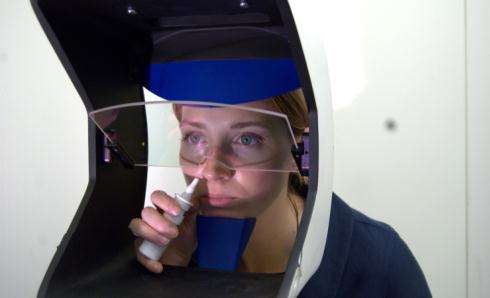
An instrument was used to measure dilation of the pupils and how test subjects focused their gaze while solving tasks on a computer screen in front of them. (Photo: Olga Chelnokova)

(Medical Xpress) -- In other contexts, oxytocin is already well-known as the “bliss hormone”. The hormone is secreted upon stimulation by touch and is known to result in a feeling of calm and physical relaxation. It is also used to induce labour in childbirth and as an aid for women experiencing difficulties in breastfeeding.

Oxytocin has also been referred to as a “mindreading” hormone. Recent research findings show that there may be some truth to these claims – although the mindreading component may have a more down-to-earth explanation.

As part of a research project carried out by Siri Leknes, a research fellow at the Department of Psychology at the University of Oslo, 40 healthy students were administered containing a dose of either saltwater or oxytocin. They were subsequently shown photographs of faces displaying angry, happy or neutral expressions. Some of the photos showed individuals displaying more “hidden” emotional expressions which tend to be picked up at a more subconscious level.

“We found that oxytocin intensified test subjects’ awareness of the emotions present in the photos. Faces expressing anger stood out as angrier and less happy, and correspondingly, faces expressing happiness were happier,” explains Dr Leknes.

“We know that people express feelings in other ways than through facial expression alone, for example, by means of body language and vocalisation. We presume that our findings also apply for these modes of expression,” she adds.
A better judge of character with nasal spray?
Enlarge

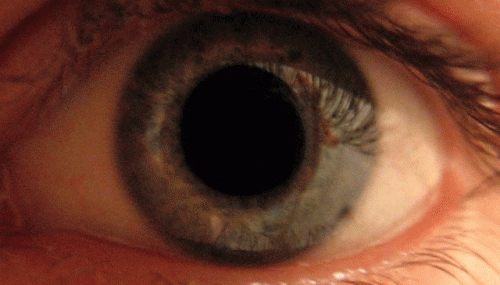
The pupils dilate when we are deep in thought or if we are especially interested in something. People who are innately poorer at interpreting emotions were also those whose pupils became the most dilated. This may indicate that the task required extra effort. (Animation: Bruno Laeng)

There were two rounds to the experiment to ensure that all student subjects were tested using both salt water and oxytocin – without letting them know which dose they would be receiving each time.

“It turns out that those with the lowest aptitude for judging emotional expression properly – that is, those with the poorest scores during the saltwater round – were the ones who showed the greatest improvement using oxytocin. This is really fascinating; the people who need it the most are thus the ones who get the most out of using the hormone,” Dr Leknes points out.

Based on previous research along with her own findings, Dr Leknes believes in oxytocin’s potential as a supplementary treatment for people suffering from mental health disorders or drug-dependency. In fact, nearly all mental health disorders involve a diminished ability to recognise the feelings of others. The same applies for drug abusers.

“Oxytocin will not be a cure-all for mental illness or drug addiction, but it may be of use as a supplementary treatment. It may make individuals better equipped to interpret the signals of others around them, which may improve how they function in social settings,” Dr Leknes explains.

Oxytocin nasal spray is available via prescription and is relatively safe when used as directed. Side effects are extremely rare. According to Dr Leknes, doctors are already allowed to prescribe oxytocin for the treatment of various problems associated with social functionality such as autism.

“In such cases, however, it’s a matter of isolated treatments which are not evaluated as a whole. It is important that we research this to gain greater insight into the effect,” she points out.

Siri Leknes and her colleagues are now hoping to take their efforts a step further and examine how well oxytocin works as a supplementary treatment for drug abusers.

“If it turns out that our assumptions are correct, then we may be able to come up with a simple treatment that would mean a great deal for people who find it difficult to pick up on the social cues of their peers,” says Dr Leknes.

Facts about oxytocin:

  • Referred to as the “bliss hormone” and is produced in brain in the hypothalamus;
  • Is used to help induce labour and to contract the uterus after childbirth, as well as for help in breastfeeding;
  • Plays an important role in the social behaviour of many species, in all likelihood including humans;
  • Animal research has shown that the hormone is vital to establishing stable relationships between mating pairs as well as caring for offspring;
  • Many studies have shown that there is a correlation between oxytocin and the ability to establish lasting relations with others; individuals also exhibit increased trust and reduced fear levels; 
  • Many studies indicate that has a positive effect on autism, both in reducing repetitive behaviour and in improving the patient’s ability to interpret emotions.

Provided by The Research Council of Norway search and more info website

4.2 /5 (6 votes)  

Filter


Move the slider to adjust rank threshold, so that you can hide some of the comments.


Display comments: newest first

JVK
Jul 30, 2012

Rank: 3 / 5 (2)
Missing fact about oxytocin. It's production is controlled by the neuronal system that develops in mammals from its origins in unicellular yeasts beginning at the advent of reproduction. The molecule in yeasts is so similar to one that is conserved across 400 years of vertebrate evolution that it elicits a luteinizing hormone response in mammals, like us. So do the mammalian pheromones, including human pheromones. The molecule in yeast is the alpha-mating pheromone linked to a locus of genes that establish the earliest form of sexual orientation. Missing fact number 2: What does oxytocin do in homosexuals? Is it their "bliss" hormone, too? Is there a model for that? See for example: From fertilization to adult sexual behavior http://www.hawaii...ion.html
PoppaJ
Jul 30, 2012

Rank: 3 / 5 (2)
The idea of a nasal spray that can combat social anxiety and many other diseases is amazing and would benefit a close freind of mine. However this does bring to mind the the episode of Star Trek with Q where the guards sniffed a substance to make them happy just before being executed by there superiors.
JVK
Jul 30, 2012

Rank: 3 / 5 (2)
The effects of oxytocin are unpredictable at the individual level, largely because the response is conditioned to occur via experience that includes many other social variables that begin at birth with sex differences in the response to the pheromones of the mother, who is always female. Males experience an immediate surge of luteinizing hormone and testosterone that alters the development of their response to oxytocin. For all that is known to current neuroscience, social anxiety may result from not being breast fed. That brings up the question of how to best treat it, but if your friend is a heterosexual male, exposure to pheromones from a woman's breasts would probably help make to make him as happy as the guards who sniffed whatever substance they sniffed before their execution.
Rank 4.2 /5 (6 votes)
Related Stories
Relevant PhysicsForums posts

More news stories

Ketamine shows significant therapeutic benefit in people with treatment-resistant depression

Patients with treatment-resistant major depression saw dramatic improvement in their illness after treatment with ketamine, an anesthetic, according to the largest ketamine clinical trial to-date led by researchers from the ...

Psychology & Psychiatry created 23 hours ago | popularity 4.8 / 5 (5) | comments 1 | with audio podcast

US psychiatry gets makeover in new manual

The latest makeover to a massive psychiatric tome honored by some, reviled by others and even called the "Bible" of mental disorders is being released Saturday with a host of new changes.

Psychology & Psychiatry created May 18, 2013 | popularity not rated yet | comments 1

Study reviews readmissions in inpatient psychiatric facilities

(HealthDay)—Most Medicare beneficiaries treated in inpatient psychiatric facilities (IPFs) exhibit characteristics associated with hospital readmission, according to a report prepared for the National Association ...

Psychology & Psychiatry created May 17, 2013 | popularity not rated yet | comments 0

Skydiving is never plane sailing

Skydivers show the same level of physical stress before every jump whether a first-timer or experienced jumper, say Northumbria researchers.

Psychology & Psychiatry created May 17, 2013 | popularity not rated yet | comments 0 | with audio podcast

Kids, especially boys, perceive sadness of depressed parents

Children of depressed parents pick up on their parents' sadness—whether mom or dad realizes their mood or not.

Psychology & Psychiatry created May 17, 2013 | popularity 4.5 / 5 (2) | comments 1 | with audio podcast


New theory on genesis of osteoarthritis comes with successful therapy in mice

Scientists at Johns Hopkins have turned their view of osteoarthritis (OA) inside out. Literally. Instead of seeing the painful degenerative disease as a problem primarily of the cartilage that cushions joints, ...

Computational tool translates complex data into simplified 2-dimensional images

In their quest to learn more about the variability of cells between and within tissues, biomedical scientists have devised tools capable of simultaneously measuring dozens of characteristics of individual ...

Researchers identify a potential new risk for sleep apnea: Asthma

Researchers at the University of Wisconsin have identified a potential new risk factor for obstructive sleep apnea: asthma. Using data from the National Institutes of Health (Heart, Lung, and Blood Institute)-funded Wisconsin ...

Study finds that sleep apnea and Alzheimer's are linked

A new study looking at sleep-disordered breathing (SDB) and markers for Alzheimer's disease (AD) risk in cerebrospinal fluid (CSF) and neuroimaging adds to the growing body of research linking the two.

'Gap' for HIV vaccine efforts after latest setback

The hunt for an HIV vaccine has gobbled up $8 billion in the past decade, and the failure of the most recent efficacy trial has delivered yet another setback to 26 years of efforts.

Ginger compounds may be effective in treating asthma symptoms

Gourmands and foodies everywhere have long recognized ginger as a great way to add a little peppery zing to both sweet and savory dishes; now, a study from researchers at Columbia University shows purified components of the ...