Curettage alone not advised for sacral giant cell tumors
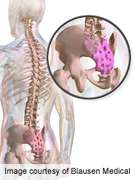
For patients with sacral giant cell tumors, curettage alone is not recommended for surgical management, according to a study published online July 16 in The Spine Journal.
(HealthDay) -- For patients with sacral giant cell tumors (GCTs), curettage alone is not recommended for surgical management, according to a study published online July 16 in The Spine Journal.
To develop an optimal treatment strategy for GCTs, Guodong Li, M.D., from the Tongji University School of Medicine in Shanghai, and colleagues reviewed a case series of 32 patients (18 women and 14 men) with sacral GCTs who underwent surgery between August 1996 and August 2008.
The researchers found that the patients underwent either wide resection, marginal resection, marginal resection plus curettage, or curettage alone (two, 11, 12, and seven patients, respectively). The highest and lowest amount of blood loss was seen for the curettage and wide resection groups, respectively. During a median of 42 months of follow-up, local recurrence was noted in 12 patients, including five of seven in the curettage group. The rate of recurrence was significantly lower in the marginal excision group versus the curettage group (18.2 versus 71.4 percent; P = 0.049). Of all the patients, bladder and bowel dysfunction were seen in five and two patients, respectively, while lower limb dysfunction was noted for four patients who underwent marginal resection. The overall and two-year recurrence-free survival was 93.6 and 84.4 percent, respectively.
"Choosing an optimal surgical margin in the treatment of sacral GCTs is of great importance for local recurrence control and sacral nerve root preservation," the authors conclude. "Curettage alone should not be used to treat sacral GCTs."
More information: Abstract
Full Text (subscription or payment may be required)
Journal reference:
Spine Journal
Copyright © 2012 HealthDay. All rights reserved.
-
Research defines timeframes, factors to deem early stage lung cancer cured
Aug 02, 2010 |
not rated yet |
0
-
Pre-op chemoradiotherapy ups survival in esophageal cancer
May 31, 2012 |
not rated yet |
0
-
Gender, BMI impact bladder perforation during resection
Apr 17, 2012 |
not rated yet |
0
-
Increased investment in thoracic surgical expertise increased UK lung cancer resection rate
Jul 06, 2011 |
not rated yet |
0
-
Preoperative/neoadjuvant therapy in pancreatic cancer
Apr 20, 2010 |
not rated yet |
0
-
Motion perception revisited: High Phi effect challenges established motion perception assumptions
Apr 23, 2013 |
3 / 5 (2) |
2
-
Anything you can do I can do better: Neuromolecular foundations of the superiority illusion (Update)
Apr 02, 2013 |
4.5 / 5 (11) |
5
-
The visual system as economist: Neural resource allocation in visual adaptation
Mar 30, 2013 |
5 / 5 (2) |
9
-
Separate lives: Neuronal and organismal lifespans decoupled
Mar 27, 2013 |
4.9 / 5 (8) |
0
-
Sizing things up: The evolutionary neurobiology of scale invariance
Feb 28, 2013 |
4.8 / 5 (10) |
14
-
Pressure-volume curve: Elastic Recoil Pressure don't make sense
May 18, 2013
-
If you became brain-dead, would you want them to pull the plug?
May 17, 2013
-
MRI bill question
May 15, 2013
-
Ratio of Hydrogen of Oxygen in Dessicated Animal Protein
May 13, 2013
-
Alcohol and acetaminophen
May 13, 2013
-
Marie Curie's leukemia
May 13, 2013
- More from Physics Forums - Medical Sciences
More news stories
Study of young Israelis emphasizes need for avoidance of sun exposure for the very young
A new study conducted using extensive medical records of over one million Israeli adolescents before military service shows clearly how exposure to the Israeli sun of young, light-skinned children increases substantially ...
Cancer
52 minutes ago |
not rated yet |
0
Genetic diversity within tumors predicts outcome in head and neck cancer
A new measure of the heterogeneity – the variety of genetic mutations – of cells within a tumor appears to predict treatment outcomes of patients with the most common type of head and neck cancer. In the May 20 issue ...
Cancer
4 hours ago |
not rated yet |
0
Molecular marker from pancreatic 'juices' helps identify pancreatic cancer
Researchers at Mayo Clinic have developed a promising method to distinguish between pancreatic cancer and chronic pancreatitis—two disorders that are difficult to tell apart. A molecular marker obtained from pancreatic ...
Cancer
5 hours ago |
not rated yet |
0
New smartphone application improves colonoscopy preparation
The use of a smartphone application significantly improves patients' preparation for a colonoscopy, according to new research presented today at Digestive Disease Week (DDW). The preparation process, which begins days in ...
Cancer
May 19, 2013 |
not rated yet |
0
Research examines new methods for managing digestive health
Research presented at Digestive Disease Week (DDW) explores new methods for managing digestive health through diet and lifestyle.
Cancer
May 19, 2013 |
not rated yet |
1
Lymphatic fluid takes detour
When tumours metastasise, they can block lymphatic vessels, as researchers from ETH Zurich have discovered using a new method. The lymphatic fluid subsequently has to find a new path through the tissue. Such ...
Research uncovers a potential role of two proteins in diabetes
(Medical Xpress)—Flinders University researchers are breaking new ground in a decade-long journey to pinpoint the function of two closely related proteins.
Vitamin D could provide new and effective treatments for asthma
(Medical Xpress)—Scientists at King's College London have discovered that Vitamin D has the potential to significantly reduce the symptoms of asthma. The study, led by Professor Catherine Hawrylowicz from ...
Rethinking treatment goals improves results for 'untreatable' anorexics
(Medical Xpress)—Patients with the most severe and dangerous form of chronic anorexia are more likely to make a significant improvement towards recovery and stay in therapy if traditional psychological treatments are re-focused ...
Discovery of novel medicine for treatment of chronic wounds
Every 20 seconds, a limb is lost as a consequence of diabetic foot ulcer that does not heal. To date, medical solutions that can change this situation are very limited. In his doctoral thesis Yue Shen from the Industrial ...
Novel mechanism allows Legionella to hide in body
(Medical Xpress)—The feared Legionella pneumophila is responsible for legionellosis, an infectious disease that can lead to pneumonia. To infect humans, this pathogen has developed a complex method that allows it to camouflage ...