Decoding the secrets of balance

(Medical Xpress) -- New understanding of how the brain processes information from inner ear offers hope for sufferers of vertigo.
If you have ever looked over the edge of a cliff and felt dizzy, you understand the challenges faced by people who suffer from symptoms of vestibular dysfunction such as vertigo and dizziness. There are over 70 million of them in North America. For people with vestibular loss, performing basic daily living activities that we take for granted (e.g. dressing, eating, getting in and out of bed, getting around inside as well as outside the home) becomes difficult since even small head movements are accompanied by dizziness and the risk of falling.
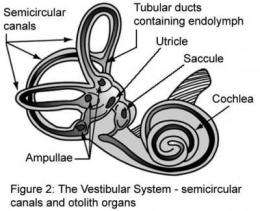
We’ve known for a while that a sensory system in the inner ear (the vestibular system) is responsible for helping us keep our balance by giving us a stable visual field as we move around. And while researchers have already developed a basic understanding of how the brain constructs our perceptions of ourselves in motion, until now no one has understood the crucial step by which the neurons in the brain select the information needed to keep us in balance.
The way that the brain takes in and decodes information sent by neurons in the inner ear is complex. The peripheral vestibular sensory neurons in the inner ear take in the time varying acceleration and velocity stimuli caused by our movement in the outside world (such as those experienced while riding in a car that moves from a stationary position to 50 km per hour). These neurons transmit detailed information about these stimuli to the brain (i.e. information that allows one to reconstruct how these stimuli vary over time) in the form of nerve impulses.
Scientists had previously believed that the brain decoded this information linearly and therefore actually attempted to reconstruct the time course of velocity and acceleration stimuli. But by combining electrophysiological and computational approaches, Kathleen Cullen and Maurice Chacron, two professors in McGill University’s Department of Physiology, have been able to show for the first time that the neurons in the vestibular nuclei in the brain instead decode incoming information nonlinearly as they respond preferentially to unexpected, sudden changes in stimuli.
It is known that representations of the outside world change at each stage in this sensory pathway. For example, in the visual system neurons located closer to the periphery of the sensory system (e.g. ganglion cells in the retina) tend to respond to a wide range of sensory stimuli (a “dense” code), whereas central neurons (e.g. in the primary visual cortex at the back of the head tend to respond much more selectively (a “sparse” code). Chacron and Cullen have discovered that the selective transmission of vestibular information they were able to document for the first time occurs as early as the first synapse in the brain. “We were able to show that the brain has developed this very sophisticated computational strategy to represent sudden changes in movement in order to generate quick accurate responses and maintain balance,” explained Prof. Cullen. “I keep describing it as elegant, because that’s really how it strikes me.”
This kind of selectivity in response is important for everyday life, since it enhances the brain’s perception of sudden changes in body posture. So that if you step off an unseen curb, within milliseconds, your brain has both received the essential information and performed the sophisticated computation needed to help you readjust your position. This discovery is expected to apply to other sensory systems and eventually to the development of better treatments for patients who suffer from vertigo, dizziness, and disorientation during their daily activities. It should also lead to treatments that will help alleviate the symptoms that accompany motion and/or space sickness produced in more challenging environments.
More information: PLoS Biology: www.plosbiology.org/


