Key results coming on 3 drugs against Alzheimer's
We're about to find out if there will be a way any time soon to slow the course of Alzheimer's disease. Results are due within a month or so from key studies of two drugs that aim to clear the sticky plaque gumming up patients' brains.
A pivotal study of a third drug will end later this year, and results from a small, early test of it will be reported next week at an Alzheimer's conference in Canada.
The three treatments are practically the last ones still going in late-stage trials, after more than a decade of failed efforts to develop a drug to halt the mind-robbing disease. Medicines such as Aricept and Namenda just temporarily ease symptoms. There is no known cure.
Experts say that if these three treatments fail, drug companies may pull out of the field in frustration, leaving little hope for the millions of people with the disease. An estimated 35 million people worldwide have dementia, which includes Alzheimer's.
The three treatments being tested are not even drugs in the traditional, chemical sense. They are antibodies — proteins made by the immune system that promote clearance of amyloid, the stuff that forms the plaque.
It's a strategy with a checkered history, and scientists aren't even sure that amyloid causes Alzheimer's or that removing it will do any good in people who already have symptoms. But there are hopeful signs they may be on the right track.
"Everybody in the field is probably holding their breath that there is something positive to come out of these trials," said Dr. Ronald Petersen, director of the Mayo Clinic's Alzheimer's Disease Research Center.
It may not be perfect in terms of improving memory and cognition, but if brain imaging or spinal fluid tests show the drugs are hitting their target, "they will be regarded as successes," he said.
William Thies, scientific director of the Alzheimer's Association, agreed.
Even if there is just a small effect, "that would be a huge finding because that would let you know you had a drug that worked," he said. It then could be tried as a preventive medicine or given earlier in the course of the disease, when it may have more impact.
The three drugs and their developers are:
—Bapineuzumab, by Pfizer Inc. and Johnson & Johnson's Janssen Alzheimer Immunotherapy unit.
—Solanezumab, by Eli Lilly & Co.
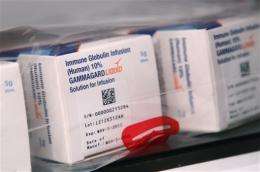
—Gammagard, by Baxter International Inc.
All are given as periodic intravenous infusions; some companies are trying to reformulate them so they could be given as shots. If a major study shows that one of the drugs works, there will be a huge effort to make it more convenient and practical, Thies predicted.
Still, it would probably be very expensive.
The first two on the list are lab-made, single antibodies against amyloid. Gammagard is intravenous immune globulin, or IVIG — multiple, natural antibodies culled from blood. Half a dozen companies already sell IVIG to treat immune system and blood disorders. It takes 130 plasma donations to make enough to treat one patient for a year.
Treating Alzheimer's with IVIG would cost $2,000 to $5,000 every two weeks, depending on the patient's weight, said Dr. Norman Relkin, head of a memory disorders program at New York-Presbyterian Hospital/Weill Cornell Medical Center. He consults for some drugmakers and has patents for tests that measure amyloid.
Relkin is also leading a late-stage, 400-patient study of Gammagard that will wrap up late this year. A much smaller, earlier study he led showed less brain shrinkage among people receiving the drug than among those getting dummy infusions.
"It was so startling that I sent it to two laboratories for independent verification," Relkin said.
Next week, at the Alzheimer's Association International Conference in Canada, Relkin will give a three-year progress report on 16 patients out of the original 24 enrolled in that earlier study.
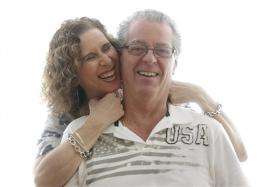
Jason Marder is among them. The New York man, who turned 70 on Tuesday, was diagnosed with Alzheimer's more than eight years ago.
"It was devastating," said his wife, Karin Marder. "I thought, 'Our life is over together as a couple.' But in fact it really has not been, and I have to attribute this really to the clinical trial."
In the roughly five years that her husband has taken Gammagard, there has been decline in his health, but it is minimal and the kind of slowing down you might expect from ordinary aging, she said. "He travels the subways, he does things that you and I do. And our quality of life together is what's most important," she said.
Jason Marder said he takes a creative writing class, runs errands for his wife and bikes around the city. As for his disease, "I fight it as much as I can," he said. "I feel I can handle it."
It's impossible to say how Marder would have fared without the treatment. Some patients decline rapidly, while others not for years. Hard evidence comes from large studies like the one that will conclude later this year, in which a group of patients getting the treatment is compared with a similar group given dummy infusions.
Studies on the two other drugs already have ended, and results are being analyzed. The main outcome is likely to be announced by the companies as soon as it is known, and detailed results are to be presented at scientific conferences in October.
Bapineuzumab is one of the largest bets ever placed in the field of Alzheimer's disease. More than 4,000 patients are participating in four studies around the world — two in people with a gene that raises the risk of Alzheimer's and two in people who don't carry that gene.
The studies, which started enrolling patients in 2007, involve brain scans every few months. "That's enormously expensive and time-consuming," said Dr. Eric Yuen, head of clinical development for Janssen. These experiments are just now yielding results.
Concern rose when an earlier study found possible bleeding or brain abnormalities in up to 10 percent of patients on the drug. However, most had no symptoms and were able to resume treatment after a brief break, Yuen said. In fact, some researchers think these changes might be a sign the drug is working to clear the amyloid plaque.
The fact that independent monitors have not stopped the new studies has made Dr. Reisa Sperling optimistic the drug will prove to be safe. Director of the Alzheimer's center at Brigham and Women's Hospital in Boston, she has consulted for Janssen and Pfizer and enrolled patients in the studies.
Relkin, who is leading the Gammagard study, said that if all three of these drugs fail, "we're in trouble." There hasn't been a new drug even to help symptoms in nine years, he said.
Petersen of the Mayo Clinic agrees.
"If they're dead-flat negative, the impact on the field and the implication for Big Pharma could be huge," he said.
Copyright 2012 The Associated Press. All rights reserved. This material may not be published, broadcast, rewritten or redistributed.


