Exploiting the early immune response in Chikungunya fever promises to provide protection
July 4, 2012 in Immunology

Exploiting the early immune response in Chikungunya fever promises to provide protection

Enlarge

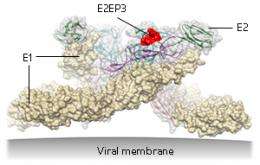
A*STAR researchers have shown that the antibody produced in the initial immune response to CHIKV recognizes the protein E2 and binds to a specific site called E2EP3, seen here in red. This site projects from the surface of the virus, making it easily accessible to the antibody. © 2012 EMBO Molecular Medicine

(Medical Xpress) -- Chikungunya fever is a viral disease that has re-emerged to cause epidemics in the Pacific region within the last decade. It is caused by the Chikungunya virus (CHIKV), which is transmitted by mosquitoes and causes symptoms including fever, rash and joint pain. It can be incapacitating, with some patients developing severe chronic symptoms, and it is sometimes fatal. The main current control measure is to prevent exposure to mosquitoes; a vaccine would reduce the threat of CHIKV.

Lisa Ng of the A*STAR Singapore Network and co-workers have now provided insight into the natural immune response that may help in developing a vaccine. Ng’s group showed previously that the initial to CHIKV is spearheaded by a specific class of antibody that disables the virus when bound to it. Their latest research reveals a way to exploit this clinically.

Working with clinicians at the Tan Tock Seng Hospital, Ng and her team took blood samples from CHIKV-infected patients and tested them to see if they contained any antibodies that recognize proteins from the surface of the virus. They found that at early stages of recovery, patients’ blood contained large amounts of an antibody that targets a protein known as E2, which projects from the surface of CHIKV (see image). The same antibody was found in different groups of patients, showing that it is a reliable indicator of early infection.

The team confirmed that this antibody neutralizes CHIKV by adding blood samples to virus which was then used to infect susceptible human cells. If the blood samples contained the antibody, infection rates were reduced, whereas removing the antibody from the samples beforehand left infection rates high.

Having identified that the antibody recognizes E2, the researchers then tested its ability to recognize fragments of the protein. This allowed identification of the epitope, or the exact site on the protein, that the antibody binds to, which they called E2EP3.

When they vaccinated mice with a protein fragment equivalent to this epitope, the mice produced the same antibody in response. On subsequent infection with CHIKV, the vaccinated mice also showed milder symptoms, making the epitope a promising basis for a future vaccine in humans.

“[This study is] highly relevant for the rational design of CHIKV vaccines and for the development of diagnostics for optimal clinical management of patients,” says Ng. “It may also inspire similar studies with other arthritic arboviruses that in many parts of the world cause severe morbidity with extensive incapacitation.”

More information: Kam, Y-W et al. Early neutralizing IgG response to Chikungunya virus in infected patients targets a dominant linear epitope on the E2 glycoprotein. EMBO Molecular Medicine 4, 1–14 (2012). dx.doi.org/10.1002… mm.201200213

Provided by Agency for Science, Technology and Research (A*STAR), Singapore search and more info website

not rated yet  

Rank not rated yet
Relevant PhysicsForums posts

More news stories

Stem-cell-based strategy boosts immune system in mice

Raising hopes for cell-based therapies, UC San Francisco researchers have created the first functioning human thymus tissue from embryonic stem cells in the laboratory. The researchers showed that, in mice, ...

Immunology created May 16, 2013 | popularity 4.8 / 5 (5) | comments 0 | with audio podcast

Resistance to visceral leishmaniasis: New mechanisms involved

Researchers from CNRS, Université Toulouse III - Paul Sabatier and IRD have elucidated new molecular mechanisms involved in resistance to visceral leishmaniasis, a serious parasitic infection. They have shown that dectin-1 ...

Immunology created May 16, 2013 | popularity not rated yet | comments 0

Women's immune systems remain younger for longer

Women's immune systems age more slowly than men's, suggests research in BioMed Central's open access journal Immunity & Ageing. The slower decline in a woman's immune system may contribute to women living longer than men. ...

Immunology created May 14, 2013 | popularity not rated yet | comments 0

Newly described type of immune cell and T cells share similar path to maturity, according to new study

(Medical Xpress)—Labs around the world, and a core group at Penn, have been studying recently described populations of immune cells called innate lymphoid cells (ILCs). Some researchers liken them to foot soldiers that ...

Immunology created May 14, 2013 | popularity 5 / 5 (3) | comments 0 | with audio podcast

Not all cytokine-producing cells start out the same way, study finds

(Medical Xpress)—Cytokines are molecules produced by immune cells that induce the migration of other cells to sites of infection or injury, promote the production of anti-microbial agents, and signal the production of inflammatory ...

Immunology created May 13, 2013 | popularity 5 / 5 (1) | comments 0 | with audio podcast


New research identifies risks, interventions for children's GI health

An increasing number of U.S. children are experiencing gastrointestinal issues that require interventions to resolve, according to research presented at Digestive Disease Week (DDW).

US psychiatry gets makeover in new manual

The latest makeover to a massive psychiatric tome honored by some, reviled by others and even called the "Bible" of mental disorders is being released Saturday with a host of new changes.

New case of SARS-like virus in Saudi: ministry

A new case of the deadly coronavirus has been detected in Saudi Arabia where 15 people have already died after contracting it, the health ministry announced on Saturday on its Internet website.

AIDS science at 30: 'Cure' now part of lexicon

Big names in medicine are set to give an upbeat assessment of the war on AIDS on Tuesday, 30 years after French researchers identified the virus that causes the disease.

For combat veterans suffering from post-traumatic stress disorder, 'fear circuitry' in the brain never rests

Chronic trauma can inflict lasting damage to brain regions associated with fear and anxiety. Previous imaging studies of people with post-traumatic stress disorder, or PTSD, have shown that these brain regions can over-or ...

New colonoscope provides ground-breaking view of colon

A ground-breaking advance in colonoscopy technology signals the future of colorectal care, according to research presented today at Digestive Disease Week(DDW). Additional research focuses on optimizing the minimal withdrawal ...