US approves 1st rapid, take-home HIV test (Update)
July 3, 2012 by MATTHEW PERRONE in HIV & AIDS

US approves 1st rapid, take-home HIV test

Enlarge

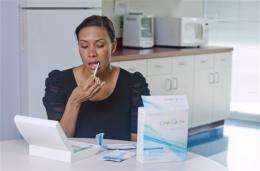
In this undated handout photo provided by Orasure a model demonstrates the OraQuick test, which detects the presence of HIV in saliva collected using a mouth swab. The test is designed to return a result within 20 to 40 minutes. The U.S. Food and Drug Administration approved the first over-the-counter HIV test Tuesday, July 3, 2012, allowing Americans to check themselves for the virus that causes AIDS in the privacy of their homes. (AP Photo/Orasure, Chuck Zovko)

The U.S. Food and Drug Administration has approved the first over-the-counter HIV test, allowing Americans to check themselves for the virus that causes AIDS in the privacy of their homes.

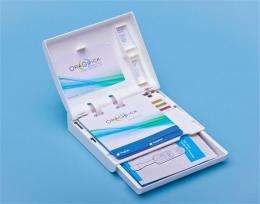
The OraQuick test detects the presence of HIV in saliva collected using a mouth swab. The test is designed to return a result within 20 to 40 minutes.

Government officials estimate one-fifth, or about 240,000 people, of the 1.2 million HIV carriers in the U.S. are not aware they are infected. Testing is one of the chief means of slowing new infections, which have held steady at about 50,000 per year for two decades.

FDA officials said the test is aimed at people who might not otherwise get tested. The company's marketing efforts will focus on populations at greatest risk of being infected, including gay and bisexual men, African Americans and Hispanics.

HIV awareness groups hailed the approval as an important step in expanding testing for the virus.

"This test will allow anyone to empower themselves to know their HIV status when, how and with whom they want to," said Tom Donohue, founding director of Who's Positive.
US approves 1st rapid, take-home HIV test
Enlarge

This undated handout photo provided by Orasure shows the OraQuick test, which detects the presence of HIV in saliva collected using a mouth swab. The test is designed to return a result within 20 to 40 minutes. The U.S. Food and Drug Administration approved the first over-the-counter HIV test Tuesday, July 3, 2012, allowing Americans to check themselves for the virus that causes AIDS in the privacy of their homes. (AP Photo/Orasure, Chuck Zovko)

HIV eventually develops into AIDS, unless treated with antiviral drugs. AIDS causes the body's immune system to break down, leading to infections which become fatal.

The FDA previously approved several HIV test kits designed to be used at home, although those kits — which usually require a blood sample — must be sent to a laboratory to be developed.

FDA stressed in its approval announcement that the test is not 100 percent accurate.

A trial conducted by Orasure showed the home test correctly detected HIV in those carrying the virus only 92 percent of the time. That means the test could miss one person for every 12 HIV-infected people who use the kit.

The test was accurate 99 percent in ruling out HIV in patients not carrying the virus. That means the test would incorrectly identify one patient as having HIV for every 5,000 HIV-negative people tested.

People who test negative should get re-tested after three months because it can take several weeks for detectable antibodies to HIV to appear, according to Dr. Jonathan Mermin, director of the Centers for Disease Control and Prevention's HIV unit.

Orasure has marketed a version of OraQuick to doctors, nurses and other health care practitioners since 2002. When used by professionals, the test is shown to accurately identify both carriers and non-carriers 99 percent of the time.

While it's not clear why the test appears less accurate in consumer trials, company researchers said they expected the test's specificity to drop when used by consumers versus professionals.

Orasure plans to launch the test in October, selling it through retailers like Walgreens, CVS and Walmart, as well as online pharmacies. Whereas the test marketed to health professionals costs about $17.50, Orasure expects the consumer version to sell for more. The company is not announcing a price yet, but said it would be less than $60. CEO Doug Michels said the additional cost will help pay for a toll-free call center to provide counseling and medical referrals to test users.

Shares of Orasure Technologies rose 59 cents, or 5 percent, to $12.09.

Copyright 2012 The Associated Press. All rights reserved. This material may not be published, broadcast, rewritten or redistributed.

not rated yet  

Filter


Move the slider to adjust rank threshold, so that you can hide some of the comments.


Display comments: newest first

concered17
Jul 09, 2012

Rank: not rated yet
"The test was accurate 99 percent in ruling out HIV in patients not carrying the virus. That means the test would incorrectly identify one patient as having HIV for every 5,000 HIV-negative people tested." Whence the 50x increased accuracy?? 1 in 5,000 would mean 99.98% accuracy or not?!
Rank not rated yet
Related Stories
Relevant PhysicsForums posts

More news stories

AIDS science at 30: 'Cure' now part of lexicon

Big names in medicine are set to give an upbeat assessment of the war on AIDS on Tuesday, 30 years after French researchers identified the virus that causes the disease.

HIV & AIDS created 4 hours ago | popularity not rated yet | comments 0

Peer-referral programs can increase HIV-testing in emergency departments

Researchers at the University of Cincinnati (UC) have found that incorporating a peer-referral program for HIV testing into emergency departments can reach new groups of high-risk patients and brings more patients into the ...

HIV & AIDS created 18 hours ago | popularity not rated yet | comments 0

HIV no barrier to getting liver transplant, study finds

(HealthDay)—Liver transplants to treat a common type of liver cancer are a viable option for people infected with HIV, according to new research.

HIV & AIDS created 18 hours ago | popularity not rated yet | comments 0

Twin epidemics: HIV and Hepatitis C in the urban Northeast

A new Yale study looks at the scope and consequences of a burgeoning health problem in the cities of the U.S. Northeast: concurrent infection with both HIV and Hepatitis C (HCV). The study appears online ...

HIV & AIDS created 22 hours ago | popularity not rated yet | comments 0

Russia has 'no anti-AIDS strategy', official says

There is no government strategy to fight the spread of AIDS in Russia, where the number of deaths caused by the disease continues to grow, a senior healthcare official said on Thursday.

HIV & AIDS created May 16, 2013 | popularity not rated yet | comments 0


For combat veterans suffering from post-traumatic stress disorder, 'fear circuitry' in the brain never rests

Chronic trauma can inflict lasting damage to brain regions associated with fear and anxiety. Previous imaging studies of people with post-traumatic stress disorder, or PTSD, have shown that these brain regions can over-or ...

Melon focus headband turns to Kickstarter for rollout plans

(Medical Xpress)—What if the quality of your work depends more on your focus on the piano keys or canvas or laptop than your musical or painting or computing skills? If target users can be convinced, they ...

Temporal processing in the olfactory system

The neural machinery underlying our olfactory sense continues to be an enigma for neuroscience. A recent review in Neuron seeks to expand traditional ideas about how neurons in the olfactory bulb might encode information about ...

Now we know why old scizophrenia medicine works on antibiotics-resistant bacteria

In 2008 researchers from the University of Southern Denmark showed that the drug thioridazine, which has previously been used to treat schizophrenia, is also a powerful weapon against antibiotic-resistant bacteria such as ...

Individuals who drink heavily and smoke may show 'early aging' of the brain

Treatment for alcohol use disorders works best if the patient actively understands and incorporates the interventions provided in the clinic. Multiple factors can influence both the type and degree of neurocognitive abnormalities ...

College women exceed NIAAA drinking guidelines more frequently than college men

In order to avoid harms associated with alcohol consumption, in 2009 the National Institute on Alcohol Abuse and Alcoholism issued guidelines that define low-risk drinking. These guidelines differ for men and women: no more ...