Frankincense as a medicine: Pharmacists clarify the anti-inflammatory impact of boswellic acids
July 9, 2012 in Medical research
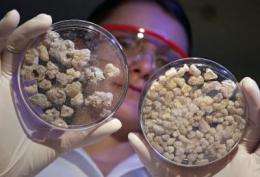
Ph.D. student Olga Scherer from Jena University compares the resin of Boswellia trees from Africa (left) and India. Credit: Photo: Jan-Peter Kasper/FSU
Since the ancient world the aromatic fragrance of burning Boswellia resin has been part of many religious ceremonies. But frankincense can do much more: The resin from the trunk of Boswellia trees contains anti-inflammatory substances. Pharmacists of University Jena were now able to show where exactly the boswellic acids - which are responsible for the impact of the ingredients of the Boswellia resin - actually interfere in the process of inflammation.
It was one of the gifts of the Magi in addition to myrrh and gold they offered frankincense to the newly born baby Jesus. Since the ancient world the aromatic fragrance of burning Boswellia resin has been part of many religious ceremonies and is still used as a means to indicate special festive atmosphere in the church today. But frankincense can do much more: "The resin from the trunk of Boswellia trees contains anti-inflammatory substances," Professor Dr. Oliver Werz of the Friedrich Schiller University Jena (Germany) says. The chair of Pharmaceutical and Medical Chemistry is convinced that these substances can be very beneficial in therapies against diseases like asthma, rheumatoid arthritis or atopic dermatitis.
However, so far the active substances in frankincense cannot at present be found in drugs in German pharmacies, as the pharmacological impact of frankincense hasn't been thoroughly investigated. "Although Boswellia resin has been used for thousands of years in the Ayurvedic medicine for instance, the clinical studies we have so far are not suffice for a license in Germany and Europe," Professor Werz explains.
But that could change. As part of a mutual project with partners of the University Saarbrücken and a start-up company, Professor Werz and his team examined the curative effect of frankincense. In this project the researchers were able to show where exactly the boswellic acids which are responsible for the impact of the ingredients of the Boswellia resin actually interfere in the process of inflammation. "Boswellic acids interact with several different proteins that are part of inflammatory reactions, but most of all with an enzyme which is responsible for the synthesis of prostaglandin E2," Oliver Werz points out. Prostaglandin E2 is one of the mediators of the immune response and plays a decisive role in the process of inflammation, in the development of fever and of pain. "Boswellic acids block this enzyme efficiently and thereby reduce the inflammatory reaction," the Jena pharmacist explains. With this, not only a targeted use in the therapy of inflammatory diseases is conceivable. It can also be expected that boswellic acids have less side effects than today's prevalent anti-inflammatory treatments like diclofenac or indometacin. Their impact is less specific, they can increase the risk of stomach ulcers and can negatively affect renal function.
In their latest study the researchers around Professor Werz additionally compared the resin of different kinds of frankincense in its anti-inflammatory impact. There are more than ten Boswellia species in the world. The most well-known and widely-used one is the Boswellia serrata from Northern and central India. "We were able to show that the resin of the Boswellia papyrifera is ten times more potent," Professor Werz explains a further result of his research. This species mostly occurs in the Northeast of Africa (Ethiopia, Somalia) and on the Arabian Peninsula (Yemen, Oman).
Whether frankincense will become accepted, is indeed not only due to the outcome of the clinical examination which is yet to come. "Boswellic acids exclusively occur in the resin of Boswellia trees and are very difficult to produce synthetically," Werz points out. Therefore these trees are the only source of these promising active ingredients. However Boswellia trees are already an endangered tree species. In many places they are just being used as heating fuel. "Thereby without sustained protection not only plant species are endangered but at the same time medicine loses promising active ingredients," Professor Werz warns.
Provided by
Friedrich Schiller University of Jena
-
Frankincense trees overexploited for Christmas scent
Dec 12, 2006 |
not rated yet |
0
-
Frankincense production 'doomed' warn ecologists
Dec 21, 2011 |
not rated yet |
0
-
A wise man's treatment for arthritis -- frankincense?
Jun 21, 2011 |
not rated yet |
0
-
An age old cure
Jun 02, 2011 |
not rated yet |
0
-
Frankincense oil -- a wise man's remedy for bladder cancer
Mar 18, 2009 |
not rated yet |
0
-
Motion perception revisited: High Phi effect challenges established motion perception assumptions
Apr 23, 2013 |
3 / 5 (2) |
2
-
Anything you can do I can do better: Neuromolecular foundations of the superiority illusion (Update)
Apr 02, 2013 |
4.5 / 5 (11) |
5
-
The visual system as economist: Neural resource allocation in visual adaptation
Mar 30, 2013 |
5 / 5 (2) |
9
-
Separate lives: Neuronal and organismal lifespans decoupled
Mar 27, 2013 |
4.9 / 5 (8) |
0
-
Sizing things up: The evolutionary neurobiology of scale invariance
Feb 28, 2013 |
4.8 / 5 (10) |
14
-
Pressure-volume curve: Elastic Recoil Pressure don't make sense
May 18, 2013
-
If you became brain-dead, would you want them to pull the plug?
May 17, 2013
-
MRI bill question
May 15, 2013
-
Ratio of Hydrogen of Oxygen in Dessicated Animal Protein
May 13, 2013
-
Alcohol and acetaminophen
May 13, 2013
-
Marie Curie's leukemia
May 13, 2013
- More from Physics Forums - Medical Sciences
More news stories
Do salamanders hold the solution to regeneration?
Salamanders' immune systems are key to their remarkable ability to regrow limbs, and could also underpin their ability to regenerate spinal cords, brain tissue and even parts of their hearts, scientists have ...
Medical research
39 minutes ago |
not rated yet |
0
|
New study finds blind people have the potential to use their 'inner bat' to locate objects
New research from the University of Southampton has shown that blind and visually impaired people have the potential to use echolocation, similar to that used by bats and dolphins, to determine the location of an object.
Medical research
3 hours ago |
not rated yet |
1
|
Germ-fighting vaccine system makes great strides in delivery
A novel vaccine study from South Dakota State University (SDSU) will headline the groundbreaking research that will be unveiled at the American Association of Pharmaceutical Scientists' (AAPS) National Biotechnology Conference ...
Medical research
3 hours ago |
not rated yet |
0
Discovery of novel medicine for treatment of chronic wounds
Every 20 seconds, a limb is lost as a consequence of diabetic foot ulcer that does not heal. To date, medical solutions that can change this situation are very limited. In his doctoral thesis Yue Shen from the Industrial ...
Medical research
8 hours ago |
5 / 5 (1) |
0
Lymphatic fluid takes detour
When tumours metastasise, they can block lymphatic vessels, as researchers from ETH Zurich have discovered using a new method. The lymphatic fluid subsequently has to find a new path through the tissue. Such ...
Medical research
8 hours ago |
not rated yet |
0
|
Scientists identify molecular trigger for Alzheimer's disease
Researchers have pinpointed a catalytic trigger for the onset of Alzheimer's disease – when the fundamental structure of a protein molecule changes to cause a chain reaction that leads to the death of neurons ...
Study shows premature birth interrupts vital brain development processes leading to reduced cognitive abilities
Researchers from King's College London have for the first time used a novel form of MRI to identify crucial developmental processes in the brain that are vulnerable to the effects of premature birth. This new study, published ...
Leading explanations for whooping cough's resurgence don't stand up to scrutiny
Whooping cough has exploded in the United States and some other developed countries in recent decades, and many experts suspect ineffective childhood vaccines for the alarming resurgence.
72 percent of pregnant women experience constipation and other bowel problems
Nearly three out of four pregnant women experience constipation, diarrhea or other bowel disorders during their pregnancies, a Loyola University Medical Center study has found.
Neurons that can multitask greatly enhance the brain's computational power, study finds
Over the past few decades, neuroscientists have made much progress in mapping the brain by deciphering the functions of individual neurons that perform very specific tasks, such as recognizing the location ...
Music therapy reduces anxiety, use of sedatives for patients receiving ventilator support
New research suggests that for some hospitalized ICU patients on mechanical ventilators, using headphones to listen to their favorite types of music could lower anxiety and reduce their need for sedative medications.