Sweat glands grown from newly identified stem cells
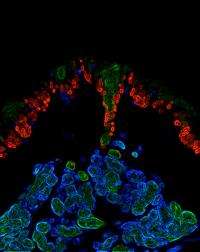
To date, few fundamentals have been known about the most common gland in the body, the sweat glands that are essential to controlling body temperature, allowing humans to live in the world’s diverse climates. Now, in a tour de force, researchers at The Rockefeller University and the Howard Hughes Medical Institute have identified, in mice, the stem cell from which sweat glands initially develop as well as stem cells that regenerate adult sweat glands.
In their study, published in Cell, the scientists devised a strategy to purify and molecularly characterize the different kinds of stem cell populations that make up the complex sweat duct and glands of the skin. With this information in hand, they studied how these different populations of stem cells respond to normal tissue homeostasis and to different types of skin injuries, and how the sweat glands differ from their close cousins, the mammary glands.
“Mammary gland stem cells respond to hormonal induction by greatly expanding glandular tissue to increase milk production,” explains Elaine Fuchs, Rebecca C. Lancefield Professor at Rockefeller and an investigator at the Howard Hughes Medical Institute. “In contrast, during a marathon race, sweat gland stem cells remain largely dormant, and glandular output rather than tissue expansion accounts for the 3 liters of sweat our body needs. These fascinating differences in stem cell activity and tissue production are likely at the root why breast cancers are so frequent, while sweat gland cancers are rare.” Their findings might also help in the future to improve treatments for burn patients and to develop topical treatments for people who sweat too much, or too little.
“For now, the study represents a baby step towards these clinical goals, but a giant leap forward in our understanding of sweat glands,” says the study’s lead author, Catherine P. Lu, a postdoctoral researcher in Fuchs’s Laboratory of Mammalian Cell Biology and Development.
Each human has millions of sweat glands but they have rarely been extensively studied possibly due to the difficulty of gathering enough of the tiny organs to research in a lab, says Lu. The mouse is traditionally used as a model for human sweat gland studies, so in this project, Lu and colleagues laboriously extracted sweat glands from the tiny paw pads of mice the only place they are found in these and most other mammals.
The research team sought to discover whether the different cells that make up the sweat gland and duct contained stem (progenitor) cells, which can help repair damaged adult glands. “We didn’t know if sweat stem cells exist at all, and if they do, where they are and how they behave,” she says. The last major studies on proliferative potential within sweat glands and sweat ducts were conducted in the early 1950s before modern biomedical techniques were used to understand fundamental bioscience.
Fuchs’ team determined that just before birth, the nascent sweat duct forms as a downgrowth from progenitor cells in the epidermis, the same master cells that at different body sites give rise to mammary glands, hair follicles and many other epithelial appendages. As each duct grows deeper into the skin, a sweat gland emerges from its base.
Lu then led the effort to look for stem cells in the adult sweat gland. The gland is made up of two layers an inner layer of luminal cells that produce the sweat and an outer layer of myoepithelial cells that squeeze the duct to discharge the sweat.
Lu devised a strategy to fluorescently tag and sort the different populations of ductal and glandular cells. The Fuchs team then injected each population of purified cells into different body areas of female host recipient mice to see what the cells would do.
Interestingly, when introduced into the mammary fat pads, the sweat gland myoepithelial cells generated fluorescent sweat gland-like structures. “Each fluorescent gland had the proper polarized distribution of myoepithelial and luminal cells, and they also produced sodium potassium channel proteins that are normally expressed in adult sweat glands but not mammary glands,” Lu says.
Intriguingly, when the host mice were put through pregnancy, some of the fluorescent sweat glands began to express milk, while still retaining some sweat gland features as well. Even more surprising was that sweat gland myoepithelial cells produced epidermis when engrafted to the back skin of the mice.
“Taken together, these findings tell us that adult glandular stem cells have certain intrinsic features that enable them to remember who they are in some environments, but adopt new identities in other environments,” Fuchs says. “To test the possible clinical implications of our findings, we would need to determine how long these foreign tissues made by the stem cells will last — unless it is long-term, a short-term “fix” might only be useful as a temporary bandage for regenerative medicine purposes,” Fuchs cautions.
Irrespective of whether the knowledge is yet prime-time for the clinics, the findings can now be used to explore the roots of some genetic disorders that affect sweat glands, as well as ways to potential ways to treat them. “We have just laid down some critical fundamentals of sweat gland and sweat duct biology,” Lu says. “Our study not only illustrates how sweat glands develop and how their cells respond to injury, but also identifies the stem cells within the sweat glands and sweat ducts and begins to explore their potential for making tissues for the first time.”
The study was supported by grants from the Stem Cell Research and Starr Foundation and from the National Institutes of Health. Researchers from the Université Libre de Bruxelles, in Belgium, and from St. Jude Children’s Research Hospital in Tennessee contributed to the study.


