Study looks at why heart attacks cause so much more damage in late pregnancy
July 2, 2012 in Cardiology

UCLA study looks at why heart attacks cause so much more damage in late pregnancy

Enlarge

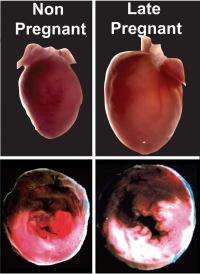
The top panels in the figure show the hearts of a non-pregnant and pregnant rat after a heart attack. The bottom panels show cross sections of the hearts -- note the damaged areas of the hearts that are shown in white are much larger during the late months of pregnancy. Credit: UCLA

Heart attacks during pregnancy are uncommon, but the prevalence of heart disease in pregnant mothers has increased over the past decade as more women delay pregnancy until they are older. These women, who are generally less physically active than their younger peers, tend to have higher cholesterol levels and are at greater risk of heart disease and diabetes.

While research has shown that the heart typically functions better during pregnancy due to a rise in cardiac pumping capacity to meet increased demands, a new UCLA study in rats and mice demonstrates that heart attacks occurring in the last trimester or late months of pregnancy result in worse and more damaged than heart attacks among non-pregnant females.

The research is published in the July edition of the peer-reviewed journal Basic Research in Cardiology.

"This very early study may help us identify and better understand the mechanisms involved in the higher risks of heart disease during pregnancy and may provide new opportunities to better treat pregnant women with and risk factors," said senior study author Dr. Mansoureh Eghbali, an assistant professor of anesthesiology at the David Geffen School of Medicine at UCLA.

For the study, researchers assessed heart differences after heart attacks among late-stage pregnant and non-pregnant animals. They found that the pregnant animals' hearts demonstrated poor , with only 10 percent restoration of heart function, compared with 80 percent restoration among the non-pregnant group. The pregnant animals also had a four-fold increase in damaged heart tissue over the non-pregnant group.

"We observed worse heart function and a greater area of damage in hearts from the group, compared to the non-pregnant group," said first author Dr. Jingyuan Li, a postdoctoral fellow in the department of anesthesiology at the Geffen School of Medicine.

"These findings show that the heart in late pregnancy may be particularly vulnerable to the type of injury caused by a ," Eghbali said.

Surprisingly, one day after giving birth, the formerly pregnant animals' heart function was partially restored; after seven days, their heart function was almost fully restored to the levels of the corresponding non-pregnant state.

Researchers took a closer look to see what mechanisms were behind the heart's inability to effectively recover after such a cardiac event in late pregnancy.

After a heart attack — caused by a lack of blood flow to the heart — the reintroduction of blood to the affected area can sometimes lead to problems, a phenomenon known as reperfusion injury, they said. When the blood hits the oxygen-starved tissue, it can result in a sudden increase in oxygen radicals that cause cell damage.

The research team found that in late pregnancy, several components of this process are especially aggravated, including the dysfunction of mitochondria, which are key cellular sub-units that are involved in cell death, and the reduction of signaling proteins that protect the heart against reperfusion injury.

Eghbali noted that the next stages of research will focus on understanding in more detail why the heart in late pregnancy is at a higher risk for coronary heart disease and will explore interventions and identify promising candidates for drug therapy.

Provided by University of California, Los Angeles search and more info website

not rated yet  

Rank not rated yet
Relevant PhysicsForums posts

More news stories

Heart failure accelerates male 'menopause'

Heart failure accelerates the aging process and brings on early andropausal syndrome (AS), according to research presented today at the Heart Failure Congress 2013. AS, also referred to as male 'menopause', was four times ...

Cardiology created 5 hours ago | popularity not rated yet | comments 1

Death highest in heart failure patients admitted in January, on Friday, and overnight

Mortality and length of stay are highest in heart failure patients admitted in January, on Friday, and overnight, according to research presented today at the Heart Failure Congress 2013. The analysis of nearly 1 million ...

Cardiology created 5 hours ago | popularity not rated yet | comments 0

First drug to improve heart failure mortality in over a decade

Coenzyme Q10 decreases all cause mortality by half, according to the results of a multicentre randomised double blind trial presented today at Heart Failure 2013 congress. It is the first drug to improve heart failure mortality ...

Cardiology created 5 hours ago | popularity 5 / 5 (1) | comments 4

Registry confirms TAVI efficacy and safety in Asian patients

Transcatheter aortic valve implantation (TAVI) is effective and safe in Asian patients, according to early experience based on first results from a multicentre Asian registry reported at EuroPCR 2013.

Cardiology created May 24, 2013 | popularity not rated yet | comments 0

Diagnostic coronary angiography: Functional flow reserve changes decisions in 25 percent of cases

Routinely measuring fractional flow reserve (FFR) using pressure wire assessment during coronary angiography for diagnosis of chest pain leads to significant changes in the management of one in four patients, according to ...

Cardiology created May 24, 2013 | popularity not rated yet | comments 0


Feds fight morning-after pill age ruling in NY

(AP)—Department of Justice lawyers have again asked a federal appeals court in New York to delay lifting age restrictions and prescription requirements on an emergency contraceptive popularly known as the morning-after ...

Researchers identify first drug targets in childhood genetic tumor disorder

Two mutations central to the development of infantile myofibromatosis (IM)—a disorder characterized by multiple tumors involving the skin, bone, and soft tissue—may provide new therapeutic targets, according to researchers ...

Driving and hands-free talking lead to spike in errors, study shows

Talking on a hands-free device while behind the wheel can lead to a sharp increase in errors that could imperil other drivers on the road, according to new research from the University of Alberta.

Comorbidities common with alopecia areata

(HealthDay)—Comorbid conditions often accompany alopecia areata, according to a study published online May 22 in JAMA Dermatology.

Pollen count apps for smartphones are nothing to sneeze at

Kate O'Reilly's spring allergy survival kit includes the usual stuff - nasal sprays, allergy pills and a box of tissues. This season, she's added a new weapon to her line of defense: an app on her smartphone.

Storm chasers: born to be wild?

(HealthDay)—We've all seen them: the surfers who race to the beach when a hurricane hits, the guy who decides to ride out the storm in his overmatched boat, the tornado chasers who fearlessly steer their ...