The key (proteins) to self-renewing skin
July 5, 2012 in Medical research

The key (proteins) to self-renewing skin

Enlarge

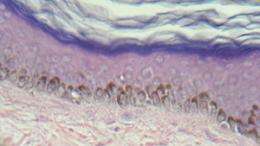
A magnification of the four distinct strata of human skin. At the top is the stratum corneum consisting of several layers of flat, dead, waterproof keratinocytes -- the outer layer of skin cells. Beneath the stratum corneum are the strata granulosum, spinosum and basale. It is in the stratum basale that resident stem cells differentiate to provide new cells and renew the skin. Below the stratum basale is the dermis, a collagen rich tissue that cushions the body. Credit: UC San Diego School of Medicine

In the July 6 issue of Cell Stem Cell, researchers at the University of California, San Diego School of Medicine describe how human epidermal progenitor cells and stem cells control transcription factors to avoid premature differentiation, preserving their ability to produce new skin cells throughout life.

The findings provide new insights into the role and importance of exosomes and their targeted gene transcripts, and may help point the way to or therapies for not just , but other disorders in which stem and progenitor are affected.

Stem cells, of course, are specialized cells capable of endlessly replicating to become any type of cell needed, a process known as differentiation. Progenitor cells are more limited, typically differentiating into a specific type of cell and able to divide only a fixed number of times.

Throughout life, self-renews. Progenitor and deep in the epidermis constantly produce new called keratinocytes that gradually rise to the surface where they will be sloughed off. One of the ways that stem and progenitor cells maintain internal health during their lives is through the exosome – a collection of approximately 11 proteins responsible for degrading and recycling different RNA elements, such as messenger RNA that wear out or that contain errors resulting in the translation of dysfunctional proteins which could potentially be deleterious to the cell.

"In short," said George L. Sen, PhD, assistant professor of medicine and cellular and molecular medicine, "the exosome functions as a surveillance system in cells to regulate the normal turnover of RNAs as well as to destroy RNAs with errors in them."

Sen and colleagues Devendra S. Mistry, PhD, a postdoctoral research fellow, and staff scientist Yifang Chen, MD, PhD, discovered that in the epidermis the exosome functions to target and destroy mRNAs that encode for that induce differentiation. Specifically, they found that the exosome degrades a transcription factor called GRHL3 in epidermal progenitor cells, keeping the latter undifferentiated. Upon receiving differentiation inducing signals, the progenitor cells lose expression of certain subunits of the exosome which leads to higher levels of GRHL3 protein. This increase in GRHL3 levels promotes the of the progenitor cells.

"Without a functioning exosome in progenitor cells," said Sen, "the progenitor cells prematurely differentiate due to increased levels of GRHL3 resulting in loss of epidermal tissue over time."

Sen said the findings could have particular relevance if future research determines that mutations in exosome genes are linked to skin disorders or other diseases. "Recently there was a study showing that recessive mutations in a subunit of the exosome complex can lead to pontocerebellar hypoplasia, a rare neurological disorder characterized by impaired development or atrophy of parts of the brain," said Sen. "This may potentially be due to loss of . Once mutations in exosome complex genes are identified in either skin diseases or other diseases like pontocerebellar hypoplasia, it may be possible to design drugs targeting these defects."

Journal reference: Cell Stem Cell search and more info website

Provided by University of California - San Diego search and more info website

5 /5 (4 votes)  

Rank 5 /5 (4 votes)
Relevant PhysicsForums posts

More news stories

Study reveals new mechanism for estrogen suppression of liver lipid synthesis

By discovering the new mechanism by which estrogen suppresses lipid synthesis in the liver, UC Irvine endocrinologists have revealed a potential new approach toward treating certain liver diseases.

Medical research created 7 hours ago | popularity not rated yet | comments 0 | with audio podcast

MRI-based measurement helps predict vascular disease in the brain

Aortic arch pulse wave velocity, a measure of arterial stiffness, is a strong independent predictor of disease of the vessels that supply blood to the brain, according to a new study published in the June issue the journal ...

Medical research created 7 hours ago | popularity not rated yet | comments 0

Antibiotics: A new understanding of sulfonamide nervous system side effects

Since the discovery of Prontosil in 1932, sulfonamide antibiotics have been used to combat a wide spectrum of bacterial infections, from acne to chlamydia and pneumonia. However, their side effects can include serious neurological ...

Medical research created 9 hours ago | popularity not rated yet | comments 0 | with audio podcast

Scientists discover molecule triggers sensation of itch

Scientists at the National Institutes of Health report they have discovered in mouse studies that a small molecule released in the spinal cord triggers a process that is later experienced in the brain as ...

Medical research created 9 hours ago | popularity 5 / 5 (2) | comments 0 | with audio podcast

Discarded immune cells induce the relocation of stem cells

Spanish researchers have discovered that the daily clearance of neutrophils from the body stimulates the release of hematopoietic stem cells from the bone marrow into the bloodstream, according to a report published today ...

Medical research created 10 hours ago | popularity 5 / 5 (2) | comments 0


Controlling mood through the motions of mitochondria

(Medical Xpress)—Regulating the distribution of power in neurons is done by a system that makes the national electric grid look simple by comparison. Each neuron has several thousand mitochondria confined ...

Multiple research teams unable to confirm high-profile Alzheimer's study

Teams of highly respected Alzheimer's researchers failed to replicate what appeared to be breakthrough results for the treatment of this brain disease when they were published last year in the journal Science.

Motion quotient: IQ predicted by ability to filter motion (w/ video)

A brief visual task can predict IQ, according to a new study. This surprisingly simple exercise measures the brain's unconscious ability to filter out visual movement. The study shows that individuals whose ...

Researchers find common childhood asthma unconnected to allergens or inflammation

Little is known about why asthma develops, how it constricts the airway or why response to treatments varies between patients. Now, a team of researchers at Weill Cornell Medical College, Columbia University Medical Center ...

Diabetes' genetic underpinnings can vary based on ethnic background, studies say

Ethnic background plays a surprisingly large role in how diabetes develops on a cellular level, according to two new studies led by researchers at the Stanford University School of Medicine.

When oxygen is short, EGFR prevents maturation of cancer-fighting miRNAs

Even while being dragged to its destruction inside a cell, a cancer-promoting growth factor receptor fires away, sending signals that thwart the development of tumor-suppressing microRNAs (miRNAs) before it's dissolved, researchers ...