Researchers find a link between age related memory loss and a specific enzyme in mice
July 2, 2012
by Bob Yirka
in Neuroscience
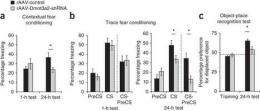
Reducing hippocampal Dnmt3a2 levels in young adult mice impairs memory formation. Image (c) Nature Neuroscience (2012) doi:10.1038/nn.3151
(Medical Xpress) -- A team of researchers working out of the Interdisciplinary Centre for Neurosciences at the University of Heidelberg have found that older mice that had levels of the enzyme DNA methyltransferase (Dnmt3a2) increased in their brains regained the memory abilities of younger mice. They also found, as they describe in their paper published in the journal Nature Neuroscience, that young mice that had their levels of Dnmt3a2 reduced lost their memory abilities similar to those of aging mice.
To come to these conclusions, the team, made up of members, Ana Oliveira, Thekla Hemstedt and Hilmar Bading, injected a virus that contains an extra gene responsible for the creation of Dnmt3a2, directly into the hippocampus of several mice that were already showing signs of diminished memory abilities due to normal aging. Subsequent testing showed the older mice were then able to perform memory tests as well as younger mice.
To test the memory of the mice, the team gave each mouse a new object to investigate for a period of time, then took it away. The next day they gave the same mouse the new object, and also another different kind of object. Prior tests had shown that younger mice will immediately begin checking out the newer object, while older mice will spend equal amounts of time investigating both objects, having apparently forgotten theyd already investigated one of them the day before. Once injected, the older mice spent most of their time checking out the new object, indicating that an increase of the enzyme had caused their memory faculties to resort back to what it was before they grew old. The team also performed an identical experiment except for that the virus introduced caused just half as much of an increase in the enzyme and found that the smaller increase didnt change memory abilities at all, indicating that there must be some sort of threshold.
And just to make sure it was the levels of Dnmt3a2 found in the hippocampus that were causing the changes in memory abilities, the team used a similar technique to cause the levels to drop in a group of younger mice and found their memory abilities diminished in ways similar to natural aging.
Unfortunately, because of differences in physiology, there is no way to try the same experiment on human beings, but the researchers are looking into other ways to change the levels of Dnmt3a2 for people to see if it might produce the same sort of results. In the meantime, the team suggests that people exercise their brains and bodies because doing so tends to increase levels of Dnmt3a2 naturally.
More information: Rescue of aging-associated decline in Dnmt3a2 expression restores cognitive abilities, Nature Neuroscience (2012) doi:10.1038/nn.3151
Abstract
Cognitive abilities decline in normal aging, yet the underlying molecular mechanisms are poorly understood. We found that aging was associated with a decrease in the expression of the DNA methyltransferase Dnmt3a2 in the hippocampus and that rescuing Dnmt3a2 levels restored cognitive functions. Moreover, we found that Dnmt3a2 is an activity-regulated
Journal reference:
Nature Neuroscience
© 2012 Medical Xpress
-
Finding the roots of memory impairment from sleep deprivation
Jun 10, 2011 |
not rated yet |
0
-
Researchers induce PTSD symptoms in mice
Feb 24, 2012 |
not rated yet |
0
-
Roots of memory impairment, resulting from sleep deprivation, identified
May 17, 2011 |
not rated yet |
0
-
Stem cells can improve memory after brain injury
Oct 31, 2007 |
not rated yet |
0
-
A link between obesity and memory?
Jun 14, 2006 |
not rated yet |
0
-
Motion perception revisited: High Phi effect challenges established motion perception assumptions
Apr 23, 2013 |
3 / 5 (2) |
2
-
Anything you can do I can do better: Neuromolecular foundations of the superiority illusion (Update)
Apr 02, 2013 |
4.5 / 5 (11) |
5
-
The visual system as economist: Neural resource allocation in visual adaptation
Mar 30, 2013 |
5 / 5 (2) |
9
-
Separate lives: Neuronal and organismal lifespans decoupled
Mar 27, 2013 |
4.9 / 5 (8) |
0
-
Sizing things up: The evolutionary neurobiology of scale invariance
Feb 28, 2013 |
4.8 / 5 (10) |
14
-
Why is zone 1 in liver more prone to ischemic injury?
18 hours ago
-
How can there be villous adenoma in colon, if there are no villi there
May 22, 2013
-
How can there be a term called "intestinal metaplasia" of stomach
May 21, 2013
-
Pressure-volume curve: Elastic Recoil Pressure don't make sense
May 18, 2013
-
If you became brain-dead, would you want them to pull the plug?
May 17, 2013
-
MRI bill question
May 15, 2013
- More from Physics Forums - Medical Sciences
More news stories
Controlling mood through the motions of mitochondria
(Medical Xpress)—Regulating the distribution of power in neurons is done by a system that makes the national electric grid look simple by comparison. Each neuron has several thousand mitochondria confined ...
Neuroscience
4 hours ago |
4.8 / 5 (5) |
0
|
Brain uses internal 'average voice' prototype to identify who is talking
(Medical Xpress)—The human brain is able to identify individuals' voices by comparing them against an internal 'average voice' prototype, according to neuroscientists.
Neuroscience
8 hours ago |
1 / 5 (1) |
0
|
Depression common among children with temporal lobe epilepsy
A new study determined that children and adolescents with seizures involving the temporal lobe are likely to have clinically significant behavioral problems and psychiatric illness, especially depression. Findings published ...
Neuroscience
8 hours ago |
not rated yet |
0
The secret lives, and deaths, of neurons
As the human body fine-tunes its neurological wiring, nerve cells often must fix a faulty connection by amputating an axon—the "business end" of the neuron that sends electrical impulses to tissues or other ...
Neuroscience
10 hours ago |
5 / 5 (2) |
0
|
Regenerating spinal cord fibers may be treatment for stroke-related disabilities
A study by researchers at Henry Ford Hospital found "substantial evidence" that a regenerative process involving damaged nerve fibers in the spinal cord could hold the key to better functional recovery by most stroke victims.
Neuroscience
10 hours ago |
not rated yet |
0
|
Multiple research teams unable to confirm high-profile Alzheimer's study
Teams of highly respected Alzheimer's researchers failed to replicate what appeared to be breakthrough results for the treatment of this brain disease when they were published last year in the journal Science.
Scientists discover molecule triggers sensation of itch
Scientists at the National Institutes of Health report they have discovered in mouse studies that a small molecule released in the spinal cord triggers a process that is later experienced in the brain as ...
Motion quotient: IQ predicted by ability to filter motion (w/ video)
A brief visual task can predict IQ, according to a new study. This surprisingly simple exercise measures the brain's unconscious ability to filter out visual movement. The study shows that individuals whose ...
Researchers find common childhood asthma unconnected to allergens or inflammation
Little is known about why asthma develops, how it constricts the airway or why response to treatments varies between patients. Now, a team of researchers at Weill Cornell Medical College, Columbia University Medical Center ...
Diabetes' genetic underpinnings can vary based on ethnic background, studies say
Ethnic background plays a surprisingly large role in how diabetes develops on a cellular level, according to two new studies led by researchers at the Stanford University School of Medicine.
When oxygen is short, EGFR prevents maturation of cancer-fighting miRNAs
Even while being dragged to its destruction inside a cell, a cancer-promoting growth factor receptor fires away, sending signals that thwart the development of tumor-suppressing microRNAs (miRNAs) before it's dissolved, researchers ...
Jul 02, 2012
Rank: not rated yet
Maybe this explains the swift drop in American and British Intelligence corresponding to Conservative Rats being found in the houses of British and American government.
Wedding Gown designer launches school for British teens but finds that most are illiterate.
http://www.dailym...zVMNWMEC