Micronutrient powder effective in combating anaemia: study
July 18, 2012 in Pediatrics

Micronutrient powder effective in combating anaemia

Enlarge

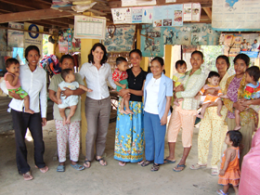
Dr. Susan Jack with some of the study children and their mothers in a Cambodian village.

(Medical Xpress) -- Mixing micronutrient powder into infants’ complementary food reduces rates of anaemia beyond what nutrition education alone can achieve, according to University of Otago-led research involving more than 3000 Cambodian under two year olds.

Otago and Cambodian researchers conducted a randomised trial of the effectiveness of “Sprinkles” in reducing anaemia and iron deficiencies among 3112 six-month-old infants in rural Cambodia. Sprinkles are sachets containing a blend of iron and other micronutrients in powder form and are easily mixed into home-prepared foods.

The findings are newly published online in the journal Archives of Pediatrics & Adolescent Medicine.

Study lead author Dr. Susan Jack says that iron deficiency anaemia in infants is a global health problem affecting both developed and developing countries, but has its greatest impact in poorer parts of the world.

“Anaemia represents a major public health concern as it can cause cognitive and learning difficulties and is associated with increased mortality,” says Dr. Jack, who is a PhD student in the University of Otago’s Centre for International Health.

In Cambodia it is estimated that 55% of children younger than five are anaemic and 40% have stunted growth, she says.

Infants in the study were divided into a control and intervention group. Both groups’ caregivers received education about the importance of continued breastfeeding and good complementary feeding, but the intervention group’s caregivers were also given Sprinkles to use in daily feeding for six months.

Compared to the control group, after 12 months the prevalence of any anaemia in the Sprinkles group was reduced by 20% and moderate anaemia by 27%. After 12 and 18 months, iron deficiency prevalence—a risk factor for developing anaemia—was reduced by 24% and 12% respectively in the Sprinkles group.

“This study provides clear evidence supporting the roll-out of Sprinkles as a micronutrient intervention in Cambodia and similar settings. Our findings also help build the case for Sprinkles to be used until at least 18 months of age, and preferably to age two, so that this period of greatest vulnerability to anaemia and iron deficiency can be fully covered,” says Dr. Jack.

The researchers plan to continue conducting surveys to monitor the effectiveness of Sprinkles in reducing as the intervention is rolled-out through more of the country’s provinces.

More information: Effect of Micronutrient Sprinkles on Reducing Anemia: A Cluster-Randomized Effectiveness Trial. Susan J. Jack, et al. doi:10.1001/archpediatrics.2012.1003

Journal reference: JAMA Pediatrics search and more info website

Provided by University of Otago search and more info website

not rated yet  

Rank not rated yet
Relevant PhysicsForums posts

More news stories

Rate of bicycle-related fatalities significantly lower in states with helmet laws

Existing research shows that bicyclists who wear helmets have an 88 percent lower risk of brain injury, but researchers at Boston Children's Hospital found that simply having bicycle helmet laws in place showed a 20 percent ...

Pediatrics created May 23, 2013 | popularity not rated yet | comments 0

More kids getting donor organs, but gaps persist, study finds

(HealthDay)—Over the last decade, the number of American children who die each year awaiting an organ donation dropped by more than half, new research reveals. And increasing numbers of children are receiving ...

Pediatrics created May 22, 2013 | popularity not rated yet | comments 0

Phthalates: Study links chemicals widely found in plastics, processed food to elevated blood pressure in children, teens

Plastic additives known as phthalates (pronounced THAL-ates) are odorless, colorless and just about everywhere: They turn up in flooring, plastic cups, beach balls, plastic wrap, intravenous tubing and—according to the ...

Pediatrics created May 22, 2013 | popularity not rated yet | comments 1 | with audio podcast

Less sleep associated with increased risk of crashes for young drivers

A study by Alexandra L. C. Martiniuk, M.Sc, Ph.D., of The George Institute for Global Health, Sydney, Australia, and colleagues suggests less sleep per night is associated with a significant increase in the risk for motor ...

Pediatrics created May 20, 2013 | popularity not rated yet | comments 0

Whole-cell vaccine was more effective than acellular vaccine during CA pertussis outbreak

Whole-cell pertussis vaccines were more effective at protecting against pertussis than acellular pertussis vaccines during a large recent outbreak, according to a new Kaiser Permanente study published in Pediatrics.

Pediatrics created May 20, 2013 | popularity not rated yet | comments 0 | with audio podcast


Heart failure accelerates male 'menopause'

Heart failure accelerates the aging process and brings on early andropausal syndrome (AS), according to research presented today at the Heart Failure Congress 2013. AS, also referred to as male 'menopause', was four times ...

First drug to improve heart failure mortality in over a decade

Coenzyme Q10 decreases all cause mortality by half, according to the results of a multicentre randomised double blind trial presented today at Heart Failure 2013 congress. It is the first drug to improve heart failure mortality ...

Feds fight morning-after pill age ruling in NY

(AP)—Department of Justice lawyers have again asked a federal appeals court in New York to delay lifting age restrictions and prescription requirements on an emergency contraceptive popularly known as the morning-after ...

Death highest in heart failure patients admitted in January, on Friday, and overnight

Mortality and length of stay are highest in heart failure patients admitted in January, on Friday, and overnight, according to research presented today at the Heart Failure Congress 2013. The analysis of nearly 1 million ...

Engineered cytomegalovirus protects monkeys from HIV equivalent

(Medical Xpress)—A new study by researchers in the US has shown that an ancient virus can be modified to help in the fight against the simian immunodeficiency virus SIV, which is the equivalent in monkeys ...

Researchers identify first drug targets in childhood genetic tumor disorder

Two mutations central to the development of infantile myofibromatosis (IM)—a disorder characterized by multiple tumors involving the skin, bone, and soft tissue—may provide new therapeutic targets, according to researchers ...