Newly discovered scaffold supports turning pain off
(Medical Xpress) -- Johns Hopkins scientists have discovered a "scaffolding" protein that holds together multiple elements in a complex system responsible for regulating pain, mental illnesses and other complex neurological problems.
The finding, published in the May 6 issue of Nature Neuroscience, could give researchers a new target for drugs to treat these often-intractable conditions.
The discovery, detailed in a study led by neuroscience professor Paul Worley, M.D., of the Johns Hopkins University School of Medicine, focuses on a family of proteins called group 1 metabotropic glutamate receptors (mGluRs) that lie on the surfaces of nerve cells. When these receptors lock in glutamate, a chemical that neurons use to communicate, it encourages neurons to fire.
Without a way to turn off these receptors, neurons would remain active indefinitely, keeping pain and other responses going long after they're useful. Previous research suggested that these mGluRs need to bind to another protein called Homer to shut down, and that this binding is stronger after other molecules called protein kinases modify the receptors. However, Worley explains, thus far it's been unclear exactly how all these different players come together.
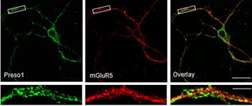
Seeking the mechanism behind this phenomenon, Worley and his colleagues started with a series of experiments to see what other proteins the mGluRs and Homer were binding with in rat brains. Their search turned up a third protein called Preso1, which bound to both mGluRs and Homer. A search in genetic databases shows that the gene responsible for making Preso1 is present in animals ranging from fruit flies to people, highlighting its importance in a wide variety of creatures.
To figure out what Preso1 does, the researchers performed another series of experiments to examine behavior of neurons that produced both mGluRs and Homer. They found that when these neurons also expressed Preso1, the mGluRs bound Homer more efficiently, suggesting that Preso1 might somehow increase modification by protein kinases.
Worley's team received another clue when they found that protein kinases also bind to Preso1.
Genetically modifying mice so that they don't make any Preso1, the researchers found that binding between mGluRs and Homer in these animals' neurons was greatly reduced compared to normal mice.
Additionally, when the researchers injected the modified mice with a chemical that causes pain and inflammation, the animals had a significantly greater and longer-lasting response compared to regular mice. A final experiment showed that neurons taken from the modified animals were significantly more responsive to the neurotransmitter glutamate. When the researchers added Preso1 to the cell cultures, this increased activity disappeared, suggesting that Preso1 is pivotal for mGluRs to signal properly.
Taken together, Worley explains, the findings suggest that Preso1 appears to gather all the important elements in this system -- Homer, protein kinases and mGluRs -- bringing them all together to coordinate the activation and deactivation of the mGluRs.
With Preso1 so pivotal for regulating group 1 mGluR activity, it could prove a useful new target for drugs to treat a variety of health problems in which these receptors are thought to play a role, including chronic pain, schizophrenia, Alzheimer's disease, and fragile X syndrome, Worley says.
"Because mGluRs play so many important roles in the brain for so many different mental and neurological health conditions, knowledge of their regulatory mechanisms is extremely important. But we really don't know how they work in great detail," he says. "You need to know all the players before you can understand the system. Here, we've identified an important player that no one had previously known had existed. Preso1 and Homer appear essential for desensitization of mGluR signaling, much like beta-adrenergic receptor kinase and arrestin are important for desensitization of adrenergic and opiate receptors."


