Non-slip tracheal implants
July 3, 2012 in Medical research
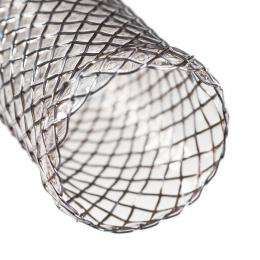
If a persons windpipe is constricted, an operation in which the surgeon inserts a stent to enlarge the trachea is often the only way to relieve their respiratory distress. But this grid-like implant can slip out of position, closing off the windpipe altogether. Researchers are working on a special surface coating for the stents to keep them in place.
When coronary blood vessels are constricted, cardiologists try to prevent a heart attack by widening them with small grid-like implants called stents, which stabilize the veins and arteries, improve the flow of blood and prevent vascular obliteration. A lesser known fact is that stents can be used to treat pathological constriction of the windpipe. This kind of respiratory stenosis, which may be caused by tumors, chronic infections or congenital deformities, can be life-threatening. The metal or plastic stents are designed to enlarge the trachea and prevent it from closing up altogether.
But complications can arise when the implants are inserted. Firstly, there is the danger that the stents will shift, thus partially or completely obstructing the respiratory tract. Secondly, bacteria can colonize the stents and trigger pneumonia. The reason for this is that the stents have no barrier-forming cells of the kind usually present in the respiratory system, whose task is to fend off bacteria and inhaled substances such as particulate. The windpipe has an important barrier function, with goblet and cilia cells purifying the inhaled air. It is very important that cells like these can adhere to the stents so as to maintain the air-purifying effect of the damaged section of the windpipe and to promote incorporation of the stents in the surrounding tracheal tissue, says Dr. Martina Hampel, a scientist at the Fraunhofer Institute for Interfacial Engineering and Biotechnology IGB in Stuttgart. Together with Prof. Dr. Thorsten Walles, head of the department of thoracic surgery at the University Hospital of Würzburg and a visiting scientist at the IGB, Dr. Hampel and her team took part in the REGiNA project, the goal of which was to develop surface coatings that enable the stents to be incorporated in the surrounding tissue, thus reducing the risk that they will move. REGiNA, a German acronym for Regenerative Medicine in the Neckar-Alb and Stuttgart Region, is funded by the German Federal Ministry of Education and Research BMBF.
Bioactive coatings lower the risk for patients
The scientists used stents lined with a polyurethane (PU) film, which were produced by Aachen-based Leufen Medical GmbH. In the ensuing tests, a wide variety of different coatings were applied to the PU film: In addition to synthetic polymers composed of organic acids, the researchers also tried out biological proteins such as fibronectin and type-I collagen. The coating was modified again using plasma technology, with vacuum-ionized gas being used to treat the surface. The experts used an untreated PU film for control purposes. In order to find out which of the surface coatings was the most suitable, we brought both lab-cultivated cell lines and human primary tracheal epithelial cells into contact with the films in cell culture vessels. What we wanted, of course, was for the primary respiratory cells from human tissue to attach themselves to the film, explains Hampel. The researchers achieved their best results with the protein-coated film, on which the primary tracheal epithelial cells grew particularly well and multiplied. The respiratory cells proved to be more vital on bioactive films rather than on ones treated with plasma. By contrast, polymer-coated film turned out to be completely useless, says Hampel.
The laboratory tests have since been completed, and animal tests are in preparation. If the good lab results are confirmed in these tests, the next step will be to conduct clinical trials of the modified stents at the Schillerhöhe specialist lung clinic, part of the Robert Bosch Hospital. We hope that, within just a few years, our well-tolerated, cell-compatible surface coatings will be used for other biomedical prostheses such as pacemaker leads, tooth implants and replacement joints, says Hampel.
Provided by
Fraunhofer-Gesellschaft
-
Stents may reduce heart attacks by delivering downstream medication
Sep 15, 2011 |
not rated yet |
0
-
Drug-coated stents less risky for heart bypass patients
Jan 22, 2009 |
not rated yet |
0
-
A new stent design may put patients at risk
Nov 17, 2011 |
not rated yet |
0
-
Regulated drug release thanks to nano bubbles
May 30, 2007 |
not rated yet |
0
-
Off-label use of stents investigated
Mar 07, 2007 |
not rated yet |
0
-
Motion perception revisited: High Phi effect challenges established motion perception assumptions
Apr 23, 2013 |
3 / 5 (2) |
2
-
Anything you can do I can do better: Neuromolecular foundations of the superiority illusion (Update)
Apr 02, 2013 |
4.5 / 5 (11) |
5
-
The visual system as economist: Neural resource allocation in visual adaptation
Mar 30, 2013 |
5 / 5 (2) |
9
-
Separate lives: Neuronal and organismal lifespans decoupled
Mar 27, 2013 |
4.9 / 5 (8) |
0
-
Sizing things up: The evolutionary neurobiology of scale invariance
Feb 28, 2013 |
4.8 / 5 (10) |
14
-
Why is zone 1 in liver more prone to ischemic injury?
May 23, 2013
-
How can there be villous adenoma in colon, if there are no villi there
May 22, 2013
-
How can there be a term called "intestinal metaplasia" of stomach
May 21, 2013
-
Pressure-volume curve: Elastic Recoil Pressure don't make sense
May 18, 2013
-
If you became brain-dead, would you want them to pull the plug?
May 17, 2013
-
MRI bill question
May 15, 2013
- More from Physics Forums - Medical Sciences
More news stories
Study reveals new mechanism for estrogen suppression of liver lipid synthesis
By discovering the new mechanism by which estrogen suppresses lipid synthesis in the liver, UC Irvine endocrinologists have revealed a potential new approach toward treating certain liver diseases.
Medical research
May 23, 2013 |
5 / 5 (1) |
0
|
MRI-based measurement helps predict vascular disease in the brain
Aortic arch pulse wave velocity, a measure of arterial stiffness, is a strong independent predictor of disease of the vessels that supply blood to the brain, according to a new study published in the June issue the journal ...
Medical research
May 23, 2013 |
not rated yet |
0
Antibiotics: A new understanding of sulfonamide nervous system side effects
Since the discovery of Prontosil in 1932, sulfonamide antibiotics have been used to combat a wide spectrum of bacterial infections, from acne to chlamydia and pneumonia. However, their side effects can include serious neurological ...
Medical research
May 23, 2013 |
3 / 5 (1) |
0
|
Scientists discover molecule triggers sensation of itch
Scientists at the National Institutes of Health report they have discovered in mouse studies that a small molecule released in the spinal cord triggers a process that is later experienced in the brain as ...
Medical research
May 23, 2013 |
5 / 5 (3) |
0
|
Discarded immune cells induce the relocation of stem cells
Spanish researchers have discovered that the daily clearance of neutrophils from the body stimulates the release of hematopoietic stem cells from the bone marrow into the bloodstream, according to a report published today ...
Medical research
May 23, 2013 |
5 / 5 (2) |
0
Engineered cytomegalovirus protects monkeys from HIV equivalent
(Medical Xpress)—A new study by researchers in the US has shown that an ancient virus can be modified to help in the fight against the simian immunodeficiency virus SIV, which is the equivalent in monkeys ...
Researchers identify first drug targets in childhood genetic tumor disorder
Two mutations central to the development of infantile myofibromatosis (IM)—a disorder characterized by multiple tumors involving the skin, bone, and soft tissue—may provide new therapeutic targets, according to researchers ...
Hormone levels may provide key to understanding psychological disorders in women
Women at a particular stage in their monthly menstrual cycle may be more vulnerable to some of the psychological side-effects associated with stressful experiences, according to a study from UCL.
Going live: Immune cell activation in multiple sclerosis
Biological processes are generally based on events at the molecular and cellular level. To understand what happens in the course of infections, diseases or normal bodily functions, scientists would need to ...
Help at hand for people with schizophrenia
How can healthy people who hear voices help schizophrenics? Finding the answer for this is at the centre of research conducted at the University of Bergen.
Alzheimer's disease, the soft target of the euthanasia debate
(Medical Xpress)—The way Alzheimer's disease is portrayed by advocacy groups and the media is having undue influence on the euthanasia debate, according to a Deakin University nursing ethics professor.
Jul 03, 2012
Rank: not rated yet
Have a look to the auto extending stent that a small french company is producing and selling since a few months: Stentys.
http://www.stenty...hp?lg=us