Study shows people view women as a collection of body parts

July 25, 2012 by Bob Yirka in Psychology & Psychiatry report

woman

Enlarge

(Medical Xpress) -- A small group of researchers has found that true to stereotype, people really do tend to look at women as a collection of body parts, rather than as a whole person. What’s perhaps most surprising though, is that the phenomenon is not confined to men, women do it too. The research team made up of Sarah Gervais, Theresa Vescio, Jens Förster, Anne Maass and Caterina Suitner, set out to see if the commonly held belief that women are objectified by others was true or if it was just myth. They set up experiments using undergraduate student volunteers of both genders using photographs and found, as they describe in their paper published in the European Journal of Social Psychology, that not only does the belief hold true, but that the conventional mode of viewing can be switched off given the right circumstances.

Many studies have been conducted regarding the impact feeling objectified by others has on . Most commonly it can lead to negative body issues and eating and mood disorders. But, the researchers found, little work has been done to find out if the feeling of being objectified is something that exists only in the minds of those that feel it, or if in fact, it’s really the way people look at women.

To find out, they enlisted the help of 227 undergraduate students of both genders. Each was asked to look at photographs of people near their own age from the knees up; again, of both genders. Following the display of each photograph, each volunteer was then shown two , side by side. One of the pictures was identical to the first picture shown while the other was slightly altered; the bust/chest or waist was changed just a little bit. The volunteers were asked to choose which was the same as the original. A second experiment was conducted in the same way as the first except when the side-by-side pictures were displayed, they were zoomed in to show just the torso.
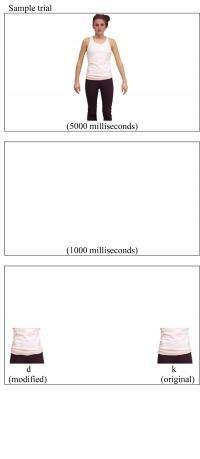
Sum of the parts? How our brains see men as people and women as body parts
Enlarge

In a new study that examined our cognitive process in how we perceive men and women, participants saw a fully clothed person from head to knee. After a brief pause, they then saw two new images on their screen: One that was unmodified and contained the original image, the other a slightly modified version of the original image with a sexual body part changed. Participants then quickly indicated which of the two images they had previously seen. They made decisions about entire bodies in some trials and body parts in other trials. Credit: University of Nebraska-Lincoln

After reviewing the results, the researchers found a clear difference between the way people of both genders view women. They found that the volunteers were better at recognizing body parts of women versus men when viewing both whole images, and images of just those . When viewing pictures of men, they found things were reversed, most of the volunteers were much better at recognizing men if they saw the whole person.

Next, the researchers tried something else. They showed volunteers pictures of letters that were made up of other different tiny letters before showing them the pictures in the first experiments. Some were asked to identify the tiny letters inside the letters, others were asked to identify which letter the little ones formed as a whole. One forced local brain processing the other global. They found that those that were forced to think globally before viewing the photographs were much less likely to objectify the women in the pictures.

The researchers don’t know why objectify women, but speculate that it’s either because of mating behaviors in our distant past, or perhaps because of more recent trends, such as the way modern media portray women.

More information: Seeing women as objects: The sexual body part recognition bias, European Journal of Social Psychology, DOI: 10.1002/ejsp.1890

Abstract
Objectification theory suggests that the bodies of women are sometimes reduced to their sexual body parts. As well, an extensive literature in cognitive psychology suggests that global processing underlies person recognition, whereas local processing underlies object recognition. Integrating these literatures, we introduced and tested the sexual body part recognition bias hypothesis that women's (versus men's) bodies would be reduced to their sexual body parts in the minds of perceivers. Specifically, we adopted the parts versus whole body recognition paradigm, which is a robust indicator of local versus global processing. The findings across two experiments showed that women's bodies were reduced to their sexual body parts in perceivers' minds. We also found that local processing contributed to the sexual body part recognition bias, whereas global processing tempered it. Implications for sexual objectification and its underlying processes and motives are discussed.

Press release

© 2012 Medical Xpress

2.6 /5 (16 votes)  

Filter


Move the slider to adjust rank threshold, so that you can hide some of the comments.


Display comments: newest first

dawkinsisgod
Jul 25, 2012

Rank: 5 / 5 (6)
That woman in the picture has nice breasts!
dawkinsisgod
Jul 25, 2012

Rank: 5 / 5 (4)
and legs.
gwrede
Jul 25, 2012

Rank: 3.4 / 5 (5)
Feminists would love to forbid the entire planet from seeing the woman as parts. I wouldn't be surprised if some of them actually tried.
Lurker2358
Jul 25, 2012

Rank: 5 / 5 (4)
I preferred her face and legs.

Parts add up to a whole.

The whole is more than the sum of the parts. So cliche.

Women objectify themselves and one another, and view themselves in parts as well, just look at any number of bra commercials or hair dye commercials or shampoo commercials, or a women's magazine, or a Special K cereal commercial; they made a brand by marketing to women trying to fit into a size smaller bikini, allegedly.
Moebius
Jul 25, 2012

Rank: 3 / 5 (2)
I view them as individual parts. Looks, legs and brains. Not necessarily in that order.
tadchem
Jul 25, 2012

Rank: 5 / 5 (1)
Men are 'hard-wired' to focus on women's "round" body parts, especially those that occur in pairs, and very especially when they can be seen to move.
Men don't have as many pairs of round body parts that can be seen to move.
Lurker2358
Jul 25, 2012

Rank: 5 / 5 (4)
Read the Song of Solomon.

Lol.

Both the male and female speaker focus almost entirely on body parts. It is nothing new obviously.
Shootist
Jul 25, 2012

Rank: 3 / 5 (2)
Go read "The Naked Ape: A Zoologist's Study of the Human Animal" © 1967.

Lips are red, why? Breasts are pendulous, why? Answer? It's for the children.
sirchick
Jul 25, 2012

Rank: 5 / 5 (1)
Women also see men in parts but in a different way... our character/personality.

Hes funny,smart,romantic etc

Its still all parts. So its not a negative thing its just how humans are, we still respect women even if they think it seems a bit objectified.... us men just like what we see, we are visual.

Any smart woman should not see this as a bad thing.
baudrunner
Jul 25, 2012

Rank: 1 / 5 (3)
This stems from our early education. We are taught the words for arm, leg, head, torso, waist, etc. as very young and impressionable children. When learning new languages, these lessons are repeated. It's no wonder that we subconsciously break down the person we see approaching us on the sidewalk into their respective body parts. Like a computer's CPU, our brains are also comparators, and this is what we do when we see someone else, male or female - we mentally and judgmentally superimpose our ideal of the human form on the person.
MrVibrating
Jul 25, 2012

Rank: 3.7 / 5 (3)
Women are generally far more self conscious - of all their body parts - than men. I would interpret the results as the men assessing aspects of sexual attractiveness / fitness, as we're wont to do, while the women are checking how they themselves compare to others / the competition...
XQuantumKnightX
Jul 25, 2012

Rank: 4.3 / 5 (6)
tadchem: You are correct but a lot of modern women see men as a collect of bank account numbers!
nuge
Jul 25, 2012

Rank: 5 / 5 (2)
Could it be just because women have more distinctive and variable body parts? Women are shapely and have fairly obvious 'features' on their torso. Men in comparison are fairly uniform.
peter09
Jul 26, 2012

Rank: 5 / 5 (2)
tadchem: You are correct but a lot of modern women see men as a collect of bank account numbers!


Interestingly I recall the theory that men evaluate women by their fitness to bear children, this resolves to breasts, skin tone, general body features etc etc

Women evaluate men by their ability to support them and their children, this resolves to big cars, fat wallets, general success etc etc.
aironeous
Jul 28, 2012

Rank: 1 / 5 (2)
Now the cause: No man is born with approach anxiety it is actively created by 7's and above. In this united states of fat girls where the FDA is corrupt and incompetent big food is allowed to create a country of fat girls and the ones that have an attractive face and figure act totally arrogant towards men in public treating them like a problem.
Why don't you women dress up with makeup as a middle aged man and move to another city and cut off ties with your friends for a year (no daddy or BF pays for your rent and no answering the low rent ads only for females you have to pay man rent) and see what it feels like to get treated like a problem in public while running your errands.
Nydoc
Jul 29, 2012

Rank: not rated yet
I think its harder to identify a slight modification if the image is zoomed in rather than when showing the whole picture. That fact that people can pick out those details better if the zoomed in image is of a woman just means that we pay more attention to detail if the image is a woman. They should have done the same experiment with pictures of fish and cows and puppies and cars. The conclusion of the study is wrong.

Attention to detail =/= objectification
Rank 2.6 /5 (16 votes)
Relevant PhysicsForums posts

More news stories

Genetic predictors of postpartum depression uncovered

Johns Hopkins researchers say they have discovered specific chemical alterations in two genes that, when present during pregnancy, reliably predict whether a woman will develop postpartum depression.

Psychology & Psychiatry created 6 hours ago | popularity not rated yet | comments 0 | with audio podcast

Mediterranean diet seems to boost ageing brain power

A Mediterranean diet with added extra virgin olive oil or mixed nuts seems to improve the brain power of older people better than advising them to follow a low-fat diet, indicates research published online in the Journal of ...

Psychology & Psychiatry created 15 hours ago | popularity 2 / 5 (1) | comments 2

The incidence of eating disorders is increasing in the UK

More people are being diagnosed with eating disorders every year and the most common type is not either of the two most well known—bulimia or anorexia—but eating disorders not otherwise specified (eating disorders that ...

Psychology & Psychiatry created 15 hours ago | popularity not rated yet | comments 0

Practice makes perfect? Not so much

Turns out, that old "practice makes perfect" adage may be overblown. New research led by Michigan State University's Zach Hambrick finds that a copious amount of practice is not enough to explain why people ...

Psychology & Psychiatry created 16 hours ago | popularity 3.5 / 5 (11) | comments 0 | with audio podcast

Study shows how bilinguals switch between languages

(Medical Xpress)—Individuals who learn two languages at an early age seem to switch back and forth between separate "sound systems" for each language, according to new research conducted at the University of Arizona.

Psychology & Psychiatry created 18 hours ago | popularity 5 / 5 (4) | comments 0 | with audio podcast


Study shows where scene context happens in our brain

In a remote fishing community in Venezuela, a lone fisherman sits on a cliff overlooking the southern Caribbean Sea. This man –– the lookout –– is responsible for directing his comrades on the water, ...

Monoclonal antibody appears effective and safe in asthma Phase IIa trial

A novel approach to obstructing the runaway inflammatory response implicated in some types of asthma has shown promise in a Phase IIa clinical trial, according to U. S. researchers.

New rice contamination reported in China

Authorities are investigating rice mills in southern China following tests that found almost half of the staple grain in one of the country's largest cities was contaminated with a toxic metal.

Exercise levels may predict hospitalizations in COPD population

Clinical measurement of physical activity appears to be an independent predictor of whether or not patients with chronic obstructive pulmonary disease (COPD) will end up being hospitalized, according to a new study conducted ...

Delayed transfer to the ICU increases risk of death in hospital patients

Delayed transfer to the intensive care unit (ICU) in hospitalized patients significantly increases the risk of dying in the hospital, according to a new study from researchers in Chicago.

Treatment with A1-PI slows the progression of emphysema in Alpha-1 antitrypsin deficiency

Treatment with an Alpha-1 proteinase inhibitor (A1-PI), a naturally occurring protein that protects lung tissue from breakdown and protects the lung's elasticity, is effective in slowing the progression of emphysema in patients ...