Poll: Russians see drug abuse as a top problem
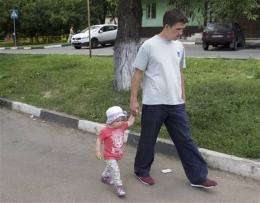
(AP) — Nikolai Leonov was walking through this Moscow suburb with his 2-year-old daughter when the toddler bent down and picked up a bloodied syringe from the grass. "I snatched it away from her a second before she could hurt herself," Leonov said, still shaken days later.
The computer hardware shop owner is one of millions of Russians horrified by a drug abuse epidemic that has turned Russia into the world's largest consumer of heroin.
An Associated Press-GfK poll released this month shows that nearly nine in 10 Russians (87 percent) identify drug abuse as at least a "very serious" problem in Russia today, including 55 percent describing the problem as "extremely serious." The only other issue that worries as many Russians (85 percent) is the corruption that pervades Russian society, business and politics.
Russians living across the vast country, of all levels of education and income, differ little when it comes to the extent of the drug abuse problem, although 91 percent of urban dwellers see it as a serious problem, compared to 82 percent of rural residents. Unprompted, 10 percent of Russians cite criminality, alcohol or drug abuse as the most important problem facing the country today, on par with the share citing basic needs such as medical care, housing and education.
Some 2.5 million Russians are addicted to drugs, and 90 percent of them use the heroin that has flooded into Russia from Afghanistan since the late 1990s, according to government statistics. The nation with a population of 143 million consumes 70 tons of Afghan heroin every year — or more than a fifth of the drug consumed globally— according to the United Nations Office on Drugs and Crime.
The number of heroin addicts in Western European countries such as Germany or the United Kingdom is significantly lower — up to 150,000 and 300,000, respectively, according to various estimates. In 2009, there were less than 1,400 drug-related deaths registered in Germany, which has a population of 82 million, and 2,500 in the U.K., which has a population of 62 million, according to the most recent data available from the European Monitoring Center for Drugs and Drug Addiction.
In Russia, heroin kills 80 Russians each day — or 30,000 a year — and is "as easy to buy as a Snickers" chocolate bar, Russia's anti-drug czar Viktor Ivanov said. Meanwhile, new drugs — such as highly addictive synthetic marijuana and a cheap and lethal concoction made of codeine pills known as "crocodile" — compete with heroin and kill thousands more.
Drug addicts are also the people Russians would least like to have as neighbors, according to the AP-GfK poll. They are seen as more undesirable than alcoholics by a margin of 87 to 77 percent.
The AP-GfK poll was conducted by GfK Roper Public Affairs and Corporate Communications from May 25 to June 10 and was based on in-person interviews with 1,675 randomly selected adults nationwide. The results have a margin of error of 2.9 percentage points.
Leonov lives with his accountant wife and two children in a recently renovated one-bedroom apartment in Reutov, a suburb of Moscow known for its Soviet-era research institutes and defense factories. A statue of Soviet founder Vladimir Lenin still stands on the town square. Their biggest problem is the addicts who live in the neighborhood.
Last year, he saw the body of an addict who apparently had overdosed right next to the playground where his children play. "He was there for a couple of hours before the cops showed up," Leonov said, pointing at a wooden bench where a bespectacled elderly woman was sitting.
Leonov claimed that the heroin that killed the addict was sold by a neighbor, who was always dirty and dressed in rags but flaunted a collection of new cell phones. His customers, mostly skinny and chain-smoking youngsters, would leave used syringes on the asphalt and occupy the benches for hours after getting their fix. The neighbor was arrested this spring, but Leonov said little has changed because the addicts apparently found another source of heroin nearby.
The heroin epidemic caught Russia by surprise.
Before the 1991 collapse of the Soviet Union, the number of drug addicts who used intravenous injections was extremely low. But the rise of the Taliban regime in Afghanistan opened a floodgate of cheap heroin, which flowed into Russia through the former Soviet republics in Central Asia.
The arrival of NATO troops in Afghanistan only aggravated the situation, because coalition troops were instructed not to eradicate poppy crops for fear of driving the farmers into the ranks of the Taliban.
Moscow for years has been urging the U.S. military in Afghanistan to take stronger action against local drug labs and smugglers, but the production of Afghan opium since NATO's arrival has increased 40-fold, according to anti-drug czar Ivanov.
Most of Russia's 2.5 million drug addicts are aged 18 to 39 — a generation of Russians lost to heroin.
"The only thing the government can do is save the new generation, because we cannot be saved," said Valery, a former heroin addict from the Volga River city of Samara. He gave only his first name because his support group does not allow contacts with the media.
After a meeting with a dozen other recovering drug addicts, he recalled childhood friends who had overdosed, gone to jail or been infected with HIV after sharing contaminated needles. He remembered sharing a needle with a man who he knew had been in jail and thus had a high chance of being infected with HIV.
"I needed a fix that badly," said Valery, now a barrel-chested body builder. "Only God saved me" from getting infected, he said.
Infection is a major concern for Leonov's family. In the past decade, the number of HIV infections in Russia has tripled in one of the world's fastest-growing epidemics of the virus that causes AIDS, according to the United Nations. An estimated four fifths of the 980,000 Russians officially registered as HIV positive became infected through dirty needles.
When Leonov's wife, Yelena, was in a maternity hospital to give birth to their daughter, Nastya, she saw another pregnant woman injecting heroin brought in by her husband. Doctors at the hospital told her they would not isolate the woman because she might die or lose her child if she went through withdrawal, she said.
Copyright 2012 The Associated Press. All rights reserved. This material may not be published, broadcast, rewritten or redistributed.


