Yoga may help stroke survivors improve balance
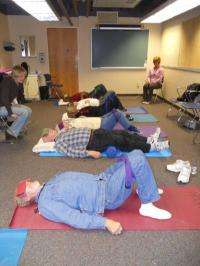
This shows a yoga class in the corpse pose and mindfulness meditation. Credit: Arlene Schmid, Ph.D., OTR
Group yoga can improve balance in stroke survivors who no longer receive rehabilitative care, according to new research in the American Heart Association journal Stroke.
In a small pilot study, researchers tested the potential benefits of yoga among chronic stroke survivors those whose stroke occurred more than six months earlier.
"For people with chronic stroke, something like yoga in a group environment is cost effective and appears to improve motor function and balance," said Arlene Schmid, Ph.D., O.T.R., lead researcher and a rehabilitation research scientist at Roudebush Veterans Administration-Medical Center and Indiana University, Department of Occupational Therapy in Indianapolis, Ind.
The study's 47 participants, about three-quarters of them male veterans, were divided into three groups: twice-weekly group yoga for eight weeks; a "yoga-plus" group, which met twice weekly and had a relaxation recording to use at least three times a week; and a usual medical care group that did no rehabilitation.
The yoga classes, taught by a registered yoga therapist, included modified yoga postures, relaxation, and meditation. Classes grew more challenging each week.
Compared with patients in the usual-care group, those who completed yoga or yoga-plus significantly improved their balance.
Balance problems frequently last long after a person suffers a stroke, and are related to greater disability and a higher risk of falls, researchers said.
Furthermore, survivors in the yoga groups had improved scores for independence and quality of life and were less afraid of falling.
"For chronic stroke patients, even if they remain disabled, natural recovery and acute rehabilitation therapy typically ends after six months, or maybe a year," said Schmid, who is also an assistant professor of occupational therapy at Indiana University-Purdue University in Indianapolis and an investigator at the Regenstrief Institute.
Improvements after the six-month window can take longer to occur, she said, "but we know for a fact that the brain still can change. The problem is the healthcare system is not necessarily willing to pay for that change. The study demonstrated that with some assistance, even chronic stroke patients with significant paralysis on one side can manage to do modified yoga poses."
The oldest patient in the study was in his 90s. All participants had to be able to stand on their own at the study's outset.
Yoga may be more therapeutic than traditional exercise because the combination of postures, breathing and meditation may produce different effects than simple exercise, researchers said.
"However, stroke patients looking for such help might have a hard time finding qualified yoga therapists to work with," Schmid said. "Some occupational and physical therapists are integrating yoga into their practice, even though there's scant evidence at this point to support its effectiveness."
Researchers can draw only limited conclusions from the study because of its small number of participants and lack of diversity. The study also didn't have enough participants to uncover differences between the yoga and control groups. The scientists hope to conduct a larger study soon.
Researchers also noticed improvements in the mindset of patients about their disability. The participants talked about walking through a grocery store instead of using an assistive scooter, being able to take a shower and feeling inspired to visit friends.
"It has to do with the confidence of being more mobile," Schmid said. Although they took time to unfold, "these were very meaningful changes in life for people."
Journal reference:
Stroke
Provided by
American Heart Association
-
Yoga helped older stroke victims improve balance, endurance
Jun 04, 2011 |
not rated yet |
0
-
Study: In-patient, out-patient stroke rehab might benefit from yoga
May 30, 2012 |
not rated yet |
0
-
Studies show siginificant benefits of yoga in 2 conditions
May 26, 2011 |
not rated yet |
0
-
Yoga eases back pain in largest US study to date
Oct 24, 2011 |
not rated yet |
0
-
Yoga recommended in breast cancer cases
Jun 05, 2006 |
not rated yet |
0
-
Motion perception revisited: High Phi effect challenges established motion perception assumptions
Apr 23, 2013 |
3 / 5 (2) |
2
-
Anything you can do I can do better: Neuromolecular foundations of the superiority illusion (Update)
Apr 02, 2013 |
4.5 / 5 (11) |
5
-
The visual system as economist: Neural resource allocation in visual adaptation
Mar 30, 2013 |
5 / 5 (2) |
9
-
Separate lives: Neuronal and organismal lifespans decoupled
Mar 27, 2013 |
4.9 / 5 (8) |
0
-
Sizing things up: The evolutionary neurobiology of scale invariance
Feb 28, 2013 |
4.8 / 5 (10) |
14
-
Classical and Quantum Mechanics via Lie algebras
Apr 15, 2011
- More from Physics Forums - Independent Research
More news stories
Systematic screening of med adherence will ID barriers
(HealthDay)—Implementation of systematic monitoring for medication adherence will allow for identification of barriers to adherence and tailoring of interventions, according to a viewpoint piece published ...
Health
1 hour ago |
not rated yet |
0
More doctors, hospitals using electronic records
(AP)—The Obama administration says more doctors and hospitals are embracing technology as adoption of computerized medical records reaches a "tipping point" in America.
Health
2 hours ago |
not rated yet |
0
Hospitals profit when patients develop bloodstream infections
Johns Hopkins researchers report that hospitals may be reaping enormous income for patients whose hospital stays are complicated by preventable bloodstream infections contracted in their intensive care units.
Health
2 hours ago |
not rated yet |
0
Alleviating hunger in the US, it's a SNAP, researcher says
A University of Illinois researcher says that the cornerstone of our efforts to alleviate food insecurity should be to encourage more people to participate in the Supplemental Nutrition Assistance Program (SNAP) "because ...
Health
3 hours ago |
not rated yet |
0
Parent and teacher support protects teens from sleep problems and depression
A new study suggests that disturbed sleep in adolescents is associated with more symptoms of depression and greater uncertainly about future success. However, perceived support and acceptance from parents and teachers appears ...
Health
4 hours ago |
not rated yet |
0
Fecal microbiota tx feasible for recurrent C. difficile in HIV
(HealthDay)—For HIV-infected individuals with recurrent Clostridium difficile infection, fecal microbiota therapy is feasible, according to a letter published in the May 21 issue of the Annals of Intern ...
FDA panel backs experimental Merck insomnia drug
(AP)—A federal panel of medical experts says that an experimental insomnia drug from Merck & Co Inc. appears safe and effective, despite evidence from company trials that the pill can cause daytime sleepiness and difficulty ...
Having both migraines, depression may mean smaller brain
(HealthDay)—Migraines and depression can each cause a great deal of suffering, but new research indicates the combination of the two may be linked to something else entirely—a smaller brain.
Brain can be trained in compassion, study shows
Until now, little was scientifically known about the human potential to cultivate compassion—the emotional state of caring for people who are suffering in a way that motivates altruistic behavior.
Swine flu pandemic of 2009 more deadly for younger adults, study finds
As the world prepares for what may be the next pandemic strain of influenza virus, in the H7N9 bird flu, a new UC Irvine study reveals that the 2009 H1N1 swine flu pandemic was deadliest for people under the age of 65, while ...
'Boys will be boys' in US, but not in Asia
A new study shows there is a gender gap when it comes to behavior and self-control in American young children – one that does not appear to exist in children in Asia.