Bill would expand fertility coverage for veterans
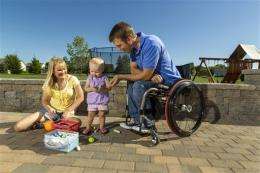
(AP) — The roadside bomb that exploded outside Andrew Robinson's Humvee in Iraq six years ago broke the Marine staff sergeant's neck and left him without use of his legs. It also cast doubt on his ability to father a child, a gnawing emotional wound for a then-23-year-old who had planned to start a family with his wife of less than two years.
The catastrophic spinal cord injury meant the couple's best hope for children was in vitro fertilization, an expensive and time-consuming medical procedure whose cost isn't covered by the Department of Veterans Affairs. Robinson and his wife were forced to pay out of pocket, with help from a doctor's discount and drugs donated by other patients.
A bill being considered in the Senate would expand the VA's medical benefits package so other veterans, and their spouses or surrogates, don't have to bear the same expense. The department currently covers a range of medical treatment for veterans, including some infertility care, but the legislation specifically authorizes the VA to cover IVF and to pay for procedures now provided for some critically injured active-duty soldiers.
The bill is meant to help wounded veterans start families as they return home from war and to address a harrowing consequence of combat that can radically change a couple's marriage but receives less attention than post-traumatic stress disorder and brain injuries.
"It's common sense: a male veteran cannot have a kid by himself. It doesn't happen. They need obviously to have it with their wife or a partner," said Robinson, of New Jersey, who is now 29 and was injured in a 2006 explosion in Al Anbar province. "So for the VA to say, 'Oh, we can only cover this part of it,' it just kind of doesn't make sense."
In vitro fertilization, the process of mixing sperm and eggs in a laboratory dish and transferring the resulting embryo into a woman's uterus, costs thousands of dollars and each cycle can take weeks. It's physically taxing too, requiring hormone injections and other invasive steps, and can take multiple tries to produce a viable pregnancy. For many wounded veterans, it represents the most promising option.
More than 1,830 veterans of the wars in Iraq and Afghanistan have suffered pelvic fractures and genitourinary injuries since 2003 that could affect their abilities to reproduce, according to Pentagon figures provided to Sen. Patty Murray, the bill's sponsor and chairwoman of the Senate Veterans Affairs Committee.
"Because they served our country, they now can't have a family, which is part of their dream," said the Washington state Democrat, who hopes the committee will act on the bill after returning from August recess. "I think we now have a responsibility to not take that dream away."
Combat injuries can dampen a soldier's ability to have children in any number of ways, said Mark Edney, a Maryland urologist and Army reservist who treats veterans. For men, a blast to the genitalia can harm sperm-producing testicles, while a spinal cord injury can cause erectile dysfunction or ejaculatory problems. For women, shrapnel can injure the pelvis and fallopian tubes, preventing fertilization.
Although expertise exists to help them become parents, Edney said veterans with fertility problems form a "relatively small subset of patients that are just forgotten in terms of policy."
The legislation would likely have helped spouses like Brenda Isaacson, who said the VA's insurance plan covered the cost of recovering sperm from her husband, Chuck — an Army staff sergeant paralyzed by a 2007 helicopter crash in Afghanistan — but not the more than half-dozen IVF attempts the couple underwent before finally having a daughter nearly a year and a half ago. She bristled at being told by officials that infertility services were not medically or psychologically necessary.
"You tell that to a man who's just been wounded — that it's not psychologically necessary to have children — when that's all we'd talked about, having babies," she said.
The proposal comes as technological improvements have made IVF a more common — and reliably successful — way to have children, with the number of births as a result of it and similar procedures rising in the past decade. It's more openly discussed in popular culture, too, from television talk shows to celebrity magazines. And the VA is becoming more sensitive to family health concerns as it encounters younger veterans trying to start post-war lives, said Patty Hayes, the agency's chief consultant for women's veterans' health.
"The culture has changed. There's a lot more veterans who need this," she said, adding that the VA was looking closely at expanding infertility treatment options.
The VA says it already covers some fertility services, including counseling, diagnostic tests and intrauterine insemination — a method of artificial insemination — for the veteran. But that leaves out many veterans and their spouses whose best hope for pregnancy is the more physically rigorous, but also more reliable, IVF process, where the average cycle costs $12,400, according to the American Society for Reproductive Medicine.
The process can be especially vexing for military couples coping with life after a catastrophic injury and trying to establish a new normal, said Barbara Cohoon, deputy director of government relations for the National Military Family Association, a nonprofit advocacy group.
"When someone has an injury and they're paralyzed from the waist down, being able to reconnect emotionally and physically as a couple is part of the therapy," she said.
The Defense Department recently made IVF a covered benefit for active-duty service members who are either seriously ill or catastrophically injured, with a policy that allows for coverage of three completed IVF cycles for the soldier's spouse, said spokeswoman Cynthia Smith. She said artificial insemination using donated sperm or eggs is excluded under its policy.
Robinson, the now-29-year-old Marine who suffered the broken neck, said he started exploring ways to have children — something he and his wife had always discussed — during an extensive rehabilitation process.
They tried artificial insemination, which didn't work because of poor sperm quality resulting from his injury. They spent $6,000 of their own money on IVF and got pregnant on the first try — and now have 8-month-old twins Collin and Leah.
"Everyone deserves to have a chance at a family. We were able to save the money and stuff like that. But maybe for someone who isn't able to do that, I would hate to see that they don't have that option," he said.
Tracy Keil used IVF to conceive her twins after her husband, Matt, was shot in the neck in Iraq in 2007 and rendered a quadriplegic, six weeks after they wed. The couple was able to save the thousands of dollars needed for treatment because they live mortgage-free in a custom-made home designed by a nonprofit that builds houses for disabled veterans and their families. She's since become a leading advocate for the legislation, testifying on it this summer before a Senate committee.
"I agree with the fact that they had other hurdles to get over first, especially with PTSD and suicide and traumatic brain injury. They had other things that were just plain more important," Keil said of the VA. "But now we're at the point where those programs are in place and it's time to address this issue."
Copyright 2012 The Associated Press. All rights reserved. This material may not be published, broadcast, rewritten or redistributed.


