Brain enzyme is double whammy for Alzheimer's disease
August 20, 2012 in Alzheimer's disease & dementia

Brain enzyme is double whammy for Alzheimer's disease

Enlarge

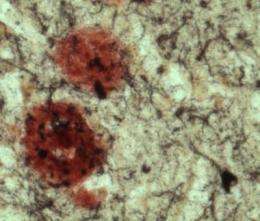
This shows beta-amyloid plaques (red) in the brain of an Alzheimer's disease patient. Credit: Sanford-Burnham Medical Research Institute

The underlying causes of Alzheimer's disease are not fully understood, but a good deal of evidence points to the accumulation of β-amyloid, a protein that's toxic to nerve cells. β-amyloid is formed by the activity of several enzymes, including one called BACE1. Most Alzheimer's disease patients have elevated levels of BACE1, which in turn leads to more brain-damaging β-amyloid protein.

In a paper published August 15 in The Journal of Neuroscience, researchers at Sanford-Burnham Medical Research Institute (Sanford-Burnham) found that BACE1 does more than just help produce β-amyloid—it also regulates another cellular process that contributes to memory loss. This means that just inhibiting BACE1's enzymatic activity as a means to prevent or treat Alzheimer's disease isn't enough—researchers will have to prevent cells from making it at all.

"Memory loss is a big problem—not just in Alzheimer's disease, but also in the normal aging population," said Huaxi Xu, Ph.D., professor in Sanford-Burnham's Del E. Webb Neuroscience, Aging, and Stem Cell Research Center and senior author of the study. "In this study, we wanted to better understand how BACE1 plays a role in memory loss, apart from β-amyloid production."

To do this, Xu and his team used a mouse model that produces human BACE1. Mice produce a different type of β-amyloid, one that's far less toxic than the human version. So, in this system, they could look solely at how BACE1 functions independent from β-amyloid formation. If BACE1 only acted to produce β-amyloid, the researchers would expect to see no effect when mice produce human BACE1—since mouse β-amyloid isn't very toxic, extra BACE1 would be no big deal. Instead, they saw that the enzyme still impaired learning and memory, indicating a secondary function at work.

If it's not producing β-amyloid, what is BACE1 doing? Many years ago, scientists found that a protein in the brain—protein kinase A (PKA), better known for directing cellular metabolism—also plays an important role in memory formation. In this study, Xu and colleagues found that BACE1 disrupts the cell's production of other molecules required for PKA function. By that mechanism, BACE1 inactivates PKA and therefore inhibits memory formation in mice, even in the absence of neurotoxic β-amyloid.

"So BACE1 is a double whammy when it comes to memory," Xu said. "But that also means that a therapy that targets BACE1 could be a double punch against , and even just normal aging-related . That's why we're now looking for ways to block BACE1 expression in the brain."

Journal reference: Journal of Neuroscience search and more info website

Provided by Sanford-Burnham Medical Research Institute search and more info website

5 /5 (3 votes)  

Rank 5 /5 (3 votes)
Relevant PhysicsForums posts

More news stories

Study finds that sleep apnea and Alzheimer's are linked

A new study looking at sleep-disordered breathing (SDB) and markers for Alzheimer's disease (AD) risk in cerebrospinal fluid (CSF) and neuroimaging adds to the growing body of research linking the two.

Alzheimer's disease & dementia created 19 hours ago | popularity 5 / 5 (2) | comments 0 | with audio podcast

Alzheimer's leaves bilingual victims stranded in Canada

The devastating effect of Alzheimer's disease on bilingual people has been thrown into focus in Canada, where the sudden loss of a second language can leave sufferers feeling like strangers in their own country.

Alzheimer's disease & dementia created 22 hours ago | popularity not rated yet | comments 0

Study identifies new approach to improving treatment for MS and other conditions

(Medical Xpress)—Working with lab mice models of multiple sclerosis (MS), UC Davis scientists have detected a novel molecular target for the design of drugs that could be safer and more effective than current FDA-approved ...

Alzheimer's disease & dementia created May 17, 2013 | popularity 5 / 5 (2) | comments 0 | with audio podcast

Nonmelanoma skin cancer tied to lower Alzheimer's risk

(HealthDay)—Older individuals with nonmelanoma skin cancer (NMSC) seem to have a significantly reduced risk of developing Alzheimer's disease (AD), according to a study published online May 15 in Neurology.

Alzheimer's disease & dementia created May 16, 2013 | popularity 5 / 5 (1) | comments 0

Skin cancer may be linked to lower risk of Alzheimer's disease

People who have skin cancer may be less likely to develop Alzheimer's disease, according to new research published in the May 15, 2013, online issue of Neurology®, the medical journal of the American Academy of Neurology. The li ...

Alzheimer's disease & dementia created May 15, 2013 | popularity 5 / 5 (1) | comments 0 | with audio podcast


Team finds mechanism linking key inflammatory marker to cancer

In a new study described in the journal Oncogene, researchers reveal how a key player in cell growth, immunity and the inflammatory response can be transformed into a primary contributor to tumor growth.

New study identifies risk factors for depression among COPD patients

Patients suffering from chronic obstructive pulmonary disease (COPD) typically suffer from depression more frequently than those without COPD, resulting in higher levels of disability and illness and increasing the overall ...

Inflammatory bowel disease raises risk of melanoma

Patients with inflammatory bowel disease (IBD) are at higher risk of melanoma, a form of skin cancer, report researchers at Mayo Clinic. Researchers found that IBD is associated with a 37 percent greater risk for the disease. ...

Pharmaceutical advances offer new options for health outcomes

Research presented at Digestive Disease Week (DDW) explores pharmaceutical advances for treating irritable bowel syndrome with diarrhea (IBS-D) and hepatitis C.

Stress test may help predict increased mortality risk in sleep apnea patients

Many studies have shown that men and women who suffer from obstructive sleep apnea (OSA) - a disorder that causes breathing to halt intermittently during sleep – have a higher mortality rate than those who do not have the ...

Source of infection affects hospital mortality in septic shock patients in the ICU

In ICU patients who have septic shock, the anatomic source of infection has a strong effect on the chances of survival, according to a new study from researchers in Canada.