The beat goes in the brain: Visual system can be entrained to future events
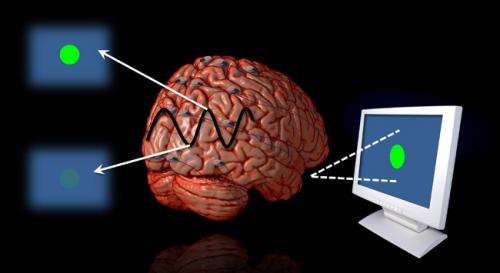
(Medical Xpress)—Like a melody that keeps playing in your head even after the music stops, researchers at the University of Illinois's Beckman Institute have shown that the beat goes on when it comes to the human visual system.
In an experiment designed to test their theory about a brain mechanism involved in visual processing, the researchers used periodic visual stimuli and electroencephalogram (EEG) recordings and found, one, that they could precisely time the brain's natural oscillations to future repetitions of the event, and, two, that the effect occurred even after the prompting stimuli was discontinued. These rhythmic oscillations lead to a heightened visual awareness of the next event, meaning controlling them could lead to better visual processing when it matters most, such as in environments like air traffic control towers.
The research was reported by Beckman and Department of Psychology faculty members Monica Fabiani, Gabriele Gratton, Diane Beck, Alejandro Lleras, first author and Beckman Fellow Kyle Mathewson, and undergraduate psychology student Christopher Prudhomme. The paper, Making Waves in the Stream of Consciousness: Entraining Oscillations in EEG Alpha and Fluctuations in Visual Awareness with Rhythmic Visual Stimulation, was published online in the Journal of Cognitive Neuroscience.
The researchers wrote that this entrainment of brain oscillators can be used to lock the timing of repetitive brain activity and, therefore, enhance, "processing of subsequently predictable stimuli."
"In nature, rhythmicity is everywhere, so it makes sense that our brain has evolved to be sensitive to rhythms in the world and to be able to latch on to them to improve neural processing," Lleras said. "It's very nice to be able to show that not only does the brain work in this oscillatory fashion but that we can harness that property that is inherent to the brain and use it to control the brain's response."
This study follows their 2010 report involving a brain entrainment experiment in which a series of repetitive flashes were presented and followed by a faint target stimulus. They found that participants were only aware of those targets whose timing could be predicted based on the rhythm of the previous flashes; targets presented on the off-beat were not seen. The authors wrote that "awareness of near-threshold stimuli can be manipulated by entrainment to rhythmic events, supporting the functional role of induced oscillations in underlying cortical excitability, and suggest a plausible mechanism of temporal attention."
Gratton said their idea in this most recent experiment was "to manipulate the brain activity and see if this manipulation was in fact predictive of performance for this phenomenon."
It was. Using EEG to test their theory, they were able to assess the brain's predictive responses, as well as show they could control them.
"We hooked up EEGs to measure the electrical activity from people's brains to see if their brain waves were becoming locked to the rhythms, and they were," Mathewson said. "Then we showed that their visibility of the target fluctuated depending on the timing with respect to this rhythm. So we locked in the timing of their brainwaves and that locked in their ability to see the world at a certain time."
The paper is titled Making Waves in the Stream of Consciousness: Entraining Oscillations in EEG Alpha and Fluctuations in Visual Awareness with Rhythmic Visual Stimulation. The research line goes back to a discovery by Mathewson of a pulsed inhibition mechanism in the brain that is based on oscillations in the alpha phase. This discovery supported the theory that the brain sometimes samples the visual environment in rhythmic "frames" rather than continuously, as the term "brain waves" implies.
This new work using EEG measurements demonstrated that not only do these repetitive oscillations influence what we see in the world, but those momentary "snapshots" as Mathewson calls them, are controllable.
"We can actually line up the snapshots how we want them, so if we want the snapshot to be at a certain moment and not another, we can do that," he said.
"Simply by exposing the brain to a predictable sequence of events, people were not only more likely to detect a faint target but we could see the brain oscillations shift to line up with the rhythmic sequence and target," Beck said.
Moreover, the entrained oscillations continued even after the visual stimuli ended, and the attention of test subjects still showed greater predictive awareness of future visual events when they were in time with the previous rhythm.
"When we stopped presenting the entrainers this repetitive brain activity continues," Gratton said.
Mathewson said the results show that after the brain becomes attuned to the rhythmic stimuli, "it expects things to happen at that rhythm.
"So if you're listening to a song at a certain rhythm you expect the next beat to come at a certain time," he added. "We present repetitive stimuli to participants and they start to predict the rhythm. Then we present the little flash of light and they are more likely to see it if it's predictable, in time with the previous beat."
The experiment used millisecond-long circle images as stimuli, and recorded the EEG signals of test subjects detecting the stimuli. The results, they wrote, support the theory of a pulsed inhibition of visual processing: "Rhythmic fluctuations in awareness elicited by entrainment of ongoing neural excitability cycles support a proposed role for alpha oscillations as a pulsed inhibition of cortical activity."
"This corresponds to our theory that changes in the ability to perceive stimuli that occur rhythmically are in fact determined by the oscillations in the brain," Gratton said.
Fabiani said the pulsed inhibition mechanism in the alpha phase, or a relaxed state, is the brain's way of making wise use of its resources.
"The system exploits the regularities in the environment to know when to pay attention and when not to," she said. "Our brain is doing a lot of other stuff as well, so it's advantageous to exploit the moment in which you do have to pay attention.
"Basically when you pay attention all the time your performance is equal. In the case of alpha oscillations on the other hand, you have really high performance when you need it and not much when you don't need it. So it's a more efficient system."
"What happens is it's not just that we pay more attention in this moment as it is we learn to pay less attention in that moment," Gratton added. "So we learn to ignore moments that are not important, or not useful."
The implications of the findings are many. "Alpha acts as a sensory inhibition mechanism that can reduce the processing of information, but only at particular phases in its cycle" the researchers wrote, while noting the opportunities inherent in discovering a way to "prep" the brain toward focusing visual attention. "Here we provide a powerful technique to control these waves of consciousness, indicating that the brain is able to harness these perceptual snapshots of high excitability and optimal processing and align them with external events, a highly adaptive feature given the rhythmicity of our sensory world."
Mathewson said potential future benefits of this research include designing human interfaces that take advantage of being able to control the timing of someone's optimal attention to their visual world.
"This was a way that we were able to find out more about how the brain pays attention to the timing of things in the world," he said. "It's really well-studied how we pay attention to a region of space compared to another region of space, but it's very new to think about how we pay attention to this moment in time compared to the next moment.
"So we can use these regularities in the world and our brain can pick up on them to save a little bit of time and do a little bit better processing. If you had a pilot and you really wanted them to be aware of the warning signal, making its timing optimal is an important consideration."
Fabiani mentioned future applications for workers in critical environments such as air traffic control systems or at a nuclear power plant.
"This could be instrumental for applied simulations like air traffic controllers, or other things that require constant vigilance, constant attention," she said. "If you work to monitor the operator for example, you would know when a warning could be presented more efficiently to avoid disaster."
More information: www.mitpressjournals.org/doi/a … 10.1162/jocn_a_00288


