Brain wave-reading robot might help stroke patients
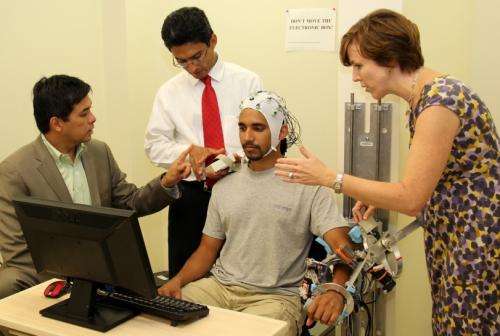
(Medical Xpress) -- What comes naturally to most people – to think and then do – is difficult for stroke patients who have lost the full use of their limbs. New research by Rice University, the University of Houston (UH) and TIRR Memorial Hermann aims to help victims recover that ability to the fullest extent possible with a $1.17 million grant from the National Institutes of Health (NIH) and the President’s National Robotics Initiative (NRI).
The multidisciplinary team hopes to develop and validate a noninvasive brain-machine interface (BMI) to a robotic orthotic device that is expected to innovate upper-limb rehabilitation. The new neurotechnology will interpret brain waves that let a stroke patient willingly operate an exoskeleton that wraps around the arm from the fingertips to the elbow.
Rice is developing the exoskeleton and UH the electroencephalograph-based (EEG) neural interface. The combined device will be validated by UTHealth physicians at TIRR Memorial Hermann with as many as 40 volunteer patients in the final two years of the four-year R01 award, the oldest research grant offered by NIH. The grant, funded through the National Institute of Neurological Disorders and Stroke, is one of only a few projects selected by the NRI, a collaborative partnership by the NIH, National Science Foundation, NASA and the Department of Agriculture to encourage the development of the next generation of robots that will work closely with humans.
Repetitive motion has proven effective at retraining motor nerve pathways damaged by a stroke, but patients must be motivated to do the work, said principal investigator Marcia O’Malley, an associate professor of mechanical engineering and materials science at Rice and director of Rice’s Mechatronics and Haptic Interfaces Lab.
“With a lot of robotics, if you want to engage the patient, the robot has to know what the patient is doing,” O’Malley said. “If the patient tries to move, the robot has to anticipate that and help. But without sophisticated sensing, the patient has to physically move – or initiate some movement.”
The team led by José Luis Contreras-Vidal, director of UH’s Laboratory for Noninvasive Brain-Machine Interface Systems and a professor of electrical and computer engineering, was the first to successfully reconstruct 3-D hand and walking movements from brain signals recorded in a noninvasive way using an EEG brain cap. The technology allows users to control, with their thoughts, robotic legs and below-elbow amputees to control neuroprosthetic limbs. The new project will be one of the first to design a BMI system for stroke survivors.
Initially, EEG devices will translate brain waves from healthy subjects into control outputs to operate the MAHI-EXO II robot, and then from stroke survivors who have some ability to initiate movements, to prompt the robot into action. That will allow the team to refine the EEG-robot interface before moving to a clinical population of stroke patients with no residual upper-limb function.
When set into motion, the intelligent exoskeleton will use thoughts to trigger repetitive motions and retrain the brain’s motor networks. An earlier version of the MAHI-EXO II developed by O’Malley, already in validation trials to rehabilitate spinal-cord-injury patients at the UTHealth Motor Recovery Lab at TIRR Memorial Hermann, incorporates sophisticated feedback that allows the patient to work as hard as possible while gently assisting – and sometimes resisting – movement to build strength and accuracy.
“The capability to harness a user’s intent through the EEG neural interface to control robots makes it possible to fully engage the patient during rehabilitation,” Contreras-Vidal said. “Putting the patient directly in the ‘loop’ is expected to accelerate motor learning and improve motor performance. The EEG technology will also provide valuable real-time assessments of plasticity in brain networks due to the robot intervention – critical information for reverse engineering of the brain.”
The three institutions bring unique perspectives to the project, O’Malley said. Rice’s robotic devices and UH’s neural interfaces will make it possible for TIRR Memorial Hermann, led by Gerard Francisco, director of the UTHealth Motor Recovery Lab, to facilitate translational research to fast-track engineering findings into clinical practice.
“This is truly an outstanding opportunity to demonstrate how various technological advances can potentially boost traditional rehabilitation therapies,” said Francisco, chief medical officer of TIRR Memorial Hermann and professor and chairman of physical medicine and rehabilitation at UTHealth. “What makes this initiative even more exciting is that the NRI recognized the value of our collaborative effort by awarding the R01 grant to multiple principal investigators. This project will be among the first to investigate the benefits of combined therapeutic interventions to help stroke survivors.”


