Cancer gene family member functions key to cell adhesion and migration
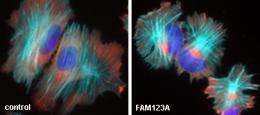
Here you see wildtype cells stained for the actin cytoskeleton in blue, tubulin protein in red, and the nucleus in dark blue. Compared to wildtype cells on the left, removal of FAM123A results in a dramatically condensed actin network and kidney shaped nuclei. Credit: Ben Major, Ph.D., the University of North Carolina at Chapel Hill
The WTX gene is mutated in approximately 30 percent of Wilms tumors, a pediatric kidney cancer. Like many genes, WTX is part of a family. In this case, WTX has two related siblings, FAM123A and FAM123C. While cancer researchers are learning more of WTX and how its loss contributes to cancer formation, virtually nothing is known of FAM123C or FAM123A, the latter of which is a highly abundant protein within neurons, cells that receive and send messages from the body to the brain and back to the body.
A UNC-led team of scientists used sophisticated technologies to identify and describe the protein interactions that distinguish each member of the WTX family. They found that unlike WTX and FAM123C, FAM123A interacts with a specific set of proteins that regulates cell adhesion and migration, processes essential to normal cell functioning and which, when mutated, contribute to human diseases such as cancer or Alzheimer's.
The report is the first to associate a member of the WTX gene family with cell adhesion and migration. Ben Major, PhD, and his research team believe that because FAM123A is so highly expressed in neurons, their findings raise the possibility that FAM123A controls neuron migration and neuronal activity, both of which play critical roles in development, neuro-degeneration and learning. Dr. Major, study senior author, is an assistant professor of cell biology and physiology in the UNC School of Medicine and a member of UNC Lineberger Comprehensive Cancer Center.
Their report appears in the September 4, 2012 online edition of Science Signaling.
This video is not supported by your browser at this time.
The white areas represent the localization of FAM123A in living cells which are migrating on a surface. Most of the FAM123A in cells resides at the periphery. However, the white streaks within the cell body demonstrate that FAM123A also localizes to the microtubule cytoskeleton, and specifically those microtubules that point in the direction of cell movement.
The specific set of proteins the scientists discovered within the FAM123A complex are known microtubules-associated proteins. Microtubules, one component of a cell's cytoskeleton, are rigid hollow rods approximately 25 nm in diameter, about 3000 times thinner than a human hair. Microtubules are dynamic structures that undergo continual assembly and disassembly within the cell. They function both to determine cell shape and to control a variety of cell movements, including some forms of cell locomotion.
This video is not supported by your browser at this time.
Here you see the movement of the FAM123A protein in living cells. Notice that the green dots move in linear pathway toward the cell edge. When we mutated specific amino acids within FAM123A necessary for binding a protein called EB1, the protein no longer associates with or moves on microtubules.
Dr. Major explains, "Since FAM123A and WTX are closely related proteins, anything we learn about FAM123A helps us know more about WTX, the tumor suppressor gene lost in pediatric kidney cancer. Unlike WTX, FAM123A binds to a specific set of proteins that are famous for regulating microtubules, a critical component within the cell's cytoskeleton or cellular 'scaffolding.' It's important to understand how different cellular cytoskeletal networks communicate and coordinate with each other. This communication is required for normal development and life."When the cytoskeleton is not functioning properly, a myriad of diseases arise, including certain cancers and cancer metastases. In cancer, cells can't move to new areas of the body without being able to squeeze between and crawl around surrounding cells and tissues, which ultimately allows the cell to move away from the primary tumor. Such movement requires complicated and intricate coordination between the cytoskeleton and the rest of the cell. Our work shows that FAM123A is critical for this communication."
Dr. Major and his research team use a powerful new technology to study protein complexes. He says, "Proteins never work alone, rather they bind each other to collectively carry out a specific task. An important challenge in cancer research today is determining which of the more than 30,000 proteins in a cell come together to form complexes." Dr. Major and colleagues can purify a specific protein from cancer cells and then, using sophisticated technologies called mass spectrometry, they identify the associated proteins.
Journal reference:
Science Signaling
Provided by
University of North Carolina Health Care
-
Study finds protein critical to breast cancer cell proliferation, migration
Sep 15, 2011 |
not rated yet |
0
-
Scientists identify a molecule that coordinates the movement of cells
Oct 02, 2008 |
not rated yet |
0
-
Surprising origin of cell's internal highways
Jun 20, 2007 |
not rated yet |
0
-
UNC scientists describe protein that protects against colon cancer
Apr 18, 2012 |
not rated yet |
0
-
Protein associated with childhood cancer alters the structure of DNA, leading to cancer
Nov 18, 2011 |
not rated yet |
0
-
Motion perception revisited: High Phi effect challenges established motion perception assumptions
Apr 23, 2013 |
3 / 5 (2) |
2
-
Anything you can do I can do better: Neuromolecular foundations of the superiority illusion (Update)
Apr 02, 2013 |
4.5 / 5 (11) |
5
-
The visual system as economist: Neural resource allocation in visual adaptation
Mar 30, 2013 |
5 / 5 (2) |
9
-
Separate lives: Neuronal and organismal lifespans decoupled
Mar 27, 2013 |
4.9 / 5 (8) |
0
-
Sizing things up: The evolutionary neurobiology of scale invariance
Feb 28, 2013 |
4.8 / 5 (10) |
14
-
Why is zone 1 in liver more prone to ischemic injury?
May 23, 2013
-
How can there be villous adenoma in colon, if there are no villi there
May 22, 2013
-
How can there be a term called "intestinal metaplasia" of stomach
May 21, 2013
-
Pressure-volume curve: Elastic Recoil Pressure don't make sense
May 18, 2013
-
If you became brain-dead, would you want them to pull the plug?
May 17, 2013
-
MRI bill question
May 15, 2013
- More from Physics Forums - Medical Sciences
More news stories
New fluorescent tools for cancer diagnosis
In recent years, microRNAs (miRNAs) and other non-coding RNAs are small molecules that help control the expression of specific proteins. In recent years they have emerged as disease biomarkers. miRNA profiles have been used ...
Cancer
May 24, 2013 |
not rated yet |
0
Modulating the immune system to combat metastatic cancer
Cancer cells spread and grow by avoiding detection and destruction by the immune system. Stimulation of the immune system can help to eliminate cancer cells; however, there are many factors that cause the immune system to ...
Cancer
May 24, 2013 |
5 / 5 (1) |
0
Scientists put bowel cancer under the microscope
Researchers from London's Kingston University have begun a two-year study which could help prolong the lives of people with colorectal tumours.
Cancer
May 24, 2013 |
5 / 5 (1) |
0
Researcher identifies breast cancer fighting hormone
Transformative research from Western University has identified new hormones in the body which may suppress breast cancer and stimulate the regression of breast tumors.
Cancer
May 24, 2013 |
5 / 5 (2) |
0
Ground breaking cancer research finds immune system link
(Medical Xpress)—Curtin University researchers have found evidence that targeting specific cells in the body can reverse the effects of cancer on the immune system.
Cancer
May 24, 2013 |
5 / 5 (4) |
0
First drug to improve heart failure mortality in over a decade
Coenzyme Q10 decreases all cause mortality by half, according to the results of a multicentre randomised double blind trial presented today at Heart Failure 2013 congress. It is the first drug to improve heart failure mortality ...
Seniors more likely to crash when driving with pet, study finds
(HealthDay)—Animals make great companions for senior citizens, but elderly people who always drive with a pet in the car are far more likely to crash than those who never drive with a pet, researchers have ...
Heart failure accelerates male 'menopause'
Heart failure accelerates the aging process and brings on early andropausal syndrome (AS), according to research presented today at the Heart Failure Congress 2013. AS, also referred to as male 'menopause', was four times ...
Death highest in heart failure patients admitted in January, on Friday, and overnight
Mortality and length of stay are highest in heart failure patients admitted in January, on Friday, and overnight, according to research presented today at the Heart Failure Congress 2013. The analysis of nearly 1 million ...
Feds fight morning-after pill age ruling in NY
(AP)—Department of Justice lawyers have again asked a federal appeals court in New York to delay lifting age restrictions and prescription requirements on an emergency contraceptive popularly known as the morning-after ...
New immune system discovered
(Medical Xpress)—A research team, led by Jeremy Barr, a biology post-doctoral fellow, unveils a new immune system that protects humans and animals from infection.